
Context
- India’s biotech startups increased 20-fold between 2018 and 2025, supported by 94 incubators across 25 states, reflecting a transition from generic manufacturing to deep-tech innovation.
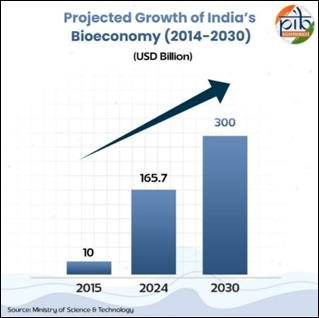
- The BioE3 Policy 2025 targets a $300 billion bioeconomy by 2030, positioning biotech alongside IT and energy as a national growth pillar.
India’s Strengths in Biotech
- India supplies 60% of global immunisation doses (DPT, BCG, measles), earning its reputation as the “Pharmacy of the World”.
- Low-cost R&D ecosystem and young STEM talent pool enable competitive innovation at a fraction of global costs.
- Integration of AI and data analytics into biotech startups is accelerating drug discovery and diagnostics significantly.
- 100% FDI is permitted in biotech, drawing global investors and partnerships under the Startup India framework.
- The Serum Institute-Oxford collaboration during COVID-19 demonstrated India’s capacity for world-class biotech diplomacy and manufacturing at scale.
Key Government Initiatives
| Initiative | Purpose |
| BIRAC (Biotechnology Industry Research Assistance Council) | Seed funding, grants, incubation through BIG and SBIRI schemes; supported 6,000+ startups |
| BioE3 Policy 2025 | Integrates biomanufacturing, bio-agriculture, bioenergy, and biopharma under one framework |
| PLI for Biopharma | Encourages domestic production of bulk drugs and critical raw materials |
| Biopharma SHAKTI (Budget 2026-27) | ₹10,000 crore for biologics and biosimilars manufacturing capacity |
Key Challenges
- Funding gap in scale-up phase: India attracted only $3 billion in biotech investment (2023-25) compared to China’s $12 billion, with Series B and C rounds remaining scarce.
- Fragmented infrastructure: Over 70 incubators exist but few offer end-to-end GMP or pilot-scale facilities, forcing startups to travel between Hyderabad, Pune, and Bengaluru to complete one product cycle.
- Regulatory outdatedness: Current clinical trial and patent regimes lag behind emerging technologies like CRISPR and AI-based therapeutics, costing startups international collaborations and IP protection.
- Brain drain: India loses over 40% of its biotech PhDs to overseas research hubs due to limited career pathways and funding continuity.
- Limited global market access: Only 15% of Indian biosimilars meet EU EMA approval criteria due to data integrity gaps, restricting high-value exports.
Way Forward
- Create integrated Bio Commons clusters in Genome Valley and the Mumbai-Pune corridor with shared GMP and regulatory facilities, clustered models in Boston and Seoul have cut scale-up costs by 25%.
- Establish a National Bio-Venture Fund using blended financing combining equity, venture debt, and institutional capital from pension and insurance funds.
- Modernise regulations through risk-based, adaptive frameworks aligned with EU AI Act and US FDA models, potentially cutting market-entry delays by 6-12 months for low-risk biologics.
- Launch reverse brain drain programmes with tax incentives, relocation grants, and micro-credential training in CRISPR, AI-biostatistics, and GMP data integrity as Israel’s similar programme boosted R&D capacity by 20%.
- Foster public-private co-development partnerships between government labs, academia, and private firms to replicate the Serum Institute-Oxford model across other therapeutic areas.