
Syllabus: Infrastructure: Energy, Ports, Roads, Airports, Railways etc.
Context: Emerging Stress in Aviation Sector
- India’s aviation sector faced multiple operational disruptions and safety incidents recently.
- Major airlines reported sharp profit declines and rising passenger dissatisfaction.
- Events included the Ahmedabad crash (June 2025), cancellations, and prolonged delays.
- December 2025 disruption exposed deeper system-wide operational fragilities.
Scale and Growth of Indian Aviation
- India is the world’s third-largest domestic aviation market.
- Sector operates over 840 aircraft annually.
- Carries more than 350 million passengers each year.
- Rapid expansion has stretched infrastructure and workforce capacity.
Pilot Shortage and Workforce Stress
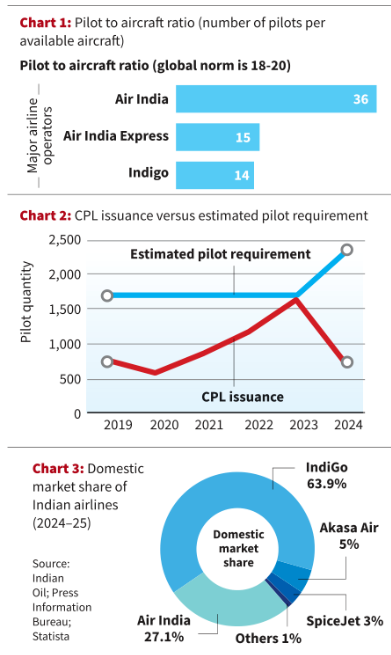
- IndiGo operated 360+ aircraft with 5,038 pilots.
- Pilot-to-aircraft ratio stood at 14, below global benchmark 18–20.
- New Flight Duty Time Limitation (FDTL) rules tightened operations.
- Night flights reduced; rest periods extended; flying hours capped.
- India needs 7,000 pilots (2024–26); demand may reach 30,000 decade-wise.
- DGCA issued only 5,700 CPLs (2020–24).
- Trainer shortages, simulators, and high costs restrict supply.
- Around 236 foreign pilot approvals issued in 2025 as stopgap.
Regulatory and Oversight Gaps
- Nearly half of DGCA technical posts remain vacant.
- Disruptions managed via schedule exemptions, not strict enforcement.
- Indicates fragile regulatory and monitoring capacity.
Market Concentration and Duopoly Risks
- IndiGo holds 63–65% domestic passenger share.
- Air India Group accounts for 27–28% share.
- Together control nearly 90% of domestic aviation market.
- IndiGo alone operates on 60.4% routes as sole carrier.
- Disruptions reduce connectivity instead of redistributing passengers.
Entry of New Regional Airlines
- NOCs issued to Shankh Air, Al Hind Air, FlyExpress (Dec 2025).
- Aim to enhance regional connectivity and underserved routes.
- Linked to UDAN scheme expansion.
- UDAN operationalised 625 routes, 85 airports by 2025.
Structural Risks for New Entrants
- Past airline failures include Kingfisher, Jet Airways, Go First.
- Causes: high costs, weak demand, poor management, infrastructure gaps.
- ATF price volatility tied to global markets remains major risk.
Safety and Systemic Concerns
- DGCA issued 19 safety violation notices by late 2025.
- Violations included FDTL breaches and equipment lapses.
- Indian airlines lack 20–25% spare crew buffers seen globally.
Way Forward
- Structural reforms needed beyond crisis management.
- Strengthen workforce, regulation, infrastructure, and fuel policy support.
- Essential as demand may reach 715 million passengers by 2030.