
Why in News: Heavy monsoon rains across Himachal Pradesh, Jammu & Kashmir, Punjab, and Delhi triggered floods, landslides, and loss of lives. The events highlight India’s growing monsoon unpredictability and the urgent need to shift focus from post-disaster relief to vulnerability reduction and climate-resilient infrastructure.
Introduction
- The recent monsoon-induced floods and landslides across Himachal Pradesh, Jammu & Kashmir, Punjab, and Delhi highlight India’s increasing vulnerability to climate-induced disasters.
- While relief measures dominate the narrative, the long-term solution lies in reducing vulnerabilities through ecological safeguards, climate-resilient infrastructure, and institutional preparedness.
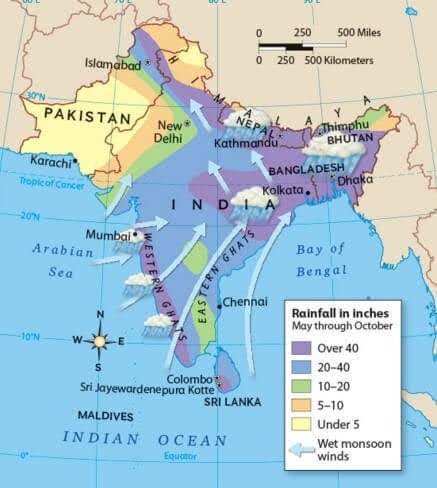
Disaster Management – Nature of the Challenge
- Erratic monsoon behaviour: Intense rainfall in concentrated bursts → floods, landslides, erosion.
- Recurring pattern: Similar destruction across multiple states annually; yet events still termed “unprecedented.”
- Inadequate preparedness: Early warning and evacuation architecture underdeveloped; relief is reactive rather than preventive.
Fragility of the Himalayas
- Deforestation & road widening: Weakens eco-sensitive slopes.
- Catchment degradation: Shrinking buffer capacity → slope failures.
- Siltation: Rivers and dams burdened → worsens downstream flood risks.
- Compensatory afforestation: Often inadequate in quality and ecological relevance.
Urbanisation and Infrastructure Issues
- Encroachment on wetlands, floodplains, and storm-water channels.
- Rapid urban expansion in unstable zones without climate-resilient design.
- Strategic projects prioritised over ecological stability.
Forecasting and Early Warning
- Forecasting capacity has improved significantly.
- Gap: Translation of forecasts into reliable, last-mile ground-level warnings remains weak.
- Lack of community preparedness: Absence of drills, pre-positioned supplies, or structured evacuation plans.
Governance and Institutional Challenges
- Relief operations dominate budgets and headlines → prevention underfunded.
- Weak Centre–State coordination in risk reduction.
- Development projects often bypass environmental safeguards.
Consequences of Inaction
- Human: Recurrent loss of life, displacement, trauma.
- Economic: Destruction of farmland, homes, and infrastructure → billions in annual losses.
- Environmental: Irreversible degradation of mountain slopes, rivers, and catchments.
- Governance: Credibility loss when predictable disasters are termed “unprecedented.”
Way Forward
Disaster Risk Reduction
- Mainstream slope-stabilisation engineering, watershed protection, and landslide mitigation.
- Restore wetlands and floodplains as natural buffers.
Climate-Resilient Infrastructure
- Conduct mandatory climate risk audits for roads, housing, dams.
- Adopt nature-based solutions alongside engineered ones.
Strengthening Forecasting and Response
- Translate IMD forecasts into localised actionable warnings.
- Build community-level preparedness through regular drills.
Ecological Safeguards
- Stop indiscriminate forest clearance in fragile zones.
- Ensure afforestation matches ecological diversity and quality.
Governance & Institutional Strengthening
- Integrate disaster risk reduction into development planning.
- Strengthen institutional frameworks like NDMA and State DMAs.
Conclusion
India’s repeated flood and landslide episodes are not unforeseen but recurring. Relief measures, though necessary, are insufficient. The focus must shift from post-disaster resilience to pre-disaster vulnerability reduction.
UPSC Relevance
GS Paper I (Geography & Society)
- Factors responsible for natural hazards and disasters.
GS Paper III (Disaster Management, Environment, Climate Change)
- Disaster and disaster management under syllabus.
Mains Practice Questions
Q1. India’s approach to monsoon disasters has been largely reactive, focusing on relief and rehabilitation rather than risk reduction. Discuss the structural vulnerabilities and suggest long-term preventive strategies.