
Context: China’s growing military capabilities pose a serious challenge to India, making it imperative to build a credible deterrence posture through a coherent defence-industrial and technological strategy.
Strategic Choices Before India
- A technology-intensive approach involves investing in new war-fighting technologies to bridge the capability gap, but carries risks of failure and industrial limitations.
- A conservative approach focuses on integrating emerging technologies with existing systems, enhancing cyber, space and electronic warfare capabilities, but may not shift the overall balance of power.
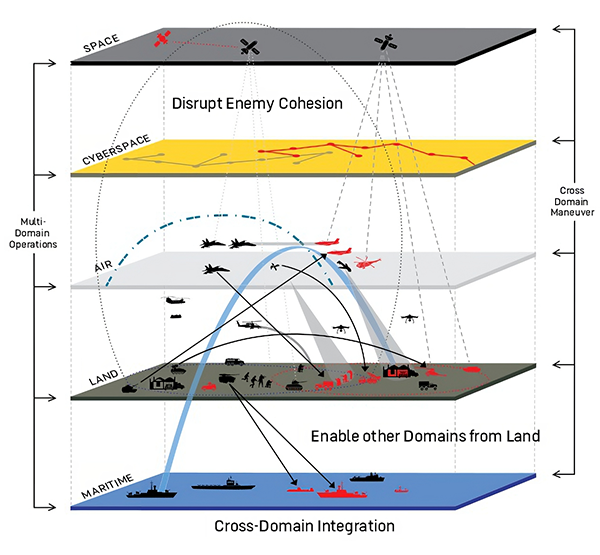
- A middle path combines legacy systems with development of enabling layers such as C2 and ISR, offering a more practical route towards multi-domain capability.
- Multi-domain operations remain difficult to define and operationalise, requiring gradual and coordinated institutional evolution.
Structural and Institutional Constraints
- India’s defence-industrial base lacks the capacity to deliver at speed and scale, despite technological competence.
- Key gaps exist in production of missiles, munitions, drones, and critical networks like ISR and C2.
- Limited integration of private sector restricts expansion of the industrial base.
- Procurement systems are often rigid and fail to adapt to evolving military needs.
- Delays due to red tape, lack of budgetary stability, and absence of long-term contracts weaken defence preparedness.
- Lack of coordination between political leadership, military, and industry hampers strategic coherence.
Critical Enabling Layers for Deterrence
- Strengthening deterrence requires building integrated layers such as C4ISR systems (Command, Control, Communications, Computers, Intelligence, Surveillance, and Reconnaissance), logistics, and strike capabilities.
- Dominance in ISR(Intelligence, Surveillance, and Reconnaissance) is crucial, as the ability to see and strike determines battlefield effectiveness.
- India needs affordable and scalable ISR platforms to maintain operational continuity.
- Cyber, space, and electronic warfare capabilities are essential to degrade adversary information systems.
- Integration of missiles, aircraft, and drones is necessary for effective deep-strike capability.
- Strong logistics and infrastructure are critical for sustaining protracted conflict.
- Nuclear deterrence continues to play a role in offsetting gaps in conventional capability.
Industrial and Strategic Imperatives
- India must identify vulnerabilities that provide China with strategic advantage.
- There is an urgent need to expand defence production capacity to address gaps in missile inventory.
- China’s ability to produce large-scale weapons during conflict poses a challenge to India’s surge capacity.
- Targeted budgetary support and incentives are required to strengthen key sectors of the defence industry.
- Without industrial strengthening, India risks being drawn into a prolonged conflict under adverse conditions.
Conclusion
- India’s path to credible deterrence lies not in isolated acquisitions but in building an integrated system that aligns technology, industry, and doctrine. Strengthening enabling layers and reforming the defence ecosystem are essential to ensure long-term strategic stability.