
Context
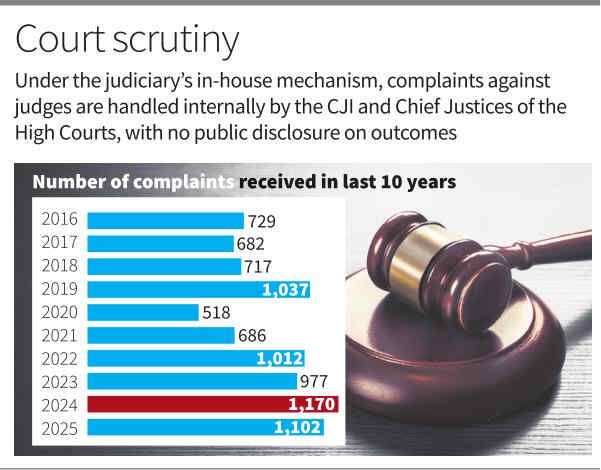
- The office of the Chief Justice of India (CJI) received 8,630 complaints against sitting judges between 2016 and 2025. The complaints pertained to allegations of corruption, misconduct, and ethical impropriety. The data was placed before Parliament by Law Minister Arjun Ram Meghwal.
Institutional Mechanisms of Judicial Accountability
- Constitutional Removal Mechanism
- Judges of the higher judiciary may be removed through impeachment.
- Constitutional provisions exist under Article 124(4) and Article 217. The removal requires proof of misbehaviour or incapacity.
- No judge has been successfully impeached to date.
- Statutory Inquiry Framework
- The Judges (Inquiry) Act, 1968 regulates investigative procedures.
- It provides mechanisms to examine allegations against judges.
- However, the process remains procedurally complex and rarely invoked successfully.
- In-House Accountability Procedure
- Adopted through a Supreme Court resolution in 1999.
- Complaints are examined by a three-judge inquiry committee.
- Serious findings may lead to resignation or removal recommendation.
- However, the procedure lacks statutory backing and operates with limited transparency.
- Ethical Standards: Judicial Conduct Norms
- Under the Restatement of Values of Judicial Life (1997):

| Judicial Pronouncements Shaping Accountability S. P. Gupta v. Union of India: Affirmed judiciary’s accountability to the public. C. Ravichandran Iyer v. Justice A.M. Bhattacharjee: Validated peer review mechanisms. K. Veeraswami v. Union of India: Criminal investigation requires CJI sanction. These rulings attempted to balance judicial independence with institutional answerability. |
Structural Issues and Accountability Deficits
- Ineffective Impeachment Process : High parliamentary threshold renders removal impractical.
- Opacity in In-House Inquiries : Lack of statutory status and public disclosure weakens credibility.
- Transparency Constraints : Limited RTI disclosure restricts public scrutiny.
- Judicial Pendency Pressures : Over four crore pending cases raise performance concerns.
- Opaque Appointments Process : Collegium functioning lacks external oversight.
- Weak Anti-Corruption Enforcement : Prior approval requirements hinder investigations.
- Absence of Independent Oversight Body : No external complaints authority exists.
- Institutional Reporting Gap : Judiciary is not mandated to publish annual performance reports.
Way Forward
- Institutional Oversight Reform
- Establish an independent National Judicial Oversight Committee.
- Ensure impartial investigation of judicial misconduct.
- Impeachment and Inquiry Reforms
- Introduce time-bound investigative procedures.
- Enhance procedural transparency and accessibility.
- Transparency and Disclosure Measures
- Mandate annual asset declarations by judges.
- Expand RTI coverage over administrative functioning.
- Administrative and Performance Reforms
- Strengthen e-Courts systems and case management tools.
- Monitor pendency through public data platforms.
- Structural Accountability Enhancements
- Consider inclusion of judiciary under Lokpal jurisdiction.
- Mandate publication of annual judicial reports.
- Review Contempt of Courts provisions to enable constructive scrutiny.
Conclusion
- Judicial accountability is integral to sustaining the rule of law. An independent judiciary commands legitimacy only when accompanied by Ethical integrity, Institutional transparency, Public trust, Procedural fairness. Accountability mechanisms must therefore strengthen and not undermine judicial independence.