
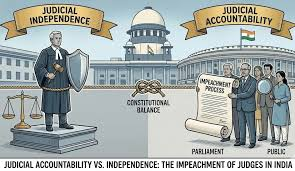
Syllabus: Structure, organisation and functioning of the Executive and the Judiciary
Context
- In December 2025, 107 Lok Sabha Members submitted a removal motion against Justice G.R. Swaminathan.
- The notice, containing 13 charges, was presented to the Speaker for preliminary consideration.
Constitutional Framework
- Articles 124(4) and 124(5) govern removal of Supreme Court judges.
- Articles 217(1)(b) and 218 extend the same procedure to High Court judges.
- The Constitution uses the term “removal”, not impeachment, for judicial offices.
- Parliament enacted the Judges (Inquiry) Act, 1968, with accompanying procedural rules.
Grounds for Removal
- Judges can be removed for proved misbehaviour or incapacity only.
- Misbehaviour includes corruption, lack of integrity, moral turpitude, and wilful misconduct.
- K. Veeraswami (1991) emphasised absolute standards of judicial honesty and impartiality.
- M. Krishna Swami (1992) clarified that errors or negligence alone do not constitute misbehaviour.
Procedure for Motion
- Motion requires 100 Lok Sabha Members or 50 Rajya Sabha Members signatures.
- The Speaker or Chairman must first admit or disallow the notice.
- Upon admission, a three-member inquiry committee is constituted.
- The committee includes a Supreme Court judge, High Court Chief Justice, and jurist.
Role of Parliament and President
- Each House must pass an address with special majority requirements.
- The address is sent to the President, who orders the judge’s removal.
- The process aims to protect judicial independence through high thresholds.
Identified Legal Flaw
- The Act allows the Speaker or Chairman to reject motions without stated criteria.
- Disallowance causes the motion to lapse without inquiry or investigation.
- Article 124(5) does not explicitly empower refusal of a validly signed motion.
- This creates potential for arbitrariness and executive influence.
Implications
- Judicial accountability can be blocked at the preliminary stage.
- Government preference may shape outcomes, weakening constitutional safeguards.
- The flaw risks undermining transparency and public trust in removal mechanisms.