
Why in News: The Supreme Court’s recent remarks on Rahul Gandhi’s comments about the 2020 Galwan clash sparked controversy.
Context:
- The Supreme Court’s recent remarks on Rahul Gandhi’s comments about the 2020 Galwan clash sparked controversy.
- The Court’s suggestion that Gandhi was not a “true Indian” for criticizing the government raised concerns over judicial overreach and the threat to democratic dissent and free speech in India.
Problems with the Court’s Remarks
1. Overstepping Judicial Role
- The comment that Gandhi is not a “true Indian” goes beyond the Court’s constitutional mandate, which is to interpret law — not judge patriotism.
2. Chilling Effect on Free Speech
- Such remarks can deter political leaders and citizens from expressing dissent, weakening democratic debate and opposition.
3. Undermines Constitutional Protections
- Criticism of government policies, especially by opposition leaders, is protected under Article 19(1)(a) — the right to free speech. The Court’s moral judgment contradicts this.
4. Creates a Dangerous Precedent
- Future dissent or critique of the government could be unfairly framed as “anti-national,” threatening the core values of democracy.
5. Lacks Factual Basis
- Gandhi’s comments on Chinese incursions were supported by credible sources like satellite imagery, parliamentary reports, and military experts — making the Court’s moral criticism unjustified.
6. Politicisation of the Judiciary
- Such personal and emotional observations can erode the public’s perception of the judiciary as a neutral and objective body.
Need for Judicial Restraint –
1. Preservation of Constitutional Boundaries
- The judiciary’s role is to interpret laws, not to judge patriotism or political motives. Remarks like “true Indian” blur the lines between judicial duty and personal opinion.
2. Protection of Free Speech
- In a democracy, critical political speech, especially from the opposition, is protected under Article 19(1)(a). Judicial restraint ensures this right isn’t indirectly curtailed through judicial commentary.
3. Avoiding Chilling Effect on Dissent
- Intemperate remarks by the judiciary can discourage citizens and politicians from holding the government accountable, harming public discourse and democratic checks.
4. Maintaining Public Trust in Judicial Neutrality
- Courts must appear impartial. Moral or emotional comments, especially on sensitive political issues, may erode public faith in judicial independence.
5. Preventing Judicial Overreach
- By stepping into the domain of executive or legislature, or issuing patriotic value judgments, courts risk undermining the doctrine of separation of powers.
6. Focusing on Legal Merits, Not Political Narratives
- Courts must adjudicate based on legal principles and facts, not on the political implications or emotional undertones of a case.
Other Examples of Judicial Overreach
1. Shyam Narayan Chouksey v. Union of India (2016)
- SC Order: Mandatory playing of the National Anthem in cinema halls.
- Criticism: Went beyond the Prevention of Insults to National Honour Act, 1971; seen as moral policing.
2. Liquor Ban on Highways (2017)
- SC Order: Prohibited liquor sale within 500m of national/state highways.
- Criticism: Considered an administrative domain of states; blurred separation of powers.
3. Arun Gopal v. Union of India (2017)
- SC Order: Restricted timing and banned non-eco-friendly firecrackers during Diwali.
- Criticism: No existing legal framework for such regulation; perceived as judicial legislation.
4. M.C. Mehta v. Union of India (2018)
- SC Order: Invalidated Rule 115(21) of the Central Motor Vehicle Rules, 1989; allowed sale of only BS-6 vehicles after March 30, 2020.
- Criticism: Overstepped into policy-making; executive domain.
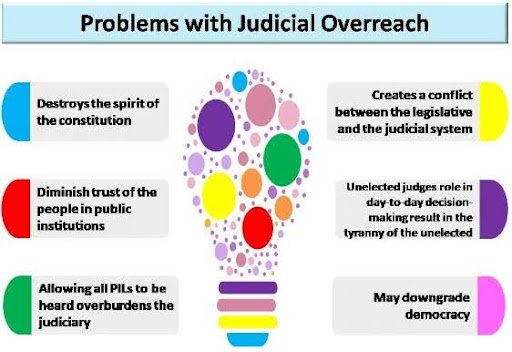
Criticism of Judicial Overreach
1. Violation of Separation of Powers:
- Encroaches upon the domain of the legislature and executive, disturbing the constitutional balance.
2. Justice Delivery Delays:
- Assuming executive/legislative roles diverts judicial attention, worsening case backlogs.
3. Judicial Overburden & Burnout:
- Extra responsibilities strain resources and reduce efficiency.
4. Accountability Concerns:
- Judiciary, being unelected, lacks direct accountability for policy decisions.
5. Lack of Policy Expertise:
- Judges may lack domain knowledge, leading to poorly informed decisions.
6. Legal Uncertainty:
- Frequent judicial interventions create confusion and unpredictability in laws.
7. Erosion of Public Trust:
- Overreach may be perceived as activism or bias, undermining credibility.
What is Judicial Restraint?
Judicial restraint refers to the principle that judges should limit the exercise of their own power. It emphasizes respect for the roles of the legislature and executive, ensuring that courts do not overstep their constitutional boundaries.
Importance of Judicial Restraint
Upholds Separation of Powers:
- As held in Divisional Manager, Aravali Golf Club v. Chander Hass (2007), every organ must respect the domain of others to maintain institutional balance.
Protects Judicial Independence:
- Prevents overreach that could invite backlash and politicization of the judiciary.
Ensures Predictability & Stability:
- Former CJI A.S. Anand cautioned that unchecked activism may lead to unpredictability and judicial adventurism.
Steps to Promote Judicial Restraint
1. Judicial Accountability:
- Use of reasoned judgments and internal review mechanisms to ensure transparency.
2. Adherence to Judicial Ethics:
- Follow established codes of conduct to avoid bias and preserve integrity.
3. Enhancing Judicial Diversity:
- Promote inclusivity and fair representation in appointments for balanced perspectives.
UPSC Relevance
GS Paper 2 – Polity and Governance:
- Separation of Powers and balance among Legislature, Executive, and Judiciary.
- Judicial Activism vs. Judicial Restraint – debate on judicial overreach.
Mains Practice Question
Q. “Judicial restraint is as important as judicial independence in a constitutional democracy. ”Discuss the significance of judicial restraint and suggest measures to ensure its practice while maintaining judicial accountability. (250 words)