
Why in News: Union Home Minister recently stated that Naxalism in India will be eliminated by mid-2026, marking the possible end of the decades-long Left-Wing Extremism (LWE) insurgency.
Introduction: The Perils of Prediction
1. Prediction-making in politics and history has often been unreliable and hazardous.
2. With the rise of Artificial Intelligence (AI), uncertainty has further deepened.
3. Political leaders must remain cautious and avoid overconfidence in forecasting outcomes.
Global Context: Terrorism’s Continuing Threat
1. Even after 25 years of the 9/11 attack, terrorism continues to persist globally.
2. Islamic State (IS)-inspired attacks (e.g., New Orleans 2024) highlight “copycat killings.”
3. Lone wolf terrorism is being incited through online propaganda and radicalisation.
4. Anti-Israel protests provide additional ideological fuel to jihadist networks.
5. The future threat includes AI-enabled terrorism and bio-weapons, raising fears of mass casualties.
Indian Context: Declining Ideological Militancy
1. India stands in contrast to global trends, with Naxalism showing a downward trajectory.
2. The Union Home Minister publicly stated that Naxalism may end by mid-2026: This is the first formal and confident prediction of the decline of Left-Wing Extremism (LWE).
3. Earlier “false dawns” (1970s, 1990s) had failed to eradicate the movement.
4. Current trends indicate not just decline in violence but also weakening ideological appeal.
Historical Background of Naxalism
1. Naxalism began with the Naxalbari uprising (1967) in West Bengal.
2. Inspired by Mao Zedong, Ho Chi Minh, and Che Guevara, it envisioned an armed revolution.
3. The slogan “China’s Chairman is our Chairman” reflected Maoist influence.
5. By the late 1970s, the movement fragmented, losing its pan-India momentum and concentrating in Central India.
The Campaign Against Naxalism (2024 Onwards)
1. A sustained counter-insurgency offensive was launched under Union Home Minister’s direction.
2. Police estimates vary, but thousands of cadres were reportedly eliminated.
3. CPI (Maoist) itself admitted 357 deaths in 2023, including over one-third women cadres.
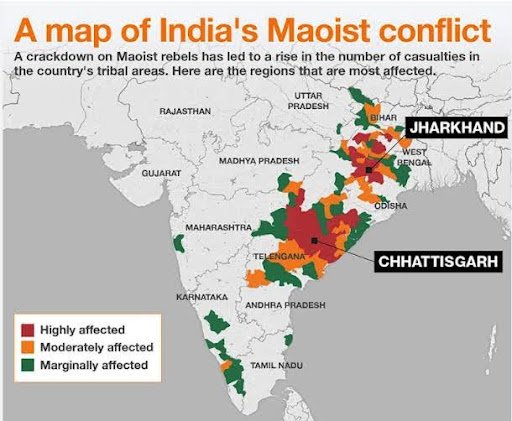
4. The Dandakaranya region (Bastar, Gadchiroli, Odisha, Andhra Pradesh) remained the epicentre.
5. Internal divisions, leadership crisis, and shrinking territory weakened the movement.
Indian vs U.S. Counter-Insurgency Approach
1. The U.S. “War on Terror” relied heavily on brute force, targeting jihadist groups in Somalia, Yemen, etc.
2. U.S. approach aimed at groups with no ideology beyond attacking the West.
3. India’s approach recognised the deep connection between Naxalites and villagers.
4. Checks and balances restricted excessive use of force, making operations more restrained.
5. India’s counter-Naxal policy combined security operations with developmental interventions.
The Ideology–Violence Transformation
1. Early Naxalites pursued radical democracy and revolutionary change.
2. Over time, the movement degenerated into indiscriminate violence, eroding popular support.
3. Splintering of groups diluted ideology, leaving only a thin Marxist-Leninist veneer.
4. The term “Urban Naxals” today is often misused, loosely applied to dissenting intellectuals.
5. Wrong classification of dissent as insurgency risks policy errors and suppression of legitimate debate.
Lessons and Way Forward
1. Recognise the difference between ideological insurgency and legitimate opposition.
2. Address root causes of extremism: tribal deprivation, land alienation, governance deficit.
3. Continue balanced strategy: security + development + rights-based governance.
4. Avoid cognitive biases and blind spots that can lead to misdirected policies.
5. Strengthen democratic institutions to ensure long-term stability in affected areas.
Conclusion
Once hailed as “Spring Thunder,” Naxalism has dwindled to fragmented violence.Current trends suggest India may witness the formal end of Left-Wing Extremism by 2026.
UPSC Relevance
General Studies Paper III: Internal Security
- Left-Wing Extremism (LWE): causes, spread, and decline.
Mains Practice Question
Q. Compare and contrast India’s approach to countering Naxalism with the U.S. ‘War on Terror’. What lessons can be drawn for counter-insurgency in a democratic society? (250 words)