
Brief Overview
- India abstained from signing a military AI governance pledge at the REAIM Summit.
- The decision preceded India’s hosting of the AI Impact Summit in New Delhi.
- Military AI governance remains peripheral within broader global AI regulatory debates.
- Only 35 of 85 countries signed the ‘Pathways to Action’ declaration.
- Participation declined significantly from 60 signatories at the previous summit.
Challenges
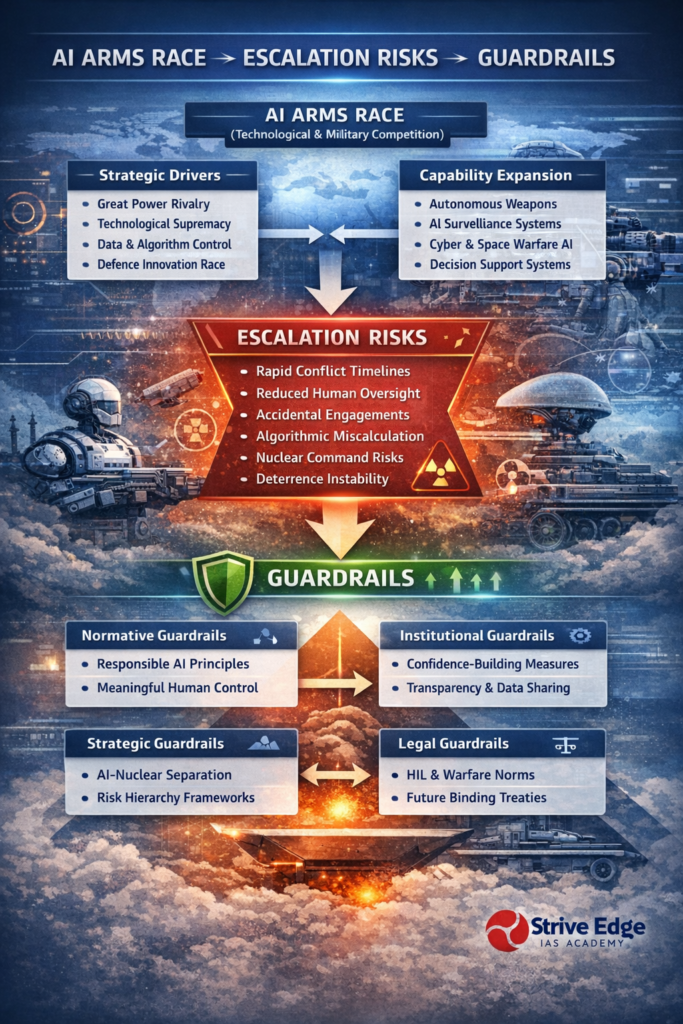
- Military AI’s dual-use nature blurs civilian innovation and defence weaponisation pathways.
- Verification of compliance becomes difficult as civilian R&D can support military applications.
- Expanding AI roles in logistics, surveillance, and combat enhances perceived battlefield advantages.
- States with heavy AI investments resist regulatory commitments limiting technological growth.
- Lethal Autonomous Weapons Systems (LAWS) represent the most controversial military AI application.
- Autonomous targeting raises ethical concerns over machine-led life-and-death decisions.
- Global governance remains weak, with UN deliberations yielding no binding outcomes.
- Absence of an internationally accepted definition of LAWS obstructs treaty formation.
- Technologically advanced states favour flexible definitions preserving operational freedom.
- Less-capable states advocate restrictive definitions enabling stronger regulation.
India’s Stance
- India balances technological ambitions with pressing national security compulsions.
- It supports principles of responsible military AI deployment.
- However, India abstained from Korea Blueprint and REAIM governance declarations. These declarations considers legally binding frameworks on LAWS premature.
- Regional security threats shape India’s cautious regulatory posture.
Way Forward
- India should advocate non-binding governance frameworks rooted in accountability principles.
- Autonomous AI systems must remain separated from nuclear command infrastructures.
- Voluntary confidence-building mechanisms can promote transparency in military AI development.
- A globally accepted risk hierarchy should classify military AI applications.
- Norm-building today can evolve into binding treaties as deployment expands.