
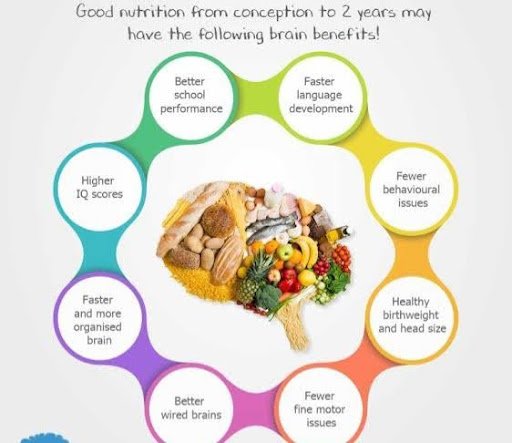
Why in News: The link between nutrition and cognition in the first 1,000 days of life is in focus as India seeks to accelerate progress in reducing child stunting and malnutrition. Initiatives like “Poshan Bhi Padhai Bhi” and the Navchetana framework aim to integrate early nutrition with cognitive stimulation to ensure holistic child development.
Introduction
- The first 1,000 days of life (conception to two years of age) are a child’s critical window of development.
- Just as catching a flight requires timely preparation, missing this window means a child may never reach full physical or cognitive potential.
- Nutrition and cognition are inseparable; deficits during this period have lifelong, often irreversible consequences.
Science of Early Childhood Development
- By age 2, the brain reaches 80% of its adult weight.
- Synapse development peaks; synaptic density reaches adult levels by preschool age.
- The frontal lobes (planning, sequencing, self-regulation) grow in spurts during the first two years.
- If early brain circuits are poorly developed, later skills and learning are permanently limited.
Nutrition and Cognitive Development
- Nutritional deficiencies before age 3 are often irreversible.
- Example: Vellore birth-cohort study showed iron deficiency in early years impairs language, verbal skills, and cognitive processing speed.
- Combined nutrition + stimulation programmes are far more effective than standalone nutrition interventions.
- Neuroplasticity in early years ensures rapid, permanent learning (e.g., language acquisition, memory of nursery rhymes).
Status of Nutrition in India
- Between 1993–2021, India made progress against malnutrition.
- At current pace, stunting prevalence may only drop to 10% by 2075.
- To meet this target by 2047, efforts must double the rate of decline by focusing on the critical 1,000-day window.
Childcare Programmes in India
Integrated Child Development Services (ICDS)
- Among the world’s largest childcare programmes.
- Combines nutrition and education for early childhood development.
“Poshan Bhi Padhai Bhi”
- Ministry of Women and Child Development initiative.
- Focuses on ensuring that nutrition and cognitive development go hand in hand.
Navchetana Framework
- National Framework for Early Childhood Stimulation (0–3 years).
- Provides 140 structured activities in a 36-month stimulation calendar.
- Delivered through parents, caregivers, Anganwadi/ crèche workers.
- Promotes play-based learning during home visits to ensure timely nutrition and stimulation.
Areas Needing Improvement
- Coverage and Quality: ICDS needs expansion to reach saturation with high-quality services.
- Urban Services: Strengthen ICDS in urban areas where migration and nuclear families challenge childcare.
- Technology Leverage: Use digital tools to enhance monitoring and delivery.
- Pre-Primary Education: Improve access, delivery, and evaluation of early learning and psychosocial well-being of children under six.
- Women’s Empowerment: Expand crèche facilities through multiple models — public, community-run, and PPPs — to support working mothers.
Broader Significance
- Investing in early childhood is not only about health but about enabling children and women to reach their full potential.
- Critical for future workforce readiness, especially with automation and mechanisation reducing opportunities for unskilled labour.
- Early investment ensures a generation capable of thriving in a rapidly changing economic and technological landscape.
Conclusion
“We are what we eat and what we think.” What is lost in the early years can never be regained.Prioritising nutrition + cognitive stimulation in the first 1,000 days is essential to break cycles of malnutrition, enhance learning outcomes, empower women, and prepare India for the future.
UPSC Relevance
GS Paper III (Social Justice, Health & Education)
- Issues relating to development and management of human resources.
Mains Practice Question
Q. The first 1,000 days of life provide a once-in-a-lifetime opportunity to shape cognitive and physical development. Discuss the link between nutrition and cognition during this critical window, and evaluate India’s efforts such as ICDS, Poshan Bhi Padhai Bhi, and Navchetana framework in ensuring holistic child development.