

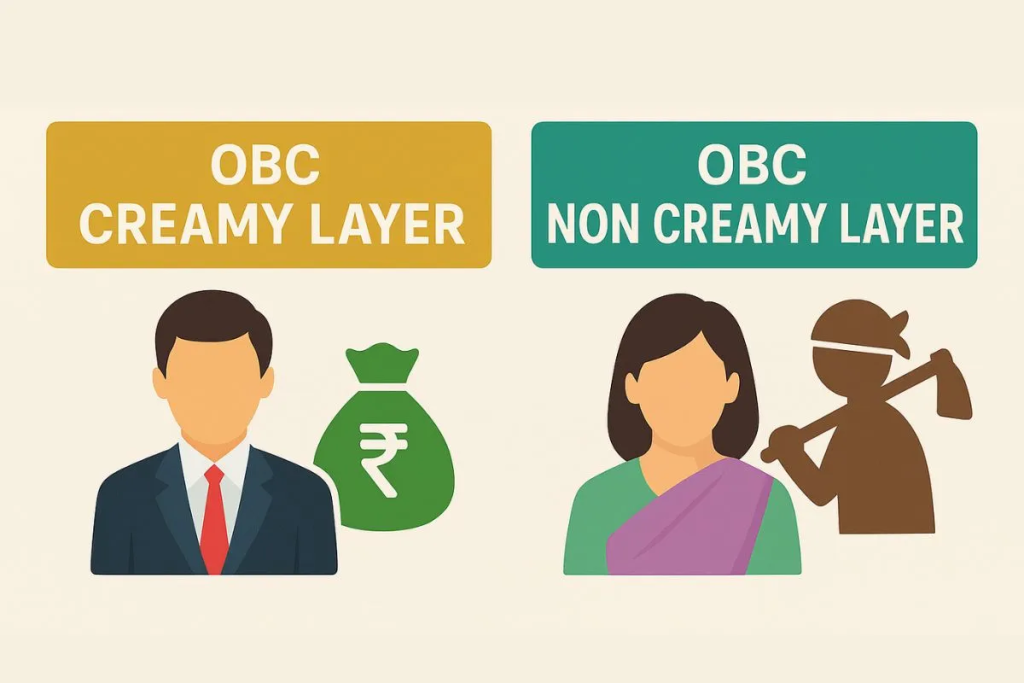
Context
- On March 11, the Supreme Court held that parental salary alone cannot determine the creamy layer status of an OBC candidate.
- The judgment addressed confusion in applying the income/wealth test to candidates whose parents work in PSUs or private employment, where equivalence with government posts has not been established.
- The idea of creamy layer originated from the Indra Sawhney judgment (1992), which allowed OBC reservations but excluded socially and economically advanced sections within the category.
Features of the Creamy Layer Framework
- Regulatory framework
- The Department of Personnel and Training (DoPT) issued an Office Memorandum (1993) identifying categories excluded from the OBC quota.
- These include children of persons holding constitutional positions and senior government posts such as President, Vice-President, Supreme Court and High Court judges, Class I and II officers, and senior armed forces officers.
- Income/wealth test
- The 1993 OM introduced an income threshold to identify the creamy layer.
- Initially set at ₹1 lakh per year, the limit has been revised several times and currently stands at ₹8 lakh (since 2017).
- A candidate falls in the creamy layer if parents earn above this limit for three consecutive years or possess wealth beyond the Wealth Tax Act, 1957 threshold.
- Income calculation
- The OM clearly stated that salary income and agricultural income must be excluded from the calculation.
- Only income from business, property, or capital gains should be considered.
- Categories covered
- The income test mainly applies to professionals, traders, property holders, and employees in PSUs or private sector posts whose equivalence with government posts is not established.
Issues in Applying the Test
- Confusion due to the 2004 clarification
- In 2004, the DoPT issued a clarification suggesting that salary income may be included while applying the test to PSU employees without post equivalence.
- This contradicted the 1993 OM, which had excluded salary income.
- Inconsistent interpretation
- Authorities relied on both the 1993 OM and the 2004 clarification, without clearly explaining when salary income should be counted.
- This created administrative confusion in determining creamy layer status.
- Discriminatory outcomes
- The Supreme Court observed that this interpretation created unequal treatment between:
- children of government employees, and
- children of PSU or private sector employees.
- Candidates from PSU or private employment backgrounds were excluded solely on the basis of salary, without considering the status of their posts.
- The Court described this as hostile discrimination, since similarly placed individuals were treated differently.
- The Supreme Court observed that this interpretation created unequal treatment between:
- Impact on candidates
- Several candidates appearing in civil service examinations since 2015 were denied OBC reservation because parental salary was wrongly included in the creamy layer calculation.
Way Forward
- Clearer application of the rule
- Authorities must apply the income/wealth test consistently, ensuring that salary and agricultural income remain excluded as intended.
- Establishing post equivalence
- The government should determine equivalence between PSU posts and government posts to remove ambiguity in applying reservation rules.
- Correcting past injustice
- The Court directed the creation of supernumerary posts where required so that eligible candidates wrongly denied reservation can receive the benefits.
- Protecting the purpose of reservation
- The creamy layer principle must function as a fair filter, ensuring that reservation benefits reach socially and educationally disadvantaged sections within the OBC category.
Conclusion
- The Supreme Court’s ruling restores clarity to the creamy layer framework and reinforces the principle that reservation policies must operate with fairness and constitutional equality. By excluding salary income from the income test and addressing discriminatory interpretations, the judgment strengthens the broader goal of social justice for backward communities.
