

UPSC Mains
GS Paper III & II
Science & Tech / Governance
One Nation, One Time: India’s Push for a Unified Standard Time System
The Centre has notified the Legal Metrology (Indian Standard Time) Rules, 2026, making IST the single official time reference for all legal, administrative, commercial and official purposes, effective in 180 days
IST PRECISION
Under 3 nanoseconds to UTC
TRANSITION WINDOW
180 days to comply
RULES NOTIFIED
27 August 2026
📰
Why in News & Background
Why in News
- On August 27, the Centre notified the Legal Metrology (Indian Standard Time) Rules, 2026, making Indian Standard Time (IST) the single official time reference for all legal, administrative, commercial and official purposes. The Rules take effect after 180 days as part of the “One Nation, One Time” initiative.
Why Does India Need a Common Time Reference?
- Several critical systems depend entirely on precise time-stamping: banking and digital payments (fraud prevention), telecom and internet (data synchronisation), railways and airports (schedule/safety coordination), power systems (grid stability), government/legal records, and emergency services.
- Different systems relying on GPS, local servers, or foreign satellites create small time mismatches that complicate banking, railway, and telecom coordination.
📰
Source: The Hindu
🗓️
How Did the Push for a Common Time Begin?
- January 2025: The government proposed the Draft Legal Metrology (Indian Standard Time) Rules, 2025 to synchronise time across India, with help from NPL and ISRO.
- Inter-Ministerial Committee: A high-level committee developed a framework to make IST mandatory, involving NPL, ISRO, IIT Kanpur, CERT-In, railways and telecom departments.
- Identifying the Problem: Some telecom/internet services used foreign time sources such as GPS, raising accuracy and national-security concerns.
- 2026 Rules: The Legal Metrology (Indian Standard Time) Rules, 2026 were notified, making IST the single legal time standard for India.
What Exactly Is IST, and How Is It Maintained?
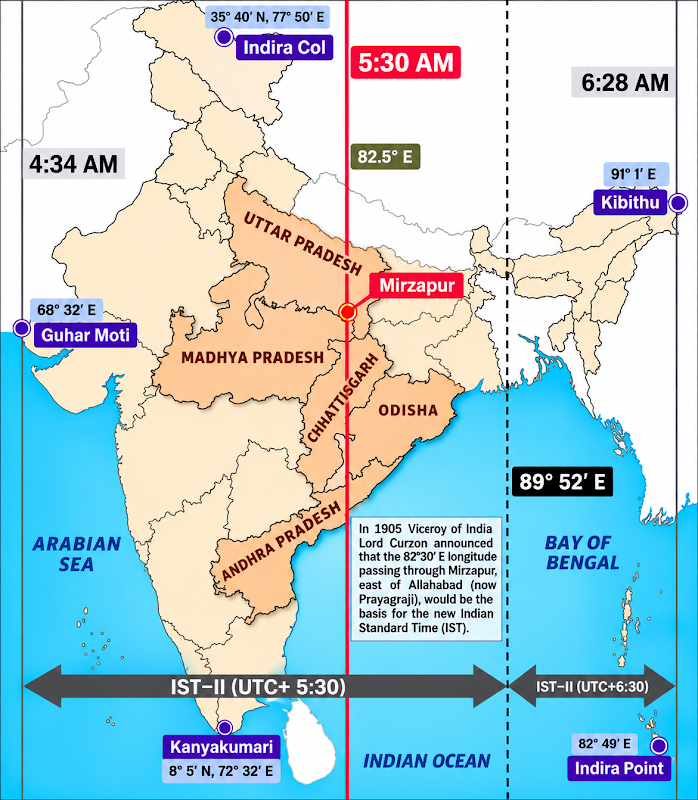
- IST is based on Coordinated Universal Time (UTC), with a fixed offset of +5:30 hours, maintained by CSIR-National Physical Laboratory (CSIR-NPL).
- Generated using advanced atomic clocks and satellite links, traceable to UTC with an uncertainty of less than 3 nanoseconds, and disseminated with millisecond accuracy through NTP servers.
- The trademark “IST®” was registered in 2024, but the time standard was never legally mandated until these Rules.
🧩
Key Dimensions of the Issue
Governance & Standardisation
Just as a country needs one currency and one weights-and-measures system, it needs one legally recognised time reference to avoid disputes and inefficiencies.
Digital Economy
Accurate, synchronised timestamps are essential for transaction integrity, fraud detection and dispute resolution as digital payments and e-governance expand.
National Security
Reliance on foreign GPS for time creates a strategic vulnerability in a crisis; NavIC insulates critical infrastructure, fitting the Atmanirbhar Bharat theme.
Critical Infrastructure Protection
Power, railways, telecom and banking are critical infrastructure; many cyberattacks exploit unsynchronised timing to hide malicious activity.
- Federal and Implementation Dimension: Since the Rules affect multiple sectors and regulators (telecom, banking, railways, power), success will require coordination across many ministries, regulators and private players.
📊
Significance and Challenges
Significance
- Improves accuracy and reliability of time-sensitive digital transactions across banking, telecom and e-governance.
- Strengthens national security by reducing dependence on foreign satellite-based time sources like GPS.
- Promotes indigenous technology, giving NavIC a central role and supporting Atmanirbhar Bharat.
- Protects critical infrastructure like power grids and financial systems from timing-based cyber-attacks.
- Enhances legal and administrative clarity by giving IST formal legal status.
- Supports ease of doing business through uniform, predictable timestamping standards.
Challenges and Concerns
- Transition cost and complexity: Businesses and ISPs must upgrade systems within the 180-day window — a tight timeline for smaller players.
- Continued reliance on GPS in practice: Many existing devices/systems are built around GPS; full transition will take time and investment.
- Coordination challenge: The initiative touches banking, telecom, railways, power and emergency services — inter-agency coordination is critical.
- Awareness gap: Smaller businesses and local bodies may not be fully aware of the new legal requirement, risking uneven compliance.
🧭
Way Forward
Support Smaller Providers
Ensure adequate technical and financial support for smaller telecom/ISPs to transition to IST/NavIC-linked systems within the deadline.
Expand Demonstration Networks
Expand the Bengaluru-style demonstration network to other regions so more sectors see a practical, working model before full enforcement.
Strengthen Coordination
Build on the existing high-power committee to monitor compliance across banking, telecom, railways and power sectors.
Invest in NavIC
Invest further in NavIC infrastructure and capacity, since time sovereignty depends on the reliability of this indigenous system.
Awareness Programmes
Run awareness and compliance support programmes for smaller businesses and local bodies to ensure smooth, inclusive transition.
Conclusion: The “One Nation, One Time” initiative strengthens digital systems, critical infrastructure and national security. Making IST mandatory and promoting NavIC will support technological self-reliance and strategic autonomy — its success will depend on smooth implementation across banks, telecom, railways and power sectors.
📰
Source: The Hindu
