
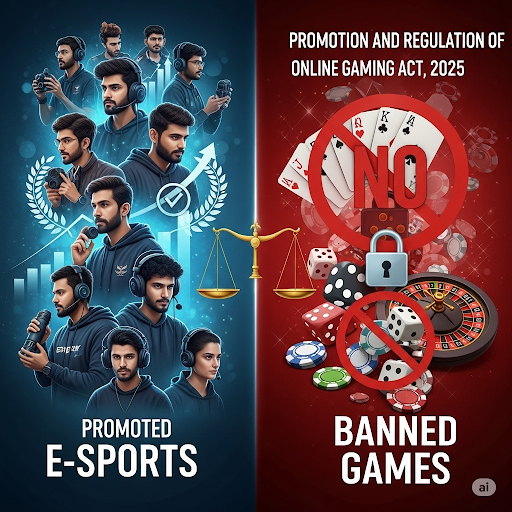
Why in News: Parliament passed the Promotion and Regulation of Online Gaming Act, 2025 (assented on August 22) which bans Real Money Games (RMGs) and their advertisements, promotes e-sports and social gaming, and prescribes strict penalties to curb financial fraud, addiction, and tax evasion linked to online money gaming.
Key Provisions of the Act
A.Categorisation of Games
1. E-sports
- Recognised under National Sports Governance Act, 2025.
- Registered with regulatory authority.
- Includes registration fees and performance-based prize money (e.g., Call of Duty, Grand Theft Auto).
2. Social Gaming
- Casual/recreational/educational games.
- Govt can promote under Section 4.
- No legal definition, but included under broad “online games” category.
3. Real Money Games (RMGs)
- Defined as games played after fee payment or expectation of winning money/stakes (coins, tokens, virtual money convertible into cash).
- Covers games of skill, chance, or both (Poker, Rummy, Fantasy Cricket, Ludo).
- All RMGs and their advertisements banned.
Regulatory Framework
Central Government empowered to:
- Establish regulatory authority for recognition & registration.
- Block/disrupt apps via CERT-IN; Interpol may be roped in for offshore operators.
- No penal action against players, but against providers & advertisers.
- Budgetary support from Consolidated Fund of India for promoting social gaming.
Penalties
- Offering RMGs / fund transactions → Imprisonment up to 3 years + fine up to ₹1 crore (or both).
- Unlawful advertisement → Imprisonment up to 2 years + fine up to ₹50 lakh (or both).
- Classified as cognisable and non-bailable offences under BNSS, 2023.
WHO’s Position on RMGs
Associated with:
- Addictive & compulsive behaviour.
- Financial hardship & debts.
- Psychological distress.
- Family breakdowns & suicides (e.g., 32 cases reported in Karnataka in 31 months).
Rationale Behind the Act
- Public complaints of massive financial losses.
- Algorithmic manipulation: no user emerges as long-term net winner.
- National security concerns:
- 2023 Parliamentary Panel → gaming portals funding terror activities.
- Chinese app FIEWIN defrauded Indians of ₹400 crore.
- Financial crimes:
- ₹2,000 crore tax evasion (2022 report).
- ₹30,000 crore GST evasion (Govt report).
- Money laundering via mule accounts & crypto wallets.
Legal & Judicial Context
Constitutional Aspect:
- State List (Entries 34, 62) → “betting & gambling” under States’ jurisdiction.
- States like Telangana, Andhra Pradesh, Tamil Nadu have earlier banned online games.
GST & Taxation:
- In 2023, 28% GST imposed on entry fee/deposits.
- Online gaming firms opposed retrospective taxation.
Supreme Court Intervention:
- Granted stay on notices to gaming companies.
- Earlier rulings: games like Rummy & Fantasy Sports involve substantial skill → not gambling.
- Pending judgment on whether fantasy sports, poker, rummy = skill games or gambling.
- Critics argue Act erases distinction between skill & chance, violating Article 19(1)(g) — Right to Trade & Occupation.
- If challenged, SC may step in with interim relief.
Challenges Ahead
- Enforcement gaps: VPNs, offshore operators, cash play.
- Industry pushback: potential loss of 2 lakh jobs across 400+ companies.
- Regulatory clarity needed between skill-based games vs gambling.
- Risk of constitutional challenge (Centre vs State powers).
Conclusion
The Online Gaming Act, 2025 reflects India’s attempt to balance digital innovation with social safeguards. By promoting e-sports and social gaming while banning RMGs, the government aims to curb financial frauds, tax evasion, and public health risks.
UPSC Relevance
GS Paper II (Governance & Polity)
- Regulation of digital platforms and federal issues (Centre vs State powers on gambling).
GS Paper III (Economy & Internal Security)
- Financial frauds, money laundering, and tax evasion through online gaming.
Mains Practice Questions
Q1. The Promotion and Regulation of Online Gaming Act, 2025 bans Real Money Games (RMGs) while promoting e-sports and social gaming. Critically analyse the socio-economic, legal, and constitutional implications of this legislation. (250 words)