
Why this topic?
- Chief of Defence Staff Anil Chauhan recently reflected on India’s early China policy. He noted that post-Independence India prioritised stable relations with China. The leadership believed the Panchsheel Agreement (1954) would stabilise Himalayan frontiers.
Conceptual Overview of the Panchsheel Doctrine
- The doctrine emerged from the 1954 India–China Agreement on Trade and Intercourse with Tibet.
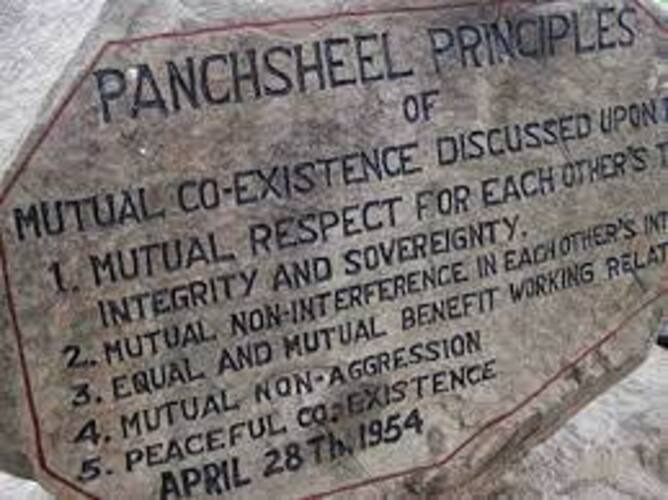
- Panchsheel refers to the Five Principles of Peaceful Coexistence.
- Mutual respect for sovereignty and territorial integrity.
- Mutual non-aggression in bilateral relations.
- Mutual non-interference in internal affairs.
- Equality and mutual benefit in cooperation.
- Peaceful coexistence as the basis of diplomacy.
- These principles sought to humanise international relations by prioritising respect, restraint, and reciprocity over coercion.
Positive Impact on India’s Foreign Policy
- Normative Leadership
- Panchsheel elevated India’s image as a proponent of peaceful global coexistence.
- It strengthened India’s moral voice among post-colonial nations.
- Afro-Asian Solidarity
- Principles were adopted at the Bandung Conference (1955).
- The conference united Asian and African nations around anti-colonial cooperation.
- Non-Aligned Movement Foundation
- Panchsheel shaped the philosophy of the Non-Aligned Movement (NAM).
- NAM institutionalised strategic independence during the Cold War.
- Global Institutional Recognition: The principles were endorsed by the United Nations General Assembly (1957).
- India-China Diplomatic Framework
- The doctrine provided the first formal framework for bilateral engagement. It fostered goodwill reflected in the slogan “Hindi-Chini Bhai Bhai.”
Limitations and Strategic Lessons
- Idealism vs Realism Gap
- Panchsheel relied heavily on mutual trust and moral diplomacy.
- It underestimated geopolitical competition and power asymmetry.
- Tibet and Buffer Loss
- India’s recognition of Chinese sovereignty over Tibet removed a strategic buffer.
- It exposed India to direct Himalayan frontier pressures.
- Boundary Question Neglect
- The agreement did not clearly settle border disputes.
- China later rejected Indian claims over Aksai Chin and Arunachal Pradesh.
- 1962 War Breakdown
- The Sino-Indian War (1962) violated non-aggression principles. It shattered bilateral trust and credibility of Panchsheel.
- Lack of Enforcement Mechanisms
- The doctrine lacked legal or institutional enforcement provisions.
- Ethical commitments alone proved insufficient to deter conflict.
Conclusion
- Panchsheel reflected India’s attempt to build a world order rooted in Mutual dignity among nations, Respect for sovereignty, Peace over militarism, Cooperation over coercion. However, its limitations underscored that enduring peace requires alignment between moral vision and strategic preparedness.