
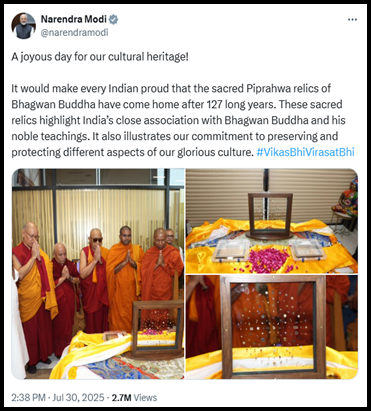
Why in News: India recently successfully repatriated the Piprahwa relics from an auction at Sotheby’s Hong Kong after government intervention. This highlighted the need for stronger legal frameworks and proactive measures to prevent the sale of India’s sacred cultural relics abroad.
Context:
- Recent repatriation of Piprahwa relics excavated in 1898 from a stupa in Uttar Pradesh.
- Relics believed to be associated with Lord Buddha’s mortal remains and early followers.
- Taken during colonial era; resurfaced for auction at Sotheby’s Hong Kong in May.
- Indian government intervened, halting auction and repatriating relics to National Museum.
Significance:
- Provides public access to an irreplaceable part of India’s and Buddhism’s heritage.
- Showcases India’s cultural diplomacy and coordinated multi-ministry efforts.
- Public-private partnership (Godrej Industries Group and government) enabled acquisition and repatriation.
- Sets a positive precedent for future recoveries.
- Raises global awareness of India’s role as steward of Buddhist heritage.
Challenges and Structural Deficiencies:
- Fragmented ownership from colonial era caused complex legal issues delaying repatriation.
- India’s reactive approach highlighted gaps in legal, administrative, and preventive frameworks.
- Auction announcement occurred before India could intervene, indicating lack of early monitoring.
- Absence of robust international legal frameworks to prevent sale of culturally sensitive objects.
- Reliance on diplomatic pressure is unsustainable and not scalable.
Way Forward – Recommendations:
1. Centralised Digital Registry:
- Develop a digitised, centralised registry of cultural assets, domestic and overseas.
- Integrate with international customs and auction houses for real-time monitoring and early alerts.
2. International Norms and Legal Frameworks:
- Lead or participate actively in creating binding international laws to prevent commercialisation of sacred relics.
3. Public-Private Partnerships (PPP):
- Expand PPPs to mobilise resources and expertise for recovery and conservation.
4. Stakeholder Involvement:
- Encourage involvement of philanthropic foundations, heritage trusts, and diverse stakeholders.
Conclusion:
- India’s experience with the Piprahwa relics underscores the urgent need for a proactive, legally robust, and cooperative framework—both nationally and internationally—to protect and repatriate sacred cultural heritage effectively.
UPSC RELEVANCE
- Culture & Heritage (GS Paper 1): Highlights India’s efforts to preserve and protect its cultural and religious heritage, particularly Buddhist relics.
- International Relations (GS Paper 2): Demonstrates India’s cultural diplomacy
Mains Practice Question:
Q. “Discuss the challenges India faces in safeguarding its cultural heritage abroad and suggest measures to improve the recovery and protection of sacred relics and artifacts. How can public-private partnerships and international cooperation play a role in this process?”
Prelims Quick Facts
Piprahwa Relics
Association: Linked to the mortal remains of Lord Buddha.
Key Features:
- Includes bone fragments, soapstone and crystal caskets.
- Contains a sandstone coffer and offerings such as gold ornaments and gemstones.
- An inscription in Brahmi script on one of the caskets confirms these as relics of the Buddha, deposited by the Sakya clan.
Discovery:
- Excavated in 1898 by William Claxton Peppé, an English estate manager and engineer.
- Found at a stupa in Piprahwa, near Lumbini (believed to be the birthplace of Lord Buddha).
Historical Context:
- Under the 1878 Indian Treasure Trove Act, the British Crown claimed Peppé’s findings.
- Bone and ash fragments were gifted by the British to King Chulalongkorn of Siam (now Thailand).
- Majority of the relics were transferred to the Indian Museum, Kolkata, in 1899.
Legal Status:
- Classified as ‘AA’ antiquities under Indian law.
- Their removal, sale, or transfer is strictly prohibited.