
Syllabus: Welfare schemes for vulnerable sections of the population by the Centre and States
Background of POCSO Framework
- The POCSO Act, 2012 created a child-specific legal framework for sexual offences.
- It replaced reliance on general IPC provisions, which failed to reflect children’s vulnerabilities.
- The Act promised child-friendly procedures, time-bound trials, and special courts.
Fast-Track Courts and Disposal Trends
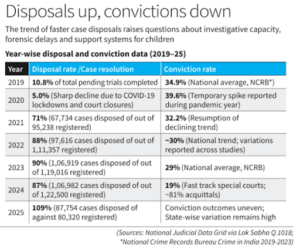
- In 2025, fast-track special courts achieved a 109% disposal rate.
- 87,754 cases were disposed against 80,320 newly registered cases.
- India operates 773 fast-track courts, with 400 dedicated to POCSO cases.
- These courts were launched in October 2019 using ₹1,952 crore from the Nirbhaya Fund.
- They cleared 3,50,685 cases by September 2025.
- Fast-track courts handle 9.51 cases per month, compared to 3.26 in regular courts.
Falling Convictions Despite Speed
- Conviction rates dropped from 35% in 2019 to 29% in 2023.
- A 90% disposal rate should have produced 45% convictions, but outcomes were weaker.
- Fast-track courts recorded only 19% average conviction rates.
- In several States, acquittals exceed convictions, leaving offenders free.
Weak Investigations and Systemic Gaps
- Hasty investigations, incomplete charge sheets, and delayed forensic reports weaken prosecutions.
- These issues are severe in Uttar Pradesh and Maharashtra.
- Support persons under Section 39 of POCSO remain largely un-empanelled across States.
- The NCPCR 2024 guidelines mandate these appointments, yet implementation remains poor.
Para-Legal Volunteers and First Response Failures
- The Supreme Court (December 2025) directed PLVs at every police station.
- Andhra Pradesh has PLVs in only 42 of 919 stations.
- Tamil Nadu has none across 1,577 stations.
- Lack of PLVs enables FIR delays, intimidation, and evidence loss.
Compensation and Social Harm
- Courts delay interim compensation, often waiting for final verdicts.
- Survivors receive support years later, making relief largely ineffective.
- Families incur travel, legal, and income losses during prolonged trials.
Conclusion
- Speed without support has produced weaker convictions and fragile justice for child survivors.
- Effective forensics, PLVs, and support persons are essential for meaningful POCSO enforcement.