
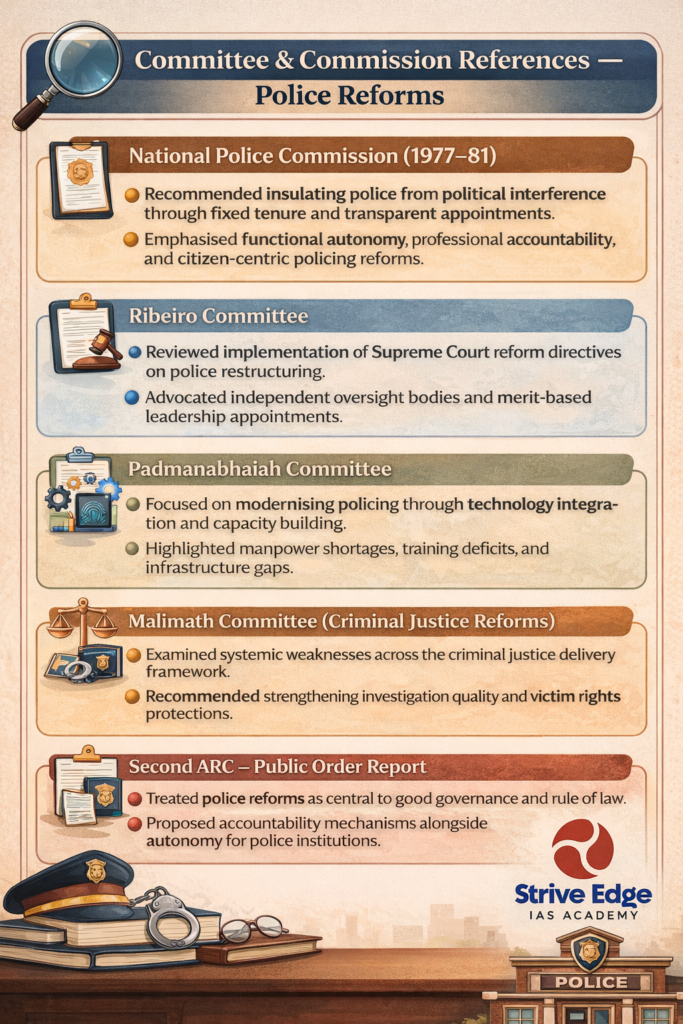
Context
- The Supreme Court criticised states for delaying police reforms despite long-pending constitutional directives. The states continue ad-hoc appointments of Directors-General of Police (DGP), undermining institutional autonomy.
- The Court expressed concern over non-implementation of reforms even after two decades. It stressed the need for independent, professionally competent police leadership.
- The judgement highlighted institutional decline due to political interference in policing structures.
Challenges Faced by Police Force in India
- Structural and Historical Challenges
- India’s policing continues to function under the colonial Police Act of 1861 legacy. The colonial design prioritised regime control rather than citizen service and rights protection.
- The Status of Policing in India Report, 2025 reflects troubling custodial attitudes. Nearly 30% personnel justified third-degree methods even for minor theft offences.
- Workforce Stress and Capacity Constraints
- Personnel Shortage : India faces a significant police personnel shortage affecting operational efficiency. Against the UN norm of 222 officers per 100,000 people, India has only 154.84 personnel.
- Excessive Working Hours : Around 24% personnel work beyond sixteen hours daily. Nearly 44% officers report working more than twelve hours regularly.
- Multiple Duty Burden : Police handle elections, VIP security, and law-order without adequate rest.
- Work-Life Imbalance : Sustained stress affects morale, judgement, and public service delivery quality.
- Public Perception and Trust Deficit
- Marginalised communities often perceive policing through a lens of discrimination and fear. This erodes public trust and weakens community intelligence gathering mechanisms.
- Successful outreach initiatives remain limited to isolated models. Example: Janamaithri (Kerala) and Mohalla Committees (Maharashtra) remain notable exceptions.
- Institutional and Operational Deficiencies
- Poor investigative capacity results in wrongful arrests and weak conviction rates.
- India faces an acute shortage of forensic scientists. The ratio stands at 0.33 per 100,000 compared to 20–50 globally.
- Political interference undermines professional autonomy in policing decisions.
- A 2019 study found 72% officers faced pressure in sensitive investigations.
Reform Imperatives and Way Forward
- Implement Judicial Directives
- Prakash Singh Directives : Full implementation of Supreme Court’s 2006 police reform directives remains essential.
- State Security Commissions : Independent SSCs must prevent political misuse of policing structures.
- Police Complaints Authorities : Statutory PCAs should investigate misconduct with institutional autonomy.
- Strengthen Internal Accountability
- Police Establishment Boards : Boards should regulate transfers and postings transparently.
- Performance Audits : Evaluation must include public satisfaction and investigation quality indicators.
- Functional Specialisation
- Separation of Functions : Investigation and Law-and-Order wings require institutional bifurcation.
- Cybercrime and Forensics : Specialised units and labs must expand nationwide capacity.
- NATGRID Integration: Database integration can enhance counter-terror intelligence coordination.
- Community Policing Transformation
- Police-Public Partnerships: Structured engagement improves intelligence gathering and trust.
- Collaborative Problem Solving: Joint platforms can address local crime drivers.
- Police-as-Service Model: Institutional behaviour must prioritise citizen service delivery.
- Citizens’ Charters: Service standards should ensure accountability and transparency.
- Addressing New-Age Security Challenges
- Specialised Crime Units: Dedicated wings must tackle cyberterrorism, narcotics, and organised crime.
- Pan-India Coordination: National cooperation is essential for transnational crime control.
- Inter-Agency Data Sharing: Security databases must integrate across institutions.
- Joint Operational Protocols: State and central agencies require synchronised response frameworks.
Conclusion
- Police reforms require dismantling colonial legacies and institutionalising democratic policing values. Implementing judicial directives, autonomy, technology adoption, and community orientation remains essential. Transformative reforms can build a professional, accountable police system for a “Viksit Bharat.”