
INTRODUCTION
The Preamble is the introductory statement of the Indian Constitution that outlines the source, philosophy, and objectives of the Constitution. It reflects the vision of the Constituent Assembly and serves as a guiding light for interpreting constitutional provisions. Though not legally enforceable, it is considered an integral part of the Constitution and forms the basis of the basic structure doctrine (Kesavananda Bharati case, 1973).
CONCEPT EXPLANATION
Historical Background of the Preamble
- Freedom Struggle & Constitutional Reform Demands
- The idea of a constitution for India evolved during the national movement.
- The Tilak Constitution (1895) was an early attempt by nationalists to draft a framework for self-rule.
- Demands for representative government intensified under leaders like Dadabhai Naoroji and Gopal Krishna Gokhale.
- British Reforms & Growing Aspirations
- Montagu-Chelmsford Reforms (1919) expanded Indian participation but retained British control.
- Simon Commission (1927), which excluded Indians, led to protests and calls for complete independence.
- Round Table Conferences (1930–32) discussed political reforms, highlighting federalism and minority rights.
- Government of India Act, 1935 provided a federal structure but under British dominance.
- Demand for Full Independence
- The 1930 Purna Swaraj Resolution declared complete independence as the Indian objective.
- This resolution emphasized popular sovereignty—a theme later echoed in the Preamble (“We, the people…”).
- Constituent Assembly & Objectives Resolution (1946)
The Constituent Assembly, formed in 1946, adopted the Objectives Resolution introduced by Jawaharlal Nehru.
- This resolution became the philosophical basis of the Preamble, reflecting the ideals of justice, liberty, equality, and fraternity.
- Drafting of the Constitution (1946–49)
- Under Dr. B.R. Ambedkar’s leadership, the Drafting Committee included the Preamble as a essence of constitutional values.
- It was adopted along with the Constitution on 26 November 1949 and came into effect on 26 January 1950.
PARTS OF THE PREAMBLE
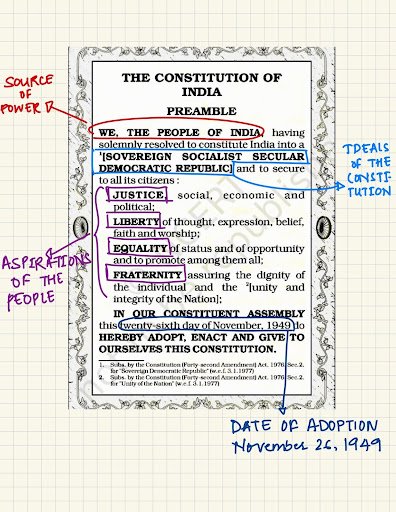
KEYWORDS IN THE PREAMBLE
| 1. Sovereign | ‘Sovereign’ implies that India is neither a dependency nor a dominion of any other nation, but an independent state– free to conduct its own affairs (both internal and external) |
| 2. Socialist | Indian National Congress itself adopted a resolution to establish a ‘socialistic pattern of society’ in its Avadi sessionIndian brand of socialism is a ‘democratic socialism’ and not a ‘communistic socialism’ (also known as ‘state socialism’)added by the 42nd Constitutional Amendment Act of 1976Democratic socialism- holds faith in a ‘mixed economy’ where both public and private sectors co-exist side by sideIndian socialism is a blend of Marxism and Gandhism, leaning heavily towards the Gandhian socialism( stateless society)- UPSC PRE 2020 |
| 3. Secular | added by the 42nd Constitutional Amendment Act of 1976positive concept of secularism i.e, all religions in our country (irrespective of their strength) have the same status and support from the state |
| 4. Democratic | doctrine of popular sovereignty, that is, possession of supreme power by the people ( it calls into activity the intelligence and character of ordinary man and women) UPSC 2017Direct democracy, the people exercise their supreme power directly as is the case in Switzerland- four devices of direct democracy, namely, Referendum, Initiative, Recall and PlebisciteReferendum is a procedure whereby a proposed legislation is referred to the electorate for settlement by their direct votes.Initiative is a method by means of which the people can propose a bill to the legislature for enactment.Recall is a method by which the voters can remove a representative or an officer before the expiry of his term, when he fails to discharge his duties properly.Plebiscite is a method of obtaining the opinion of people on any issue of public importance. It is generally used to solve territorial disputes.Indirect democracy, on the other hand, the representatives elected by the people exercise the supreme power and thus carry on the government and make the laws ex. IndiaThe principles of liberty, equality and fraternity are not to be treated as separate items in a trinity. They form a union of trinity in the sense that to divorce one from the other is to defeat the very purpose of democracy |
| 5. Republic | the head of the state is always elected directly or indirectly for a fixed period, e.g., USAIndia has an elected head called the president. He is elected indirectly for a fixed period of five yearsA republic also means two more things: vesting of political sovereignty in the people and not in king; second, the absence of any privileged class and hence all public offices being opened to every citizen without any discrimination |
| 6. Justice | The ideal of justice–social, economic and political–has been taken from the Russian Revolution (1917). |
| 7. Liberty | ‘liberty’ means the absence of restraints on the activities of individuals, and at the same time, providing opportunities for the development of individual personalities (UPSC 2019)The Preamble secures to all citizens of India liberty of thought, expression, belief, faith and worship(UPSC PRE 2017) |
| 8. Equality | absence of special privileges to any section of the society, and the provisions of adequate opportunities for all individuals without any discrimination. |
| 9. Fraternity | Sense of brotherhood– to assure two things– the dignity of the individual and the unity and integrity of the nation word ‘integrity’ has been added to the preamble by the 42nd Constitutional Amendment (1976) |
JUDICIAL PRONOUNCEMENTS ON THE PREAMBLE
1. Berubari Union Case (1960)
- Held: Preamble is not a part of the Constitution and cannot be used for interpretation.
- The Court relied on the American jurisprudence, which viewed the Preamble as a mere introductory statement and not a source of power.
- Significance: This position was later overruled in Kesavananda Bharati.
2. Golak Nath v. State of Punjab (1967)
- Held: Preamble lays down main objectives the Constitution seeks to achieve.
- Used to determine whether amendments violate those objectives.
3. Kesavananda Bharati v. State of Kerala (1973)
- Overruled Berubari: SC held that the Preamble is an integral part of the Constitution.
- It is not a source of power but is useful in interpreting ambiguous provisions.
- The values enshrined in the Preamble—justice, liberty, equality, fraternity, secularism, and democracy—are part of the Basic Structure Doctrine.
- Any constitutional amendment violating the Preamble’s spirit is invalid.
3. S.R. Bommai v. Union of India (1994)
- Held: Secularism in the Preamble is part of the basic structure.
- The state must remain neutral in religious matters.
4. Indira Nehru Gandhi v. Raj Narain (1975)
- Held: Preamble is integral to the Constitution, and its spirit pervades the entire document.
- Acts as a key to understanding the intent of the framers.
5. R.C. Poudyal v. Union of India (1994)
- Held: Preamble is a basic feature and has the same sanctity as other constitutional provisions.
- Its principles—justice, liberty, equality, fraternity—must be upheld.
6. LIC of India v. Consumer Education & Research Centre (1995)
- Held: Preamble reflects aspirations and goals of the Constitution and is an integral part of the Constitution.
- Aids in interpreting laws to achieve social, economic, and political justice.
- However, it clarified that the Preamble cannot be directly enforced in court as a standalone provision.
7. Union of India v. Madras Bar Association (2014)
- Held: Preamble cannot strike down a law, but can be used to interpret ambiguous laws.
AMENABILITY OF THE PREAMBLE
The question of whether the Preamble can be amended was a subject of legal debate until settled by the Supreme Court.
1. Constitutional Provision
- Article 368 allows for amendment of the Constitution.
- However, it does not explicitly mention the Preamble, raising doubts about its amenability.
2. Judicial Verdict – Kesavananda Bharati Case (1973)
- The Supreme Court held that the Preamble is a part of the Constitution and hence, can be amended under Article 368.
- But, such an amendment must not alter or destroy the “Basic Structure” of the Constitution.
3. 42nd Constitutional Amendment Act (1976)
- The only amendment to the Preamble till date.
- Added the words: “Socialist,” “Secular,” and “Integrity” to reflect the evolving national vision.
4. Current Legal Position
- The Preamble can be amended, but only in a way that preserves its essential features.
- Any change that affects the basic structure is unconstitutional.
SIGNIFICANCE OF THE PREAMBLE
- Philosophical Foundation
- Acts as the moral and ideological compass of the Constitution.
- Provides the core principles guiding Indian democracy and governance.
- Source of Sovereignty
- Asserts that the Constitution is made by “We, the People of India”, establishing popular sovereignty and democratic legitimacy.
- Asserts that the Constitution is made by “We, the People of India”, establishing popular sovereignty and democratic legitimacy.
- Democratic Character
- Reinforces citizen participation and consent-based governance.
- Highlights the ultimate authority of the people.
- Value Framework
- Enshrines Justice, Liberty, Equality, and Fraternity as the guiding values of Indian democracy.
- Reflects the aspiration for a dignified and inclusive society.
- Commitment to Socialism
- Acknowledges the need for socioeconomic justice and welfare for all.
- Emphasizes upliftment of the marginalized through equitable development.
- Affirmation of Secularism
- Advocates religious tolerance and equality of faiths.
- Upholds India’s pluralistic and inclusive identity.
- Interpretative Value
- Though not enforceable, it helps in interpreting constitutional provisions and shaping judicial understanding.
- Though not enforceable, it helps in interpreting constitutional provisions and shaping judicial understanding.
- Contemporary Relevance
Continues to guide responses to evolving challenges and societal needs, making it a living preamble.