

Strait of Hormuz
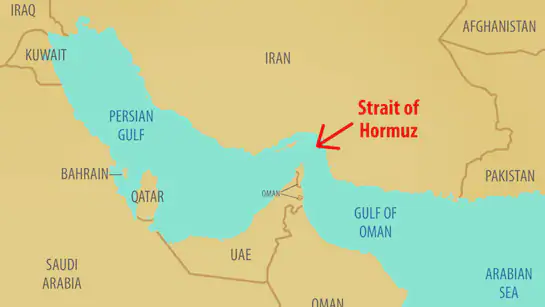
Basic Geography
- Located between Iran (North) and Oman & UAE (South)
- Connects the Persian Gulf (West) with the Gulf of Oman / Arabian Sea (East)
- Narrowest width is approximately 33 km (21 miles)
- Shipping channel is only 2 miles wide in each direction with a 2-mile buffer zone
- Governed under UNCLOS; controlled by Iran (North) and Oman (South)
Strategic Importance
- The only sea passage from the oil-rich Persian Gulf to the open ocean
- Serves as a critical global energy chokepoint
- Around 20 million barrels of crude oil and LNG thus representing ~20% of global daily consumption, pass through it every day
- Deep enough to allow transit of Very Large Crude Carriers (VLCCs)
- Shipping lanes pass through both Iranian and Omani territorial waters
- Key Countries Dependent on the Strait
- Major exporters: Iran, Iraq, Kuwait, Saudi Arabia, UAE, and Qatar
- Major importers: China, India, Japan, and South Korea
- Alternative Routes: Limited Capacity
- Saudi Arabia’s East-West Pipeline and UAE’s Fujairah Pipeline serve as alternatives
- However, they cannot collectively handle more than 15% of the volume transiting through the strait
- A closure would severely disrupt global energy supply chains and trigger price surges
- Key Nearby Ports
- Bandar Abbas: Iran
- Fujairah: UAE
Project Cheetah
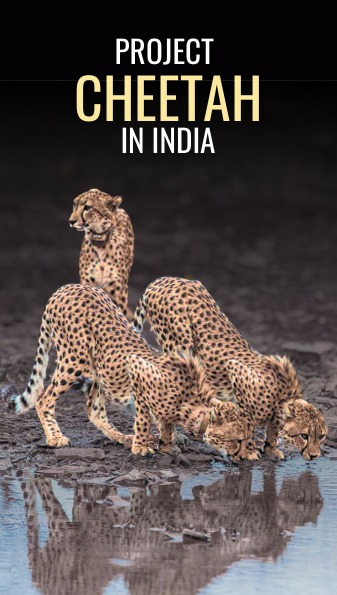
About Cheetah
- Scientific name: Acinonyx jubatus
- The fastest land animal thus relies on speed rather than strength to hunt
- A diurnal predator that hunts by sight and speed, not ambush
- Cannot roar thus communicates through chirps, purrs, growls, and hisses
- Females are solitary; males form coalitions (usually brothers)
- Gestation period: 90–95 days; gives birth to 3–5 cubs
Historical Background
- Cheetahs were once widely found across the Indian subcontinent
- Decline caused by excessive hunting, habitat loss, and decline in prey base
- Officially declared extinct in India in 1952
- Early reintroduction proposals discussed in the 1970s but did not materialise
Project Cheetah: Launch & Implementation
- Launched in 2022 after extensive scientific studies
- Implemented under the Ministry of Environment, Forest and Climate Change
- First batch of African cheetahs from Namibia released into Kuno National Park, Madhya Pradesh
- Second batch arrived from South Africa in 2023
Key Objectives
- Reintroduce cheetahs after a gap of more than 70 years
- Establish a viable, free-ranging, self-sustaining cheetah population
- Restore grassland and savannah ecosystems
- Re-establish a top predator in the food chain
- Promote eco-tourism and local livelihoods
Current Status (2025)
- Around 30 cheetahs are currently present in India, including translocated adults and India-born cubs
- Multiple litters born in Kuno thus indicating successful adaptation
- Nearly two-thirds of the current population are India-born cubs
- Kuno National Park remains the primary habitat
- Gandhi Sagar Wildlife Sanctuary has emerged as the second cheetah site
- Future target: 60–70 cheetahs across interconnected landscapes in central India
Pradhan Mantri Garib Kalyan Anna Yojana (PMGKAY)
Background
- Announced in 2020 during the COVID-19 pandemic as part of the existing Pradhan Mantri Garib Kalyan Yojana
- Initially scheduled to run from April to June 2020
- Nodal Ministry: Ministry of Finance
- Implemented by: Department of Food and Public Distribution under Ministry of Consumer Affairs, Food and Public Distribution
Key Features
- Provides food grains to the poorest citizens through the Public Distribution System (PDS)
- Covers all priority households i.e. ration card holders and those under Antyodaya Anna Yojana (AAY)
- Entitlement: 5 kg of rice or wheat per person and 1 kg of dal per family thus provided above the monthly entitlement under NFSA
- Budget: ₹2 Lakh Crores for FY 2022-23 thus making it the largest food security programme in the world
About National Food Security Act (NFSA), 2013
- Nodal Ministry: Department of Food and Public Distribution under Ministry of Consumer Affairs, Food and Public Distribution
- Coverage
- 75% of rural population and up to 50% of urban population covered under subsidised foodgrains through Targeted Public Distribution System (TPDS)
- Total coverage: 67% of India’s population
- Beneficiary Categories
- Antyodaya Anna Yojana (AAY):
- Entitled to 35 kg of foodgrains per month irrespective of family size
- Priority Households:
- Each member entitled to 5 kg of foodgrains per month
- Identification of eligible households done by States/UTs
- Antyodaya Anna Yojana (AAY):
- Support for Women and Children
- Pregnant women and lactating mothers entitled to maternity benefits of not less than ₹6,000
- Children (6–14 years), pregnant women, and lactating mothers entitled to meals under ICDS and Mid-Day Meal (MDM) schemes
- Eldest woman of the household aged 18 years or above shall be the head of household for issuing ration cards
- Other Provisions
- Central Government provides assistance to states for transportation of foodgrains, handling, and FPS dealers’ margin
- Provision for food security allowance to entitled beneficiaries in case of non-supply of foodgrains or meals
Geological Survey of India (GSI)
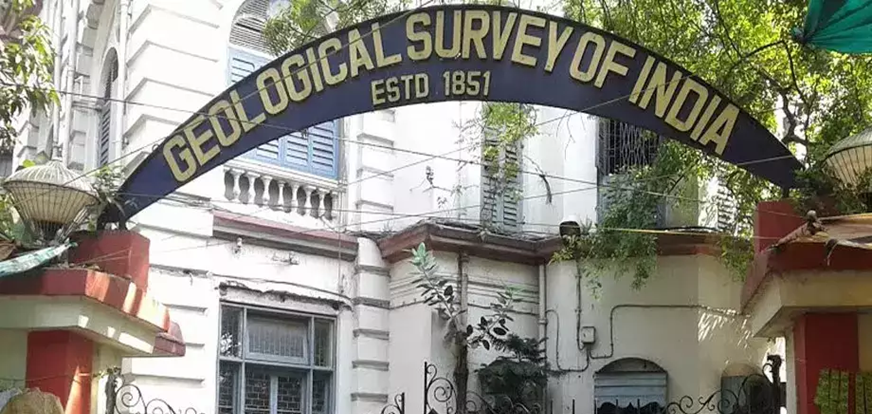
Basic Facts
- Established in 1851 by Sir Thomas Oldham
- Originally set up to find coal deposits for the Railways
- Headquarters: Kolkata
- Six Regional Offices: Lucknow, Jaipur, Nagpur, Hyderabad, Shillong, and Kolkata
- Nodal Ministry: Ministry of Mines (attached office)
Key Functions
- Provides geological expertise and geoscientific information for policy-making and socio-economic needs
- Systematic documentation of geological processes — both surface and subsurface — including offshore areas
- Conducts geological, geophysical, and geochemical surveys
- National geoscientific information creation and updation
- Mineral resource assessment
- Has played a pioneering role in geological mapping, mineral exploration, disaster studies, and geoscientific research
Self-Replicating RNA (QT45)
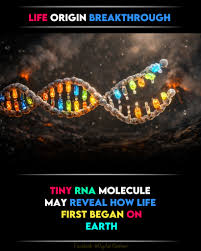
Context: Scientists discovered QT45, a small RNA molecule that can copy itself, providing the first clear evidence of a self-replicating RNA
Background
- Miller-Urey Experiment (1953): Recreated early Earth conditions in a lab and showed that amino acids (building blocks of proteins) could form naturally, but did not find DNA or RNA
- Core Problem: Life needs genetic material to store information and copy itself
- Modern cells use proteins to copy DNA/RNA, but DNA/RNA are needed to make those proteins thus creating a “chicken-and-egg” problem
- RNA’s Special Role
- In the 1980s, scientists discovered that RNA could both store genetic information AND carry out chemical reactions, acting like a basic enzyme
- This suggested that early life may have depended only on RNA, before proteins evolved known as the RNA World Hypothesis
About QT45
- Only 45 nucleotides long, making it the simplest self-replicating RNA discovered
- Copies itself using three-nucleotide building blocks
- First makes a matching copy, then use that copy to rebuild the original
- Copying is very slow and needs special conditions, it can take weeks, while modern cells do it in seconds
- Developed by selecting rare RNA sequences from large pools and improving them step by step
- Significance
- Strengthens the RNA World Hypothesis that RNA was Earth’s first genetic material. However, it does not conclusively prove it
Quick Facts
| Aspects | DNA | RNA |
| Structure | Long, stable, double-stranded | Shorter, single-stranded |
| Function | Stores and replicates genetic information — blueprint of life | Carries genetic instructions from DNA to build proteins; chemically more reactive |
