
Total Fertility Rate (TFR)
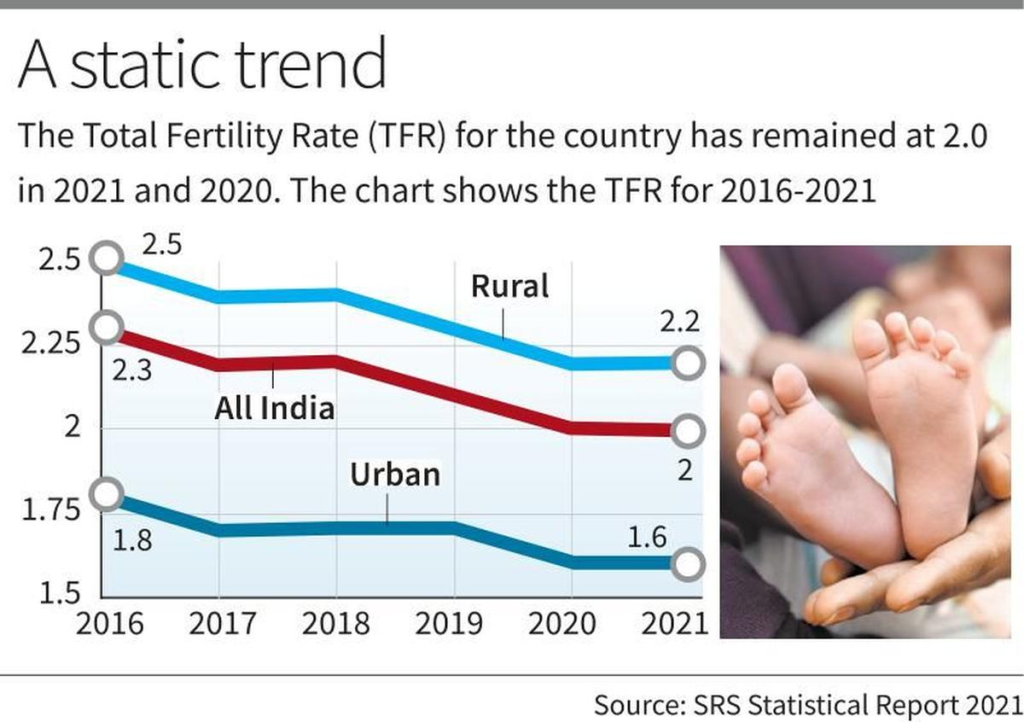
Context: Andhra Pradesh introduced the Draft Population Management Policy, aiming to raise the Total Fertility Rate (TFR) from 1.5 to an optimal 2.1, reversing the declining fertility rate.
Total Fertility Rate (TFR)
- The average number of children a group of women would have by the end of their reproductive years (ages 15–49), assuming current fertility rates and no mortality
- Expressed as children per woman
- As per NFHS-5 (2019–21): India’s TFR has declined to 2.0 children per woman from 2.2 (NFHS-4, 2015–16)
Replacement Level
- A TFR of 2.1 is considered the replacement level, where each generation replaces itself without significant population growth or decline
- A TFR below 2.1 can lead to negative population growth, causing long-term demographic challenges including an ageing population
Consequences of Low Fertility Rates
- Ageing Population
- With fewer births and longer life expectancy, India’s population is ageing rapidly
- Currently, India has 149 million people aged 60 years or above, comprising 10.5% of the total population
- By 2050, this number is expected to surge to 347 million or 20.8% of the population.
- Economic Impact
- A shrinking young workforce and growing elderly population lead to higher dependency ratios
- Strains social welfare and healthcare systems
- Rising costs of pensions and elder care burden both governments and families
- Unlike developed nations that aged with higher per capita incomes, India faces the challenge of ageing without the same economic cushion
- India risks getting caught in the middle-income trap if growth cannot be sustained
- Impact on the Labour Market
- Declining fertility reduces the size of the workforce, negatively impacting productivity and economic output
Maritime Zones
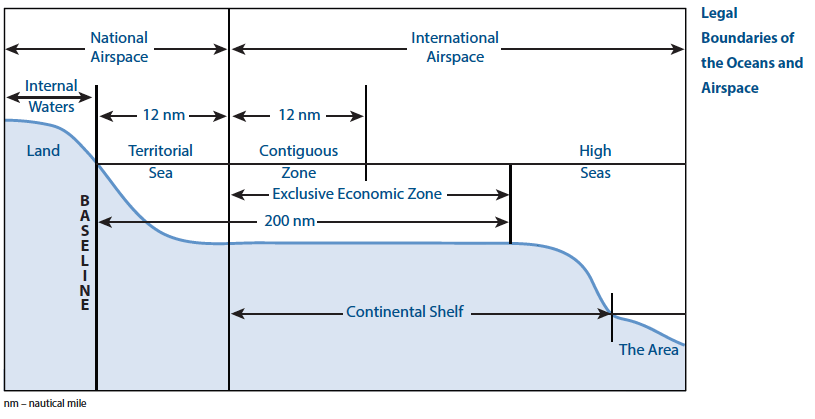
Context: Sri Lanka is evacuating 208 crew members from the Iranian naval ship IRINS Bushehr, stranded near its territorial waters.
Maritime Zones
- Baseline
- The low-water line along the coast as officially recognised by the coastal state
- All maritime zones are measured seaward from this line
- Internal Waters
- Waters on the landward side of the baseline.
- Coastal states have full sovereignty over internal waters, similar to land territory.
- Examples: bays, ports, inlets, rivers, and lakes connected to the sea.
- No right of innocent passage exists in internal waters.
- Innocent passage means passing through waters in a manner not prejudicial to peace and security and nations can suspend this right.
- Territorial Sea
- Extends up to 12 nautical miles (nm) from the baseline
- 1 nautical mile = 1.1508 land miles or 1.85 km
- Coastal states have full sovereignty and jurisdiction, including over the surface, seabed, subsoil, and airspace
- However, this sovereignty is limited by the right of innocent passage for foreign ships
- Extends up to 12 nautical miles (nm) from the baseline
- Contiguous Zone
- Extends up to 24 nm from the baseline
- An intermediary zone between the territorial sea and the high seas
- A coastal state can prevent and punish infringement of fiscal, immigration, sanitary, and customs laws
- Jurisdiction is only over the ocean surface and floor, does not extend to airspace
- Exclusive Economic Zone (EEZ)
- Extends up to 200 nm from the baseline
- Within the EEZ, coastal states have sovereign rights for:
- Exploring, exploiting, conserving, and managing natural resources — both living and non-living — of the seabed and subsoil
- Production of energy from water, currents, and wind
- The EEZ does not give the coastal state the right to prohibit freedom of navigation or overflight
- High Seas
- Ocean surface and water column beyond the EEZ
- Considered the “common heritage of all mankind” thus beyond any national jurisdiction
- All states can conduct activities here for peaceful purposes such as transit, marine science, and undersea exploration
About UNCLOS
- United Nations Convention on the Law of the Sea (UNCLOS), 1982, is also known as the Law of the Sea
- The only international convention that stipulates a framework for state jurisdiction in maritime spaces
- Provides different legal status to different maritime zones
- Serves as the backbone for offshore governance by coastal states
Pradhan Mantri Jan Arogya Yojana (PM-JAY)

About PM-JAY
- PM-JAY is a component of Ayushman Bharat.
- World’s largest government-funded health assurance scheme.
- Provides free secondary and tertiary healthcare to India’s poorest families.
- Launched: 23rd September 2018 in Ranchi, Jharkhand.
- Aim
- Provide cashless and paperless access to quality healthcare for 12 crore vulnerable families (≈55 crore people).
- Covers the bottom 40% of the Indian population.
- Prevent catastrophic medical expenditure that pushes millions into poverty annually.
- Key Features
- Coverage:
- ₹5 lakh annual health cover per family on a family floater basis.
- No limit on family size, age, or gender.
- Treatment:
- Cashless treatment across public and private empanelled hospitals nationwide.
- Covers 1,929 medical procedures, including diagnostics, surgery, implants, ICU, and medicines.
- Hospitalisation Care:
- Includes 3 days of pre-hospitalisation and 15 days of post-hospitalisation care.
- Other Features:
- Portability: Benefits can be availed at any empanelled hospital across India.
- Pre-existing diseases are covered from day one.
- Fully funded by the Government on cost shared between Centre and States.
- Coverage:
- Beneficiaries
- Based primarily on SECC-2011 data.
- Expanded to include senior citizens aged 70+ years.
Supporting Initiatives
- Ayushman Bharat Digital Mission (ABDM) – 2021
- Creates digital health infrastructure for seamless health data exchange.
- Outlay: Rs 1,600 crore for 5 years (2021-22 to 2025-26).
- Components
- ABHA Number (Unique Health ID): 14-digit unique number for each citizen; simplifies access and sharing of health records with secure, accurate data.
- ABHA Mobile App (PHR): Create ABHA address, link health records, manage consent for data sharing.
- Healthcare Professionals Registry (HPR): Digital platform connecting healthcare professionals.
- Health Facility Registry (HFR): Catalogs healthcare facilities for better coordination.
- Technology
- Leverages Aadhaar, UPI, JAM trinity for identity verification, electronic transactions, secure data storage.
- Uses AI, IoT, Blockchain, cloud computing for enhanced digital health ecosystem.
- Significance
- Paperless transactions, secure healthcare management.
- Integration with AB-PMJAY ensures seamless health service experience.
International Energy Agency (IEA)

Basic Facts
- An intergovernmental organisation working to ensure global energy security, reliable energy data, and sustainable energy policies.
- Established: 1974
- In the wake of the 1973 oil crisis (Arab oil embargo)
- Headquarters: Paris, France
- Aim: To help industrialised nations coordinate a collective response to major oil supply disruptions
- Membership Structure
- Full Members: Currently 33 countries
- Colombia was inducted as the 33rd member in February 2026
- Historically, a country must be a member of OECD to join the IEA
- Association Countries: 13 countries, including India, China, Brazil, and South Africa
- Participate in discussions but lack decision-making rights
- Full Members: Currently 33 countries
- Members must hold oil stocks equivalent to at least 90 days of net imports through the Strategic Petroleum Reserve mechanism
- Publishes the World Energy Outlook and the Monthly Oil Market Report, considered the gold standard for energy statistics
India and the IEA
- India became an Associate Member in 2017 and signed a Strategic Partnership in 2021
- In October 2023, India formally applied for full membership to have a seat in global energy decision-making
- The OECD Hurdle:
- India is not a member of OECD and has no immediate plans to join
- For India to become a full member, the IEA must amend its 1974 founding charter
- IEA leadership and major members now support this amendment, recognising India as the world’s 3rd largest energy consumer
Force Majeure
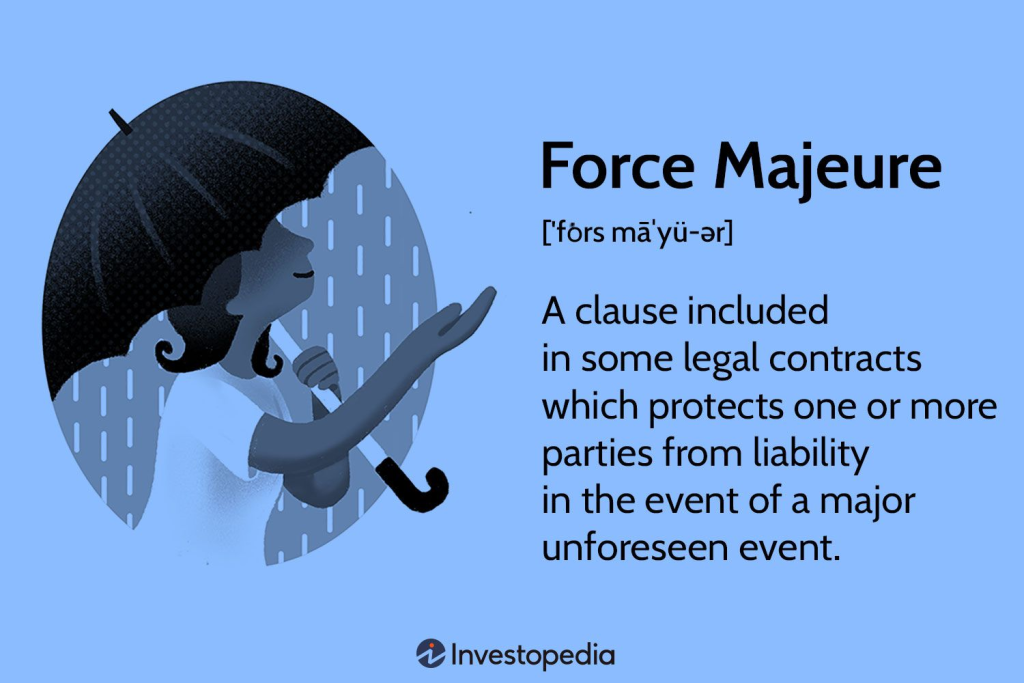
What is Force Majeure?
- A French term literally meaning “greater force”
- Refers to an extraordinary event that renders the legal obligations between contractually bound parties impossible to fulfil
- Related to the concept of an “act of God”, an event for which no party can be held accountable and which is entirely beyond the parties’ reasonable control
Key Features
- Many commercial agreements contain force majeure clauses as a precautionary measure against breach of contract.
- These clauses list major events that could result in non-performance of contractual duties
- Notable events include war, riots, criminal activity, epidemics, pandemics, and other unforeseeable circumstances.
- For force majeure to apply:
- The hindering circumstances must be beyond a party’s reasonable control
- Parties must prove their reasonable efforts to mitigate the circumstances
Consequences of Force Majeure
- Parties may delay their obligations for a period of time
- Contract terms may be revised
- Parties may agree on the contract’s cancellation
Force Majeure in Indian Law
- Force majeure has neither been defined nor specifically dealt with in Indian statutes
- However, Section 32 of the Indian Contract Act, 1872, provides that if a contract is contingent on the happening of an event which becomes impossible, then the contract becomes void.
Green Bonds

What are Green Bonds?
- According to SEBI, a green debt security is one issued with the intention of raising money for causes like sustainable development or increased energy efficiency.
- Green bonds are debt instruments similar to normal bonds, but the capital raised must be earmarked exclusively for green projects.
- Green projects typically include those linked to renewable energy, pollution reduction, and similar environmental initiatives.
Key Features
- Green bonds can be issued by both governments and private companies such as multinational corporations.
- They generally carry lower interest rates than loans provided by commercial banks.
- They are considered less risky since they are linked to the issuer rather than the successful completion of the projects.
- When issuing green bonds, issuers must provide information about the project needing green financing and the overall environmental benefits arising from it.
Green Bonds vs Normal Bonds
| Aspect | Normal Bonds | Green Bonds |
| 1. Use of funds | Any project | Green projects only |
| 2. Interest rate | Market rate | Generally lower |
| 3. Disclosure requirement | Standard | Must disclose environmental benefits |
Gravity Bombs
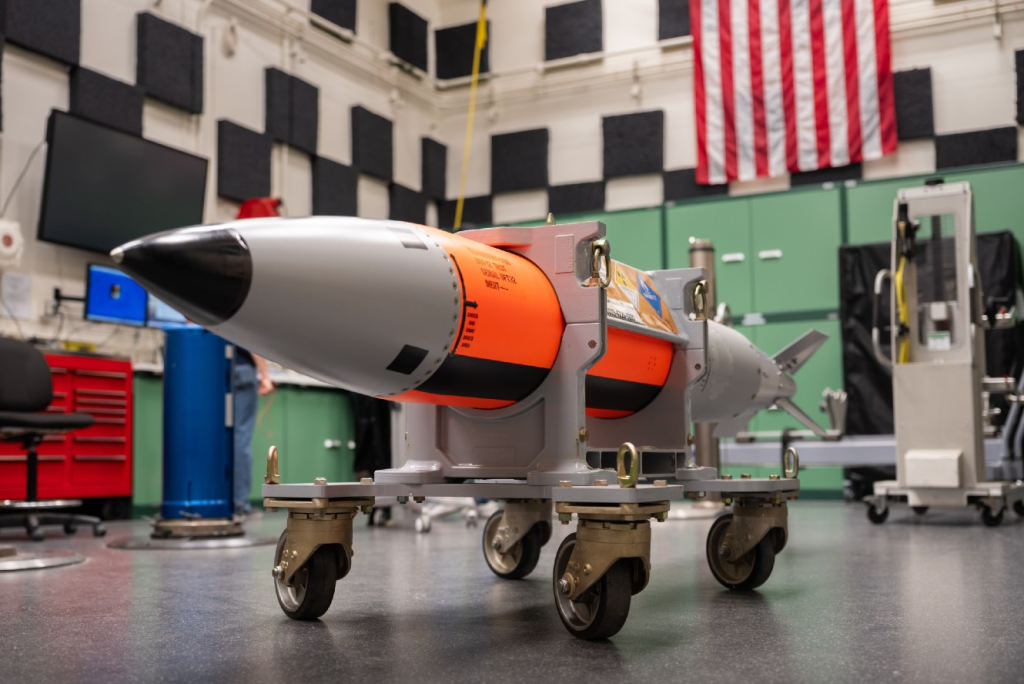
What is a Gravity Bomb?
- Historically known as a “free-fall” bomb i.e. an unpowered munition
- Unlike a cruise missile, it lacks an internal engine.
- Once released, its trajectory is dictated entirely by gravity, aerodynamics, and the speed and altitude of the dropping aircraft.
- The US has modernised these into “precision ammunition” by attaching Joint Direct Attack Munition (JDAM) kits, equipped with GPS and steerable fins to glide precisely to specific coordinates
Conventional vs Nuclear Gravity Bombs
| Aspect | Conventional | Nuclear |
| Examples | Mark 80 series (MK 82, 83, 84) | B61 and B83 series |
| Explosive | Standard chemical explosives | Nuclear yield |
| Yield Measurement | Pounds of explosive | Kilotons or megatons of TNT |
| Cost | ~$25,000–$30,000 (with JDAM) | Upwards of $20 million per unit |
| Authorisation | Theatre commanders (four-star generals) | Explicit authorisation from the US President |
| Implication | Tactical battlefield use | Signals global nuclear escalation |
