

VB-G RAM G Act, 2025

Context: The Viksit Bharat – Guarantee for Rozgar and Ajeevika Mission (Gramin) Act, 2025 proposed as a replacement for MGNREGA, 2005. The act aligns rural employment with PM Gati Shakti and Viksit Gram Panchayat Plans (VGPPs)
Key Provisions of VB-G RAM G Act
- Employment & Wages
- Statutory guarantee of 125 days as the right to demand employment is legally enforceable
- Unemployment allowance is payable after 15 days if employment is not provided
- Earlier dis-entitlement provisions removed.
- Asset Creation: (Four Priority Domains)
- Water security and conservation
- Core rural infrastructure
- Livelihood-supporting infrastructure
- Climate risk mitigation works
- All assets integrated into Viksit Bharat National Rural Infrastructure Stack
- Decentralised Planning
- Plans originate from Viksit Gram Panchayat Plans (VGPPs) approved by Gram Sabhas
- Panchayats control identification, prioritisation, and social audits
- Digital integration with PM Gati Shakti
- Centre: State Financial Contribution
- General States: 60 : 40
- North-East & Himalayan States: 90 : 10
- UTs without legislatures: 100% Central
- Administration & Technology
- Administrative expenditure ceiling raised from 6% to 9%
- Biometric authentication, geo-tagging, AI-enabled analytics, real-time dashboards
- Technology as enabler, not gatekeeper
- Social audits by Gram Sabhas strengthened
MGNREGA vs VB-G RAM G
| Feature | MGNREGA | VB-G RAM G Act |
| Guaranteed Workdays | 100 days/household/year | 125 days/household/year |
| Wage Funding | 100% Central funding for unskilled wages | 60:40 Centre-State cost sharing |
| Nature of Right | Justiciable Right as citizens can sue if work is denied; open-ended funding | Schematic Entitlement as a guarantee limited by a fixed budget cap |
| Budgeting Approach | Based on the labour budget reflecting actual demand from states | Centre determines fixed state-wise annual allocation |
| Operational Period | Continuous with no seasonal pauses | Work suspension is allowed up to 60 days during peak agricultural seasons |
| Payment Frequency | Wages paid within 15 days of work completion | Wages paid weekly |
Narcotics Control Bureau (NCB)

Basic Facts
- Nodal drug law enforcement and intelligence agency under the Ministry of Home Affairs
- Constituted on 14th November 1985 under the NDPS Act, 1985
- Headquarters: New Delhi
Key Functions
- Coordinates actions by State Governments, various offices, and other authorities under:
- NDPS Act, 1985
- Customs Act
- Drugs and Cosmetics Act
- Implements India’s obligations under international conventions and protocols against illicit drug trafficking
- Assists foreign authorities and international organisations in the prevention and suppression of illicit drug traffic
- Coordinates with concerned ministries, departments, and organisations on drug abuse matters
Enforcement Role
- Functions as an enforcement agency through its zonal offices
- Zonal offices:
- Collect and analyse seizure data of narcotic drugs and psychotropic substances
- Study trends and modus operandi
- Collect and disseminate intelligence
- Cooperate with Customs, State Police, and other law enforcement agencies
National Tiger Conservation Authority (NTCA)

About NTCA
- Statutory body under the Ministry of Environment, Forest and Climate Change (MoEFCC)
- Established in 2006 under the Wildlife Protection Act, 1972
- Provides statutory authority to Project Tiger
- Project Tiger is a Centrally Sponsored Scheme of MoEFCC for in-situ conservation of tigers in designated tiger reserves
Composition
- Chairperson: Minister in charge of MoEFCC
- Vice-Chairperson: Minister of State in MoEFCC
- Three Members of Parliament + Secretary (MoEFCC) + other members
Key Functions
- Approves the Tiger Conservation Plans prepared by State Governments
- Lays down normative standards for tourism in the core and buffer areas of tiger reserves
- Ensures tiger reserves and wildlife corridors are not diverted for ecologically unsustainable uses
- Any diversion requires approval of the National Board for Wildlife (NBWL) and advice of NTCA
- Approves and coordinates research and monitoring on tigers, prey, and habitats
- Addresses human-wildlife conflict and promotes coexistence
- Supports the capacity building of tiger reserve staff and officers
Objectives
- Fosters Centre-State accountability in Tiger Reserve management through MoUs
- Provides Parliamentary oversight of tiger conservation
- Addresses the livelihood interests of local communities around tiger reserves
Raisina Dialogue 2026

What is Raisina Dialogue?
- India’s premier multilateral conference on geopolitics and geo-economics
- Platform for world leaders, policymakers, military commanders, academics, and industry experts
- Name derived from Raisina Hill, the seat of the Government of India, New Delhi
- Comparable to the Munich Security Conference and the Shangri-La Dialogue
Basic Facts
- Launched: 2016
- Hosted by: Observer Research Foundation (ORF) in partnership with the Ministry of External Affairs (MEA)
- First edition: 1–3 March 2016
- 2026 Edition: 11th edition, held 5–7 March 2026, New Delhi
- Participants: ~2,700 from 110 countries
Raisina Dialogue 2026
- Theme: Saṁskāra- Assertion, Accommodation, Advancement
- Six Thematic Pillars:
- Contested Frontiers: Power, Polarity and Periphery
- Repairing the Commons: New Groups, New Guardians, New Avenues
- White Whale: The Pursuit of Agenda 2030
- The Eleventh Hour: Climate, Conflict and the Cost of Delay
- Tomorrowland: Towards a Tech-topia
- Trade in the Time of Tariffs: Recovery, Resilience, Reinvention
Significance
- Strengthens India’s role as a convening power in global diplomacy
- Shapes global conversations on geopolitics, geo-economics, and international cooperation
Commission on the Status of Women (CSW)

Overview
- A functional commission of the Economic and Social Council (ECOSOC)
- Established by ECOSOC resolution on 21 June 1946
- Principal global intergovernmental body dedicated to gender equality and empowerment of women
- 45 Member States serve at any one time, elected by ECOSOC on an equitable geographical distribution basis
- Members are elected for a period of four years
- CSW-70 (70th Session), recently held at UN Headquarters
Mandate
- Promotes women’s political, economic, civil, social, and educational rights
- Documents the reality of women’s lives globally
- Shapes global standards on gender equality
1996 Expansion of Mandate
- ECOSOC expanded mandate in 1996
- CSW took a leading role in monitoring the implementation of the Beijing Declaration and Platform for Action
- Also tasked with mainstreaming gender perspective in UN activities
Beijing Declaration
- Adopted by 189 countries
- Most comprehensive and transformative global agenda for gender equality
- CSW is the principal monitoring body for its implementation
Deinococcus Radiodurans

What is it?
- A bacterium best known for its extreme resistance to ionising radiation
- Known as the most radiation-resistant organism on Earth
- Nicknamed “Conan the Bacterium”
- First discovered in 1956 in canned meat treated with radiation
- Gram-positive, nonmotile, reddish-coloured bacterium
Key Features
- Withstands radiation thousands of times higher than lethal doses for humans
- Can survive extreme cold, dehydration, vacuum, and acid
- Recent finding: Can survive pressures of 14,000–24,000 Earth atmospheres — simulating being blasted off a planet’s surface
Mechanism of Resistance
- Contains simple metabolites that combine with manganese to form a powerful antioxidant
- Enzyme thioredoxin reductase helps repair broken DNA strands
- Can eliminate damaged DNA parts
- Carries extra copies of important genes
- Helps recover from desiccation (extreme dryness) and starvation
THAAD Missile System
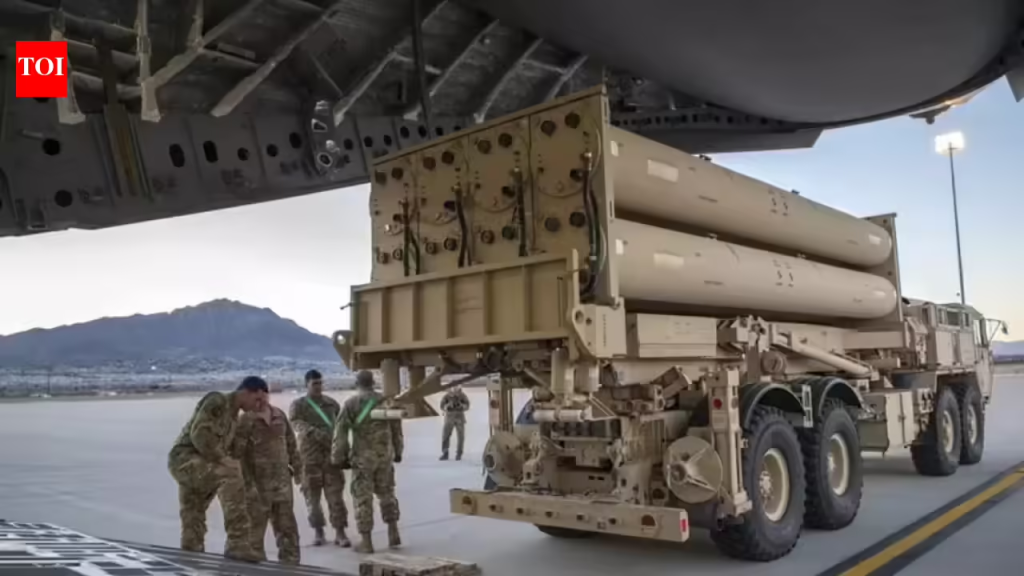
What is THAAD (Terminal High Altitude Area Defence)?
- One of the most advanced missile defence platforms developed by the United States
- A major element of the broader Ballistic Missile Defence System (BMDS)
- Recent Context: Iran destroyed a key THAAD radar system used by the US in the Middle East
- Key Features
- Designed to intercept missiles during the final stage of flight (terminal phase)
- Can destroy threats both inside and outside Earth’s atmosphere
- Defends against short, medium, and limited intermediate-range ballistic missiles
- Uses “hit-to-kill” technology, thus interceptors destroy targets through direct kinetic collision (no explosive blast)
- Engagement range: ~150–200 kilometres
- Key Components
- Interceptor missiles: kinetic impact destruction
- Truck-mounted launchers for deployment
- AN/TPY-2 radar: detects and tracks long-range missile threats
- Tactical fire control and communications unit for targeting coordination
- THAAD Battery Composition
- ~90 personnel
- 6 launchers
- 48 interceptors (each launcher carries 8 missiles)
