
Prelims
Regulation of AI-Generated Synthetic Media in India
Background and Legal Framework
- Union government amended Information Technology Rules, 2026 to regulate AI-generated content.
- Rules notified under IT (Intermediary Guidelines and Digital Media Ethics Code) framework.
- Provisions will come into force from February 20.
- Aim is to ensure transparency and accountability in digital content.
Mandatory Labelling of AI Content
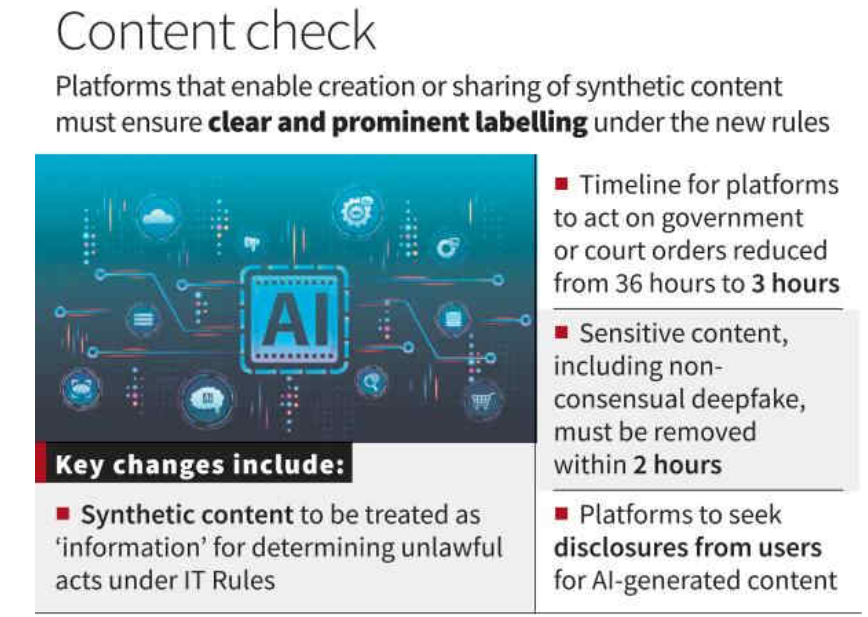
- Platforms must prominently label photorealistic AI-generated media.
- Covers audio, visual, and audio-visual synthetic content.
- Content appearing real, authentic, or indistinguishable falls under regulation.
- Definition narrowed compared to October 2025 draft rules.
- Automatic smartphone touch-ups excluded from disclosure requirement.
User Disclosure and Platform Responsibility
- Platforms must seek user disclosure for AI-generated uploads.
- In absence, intermediaries must label or remove such content.
- Non-consensual deepfakes require mandatory takedown action.
Takedown Timelines Tightened
- Earlier removal window reduced from 24–36 hours.
- Illegal content flagged by courts/government: 3-hour removal deadline.
- Deepfakes and non-consensual nudity: 2-hour takedown mandate.
Safe Harbour and Compliance
- Non-compliance may lead to loss of safe harbour protection.
- Platforms failing due diligence may face legal liability.
- Safe harbour shields intermediaries from publisher-level responsibility.
Administrative Changes
- States can now appoint multiple authorised takedown officers.
- Earlier rule limited each State to one designated officer.
Removal of Lok Sabha Speaker
Context
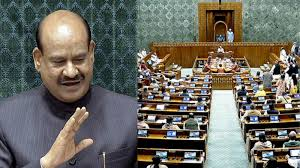
- Opposition moved a no-confidence motion against Lok Sabha Speaker Om Birla.
- Motion to be examined as per parliamentary rules and procedures.
Constitutional Basis
- Removal governed by Article 94(c) of the Constitution.
- Applies only to Lok Sabha Speaker and Deputy Speaker (not Rajya Sabha).
- Resolution must be passed by majority of all then members.
- Conditions for Vacation / Removal (Article 94) → Speaker / Deputy Speaker vacate office if:
- Ceases to be Lok Sabha member – automatic vacation.
- Resigns through written communication addressed appropriately.
- Removed by House resolution passed by effective majority.
- Notice Requirement
- Written notice submitted to Secretary-General of Lok Sabha.
- Can be jointly submitted by two or more members.
- Minimum 14 days’ prior notice mandatory before moving resolution.
- Admissibility & Listing
- Motion entered in List of Business after notice period.
- Date fixed after completion of 14 days from notice receipt.
- Support Requirement
- At least 50 members must stand in support.
- Ensures quorum and seriousness of motion.
- Governed by Rules 200–203 of Lok Sabha procedure.
- If Motion is Admitted
- Presiding officer grants leave if ≥50 members rise.
- Resolution scheduled within 10 days of admission.
- Discussion held; debate confined strictly to charges.
- Mover’s speech limited to 15 minutes.
- If Support Falls Short
- If <50 members rise, motion lapses.
- House informed that leave is not granted.
- Voting Requirement
- Passed by majority of all then members (effective majority).
- Passed by majority of all then members (effective majority).
Speaker’s Rights During Proceedings
- Can participate and speak in removal debate.
- Can vote in first instance.
- No casting vote in case of tie.
Historical Instances
- No-confidence motions moved earlier against Speakers:
- 1954 – G.V. Mavalankar.
- 1966 – Hukam Singh.
- 1987 – Balram Jakhar.
- None resulted in removal.
IPO, FPO & OFS

Context: Government to sell up to 5% stake in BHEL via OFS at ₹254 per share.
More in news:
- Base offer of 3% equity with additional 2% green shoe option in BHEL.
- Offer for Sale (OFS) part of government’s ongoing public sector disinvestment programme.
Initial Public Offering (IPO)
- IPO refers to first-time sale of company shares to the public.
- It marks the process of a company “going public”.
- Shares are listed on a recognised stock exchange.
- Investors purchase shares directly from the company.
- Purpose of IPO
- Raises funds for future expansion and growth.
- Helps repay existing borrowings or liabilities.
- Enhances company visibility and market credibility.
Follow-on Public Offer (FPO)
- FPO is the issuance of shares by an already listed company.
- Conducted after completion of IPO process.
- Types of FPO
- Dilutive FPO
- Company issues fresh shares to investors.
- Increases total number of outstanding shares.
- Used to raise funds for expansion or debt repayment.
- Non-Dilutive FPO
- Existing shareholders sell their holdings.
- No new shares are created.
- Company does not receive funds directly.
- Dilutive FPO
Offer for Sale (OFS)
- Mechanism where existing shares are sold to public.
- Only promoters or large shareholders participate.
- Eligibility
- Shareholders holding more than 10% stake can offer shares.
- Key Features
- No fresh shares are issued.
- Entire sale involves already existing shares.
- Retail bids backed by 100% cash margins.
Key Differences: IPO vs FPO vs OFS
- IPO
- Unlisted company enters stock market.
- Issues new shares to raise capital.
- Lengthy process with regulatory approvals.
- Retail quota around 35%.
- FPO
- Listed company raises additional capital.
- May issue new shares or sell existing ones.
- Used for expansion or debt reduction.
- OFS
- Only existing shareholders sell stake.
- No capital raised by the company.
- Completed in single trading day.
- Exchange notified two working days prior.
- 25% shares reserved for mutual funds and insurers.
Moon’s Mons Mouton

Context
- ISRO’s Space Applications Centre identified a safe landing site near Mons Mouton.
- It is shortlisted for Chandrayaan-4 lunar sample return mission.
What is Mons Mouton?
- Mons Mouton is a flat-topped lunar mountain massif near the Moon’s south pole.
- Officially named by the International Astronomical Union (IAU).
Location
- Situated in the south polar region of the Moon.
- Lies near the rim of the South Pole–Aitken (SPA) Basin.
- Located roughly 160 km from the lunar south pole.
- SPA Basin is among the largest and oldest impact basins in the Solar System.
Origin
- Formed through rim uplift of the South Pole–Aitken Basin.
- Resulted from ancient massive asteroid impacts.
- Represents exposed deep lunar crust layers.
Key Physical Features
- Width spans nearly 100 km.
- Elevation rises about 6,000 metres above surrounding terrain.
- Terrain marked by rugged relief and steep gradients.
- Contains impact craters and extensive boulder fields.
- Exhibits unique illumination contrasts due to polar location.
Illumination Characteristics
- Some zones receive near-continuous sunlight.
- Others remain in permanent shadow.
- Visible during favourable libration phases via amateur telescopes.
Scientific & Strategic Significance
- For Chandrayaan-4
- Identified as a potential landing region.
- Offers manageable slopes for safe touchdown.
- Shows low boulder density.
- Provides adequate sunlight for mission operations.
- For Lunar Science
- Helps study early Moon formation processes.
- Offers evidence of ancient impact history.
- For Future Exploration
- Lies within zones of interest for Artemis and global missions.
- Close to permanently shadowed regions.
- Raises prospects of studying lunar volatiles like water ice.
Kyasanur Forest Disease (KFD)
Context
- India initiated Phase-I human clinical trials of an indigenous KFD vaccine.
- Developed under ICMR-led collaborative research framework.
What is Kyasanur Forest Disease (KFD)?
- KFD is a tick-borne viral haemorrhagic fever affecting humans.
- First detected in Kyasanur Forest, Karnataka.
- Causes high fever, weakness, and potential fatal complications.
Geographical Distribution
- Endemic to the Western Ghats region of India.
- Reported from:
- Karnataka
- Tamil Nadu
- Kerala
- Goa
- Maharashtra
Vector & Transmission
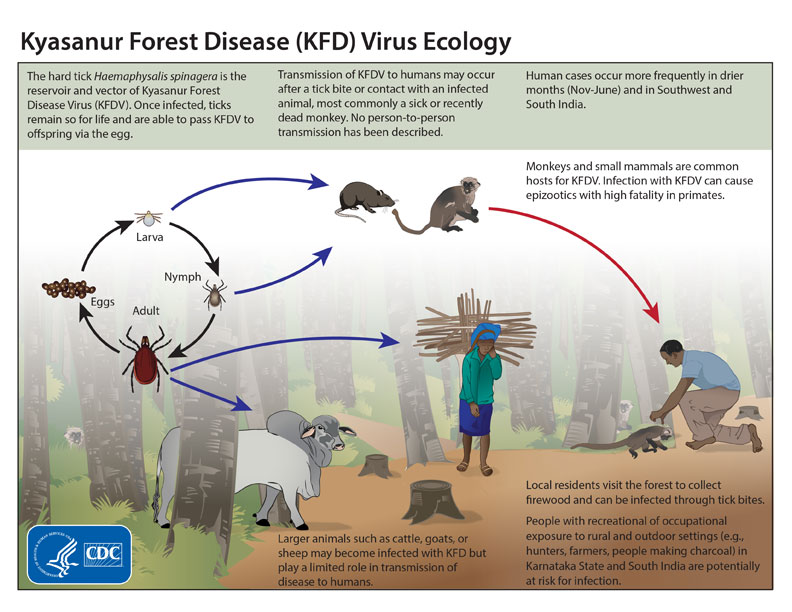
- Primary vector: Hard ticks (Hemaphysalis spinigera).
- Spread through infected tick bites.
- Secondary route: Contact with infected animals, especially monkeys.
- No human-to-human transmission reported.
Incubation Period
- Typically ranges between 3–8 days after infection.
Clinical Symptoms
- Initial Phase
- Sudden onset of high fever and chills.
- Severe headache and muscle pain.
- Vomiting and gastrointestinal disturbances.
- Advanced / Complicated Phase
- Bleeding manifestations in some patients.
- About 10–20% cases develop second phase.
- Neurological complications include:
- Tremors
- Mental disturbances
Treatment & Management
- No specific antiviral treatment available currently.
- Care is largely supportive and symptomatic.
Supportive Management Includes
- Fluid therapy.
- Oxygen support.
- Blood pressure stabilisation.
- Management of secondary infections.
India–Malaysia IMPACT Framework
Context
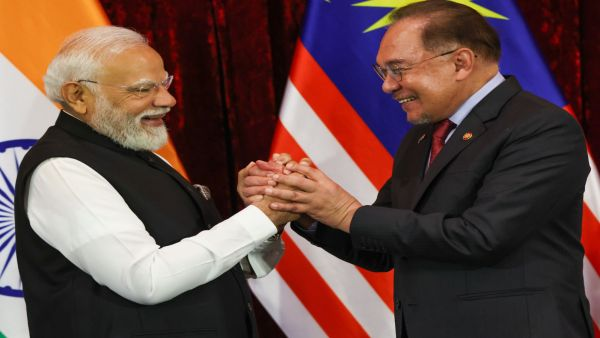
- India’s Prime Minister articulated the IMPACT framework during Malaysia visit.
- Announced while addressing the Indian diaspora in Kuala Lumpur.
What is IMPACT Framework?
- IMPACT = India–Malaysia Partnership for Advancing Collective Transformation.
- A strategic vision to deepen bilateral cooperation.
- Focuses on economic, digital, cultural, and people-centric engagement.
Aim
- Accelerate pace and scale of India–Malaysia cooperation.
- Deliver tangible developmental benefits to citizens.
- Position ties as a driver of Asia’s collective growth.
Key Features
- Economic & Technology Cooperation
- Over 100 Indian IT companies operate in Malaysia.
- Generates employment and strengthens digital ecosystems.
- Expands technology-led bilateral economic engagement.
- Digital Connectivity
- Launch of UPI digital payment system in Malaysia.
- Supported by Malaysia–India Digital Council collaboration.
- Enhances fintech integration and cross-border payments.
- People-to-People & Diaspora Linkages
- Indian-origin community is second-largest diaspora globally in Malaysia.
- OCI eligibility extended up to sixth generation.
- Scholarships and academic collaborations promoted.
- Cultural institutions include Thiruvalluvar Chair/Centre.
- Cultural & Civilisational Bonds
- Deep Indian Ocean maritime heritage linkages.
- Shared linguistic traditions — Tamil and Malay.
- Historical connections include INA legacy.
- Strategic & Regional Outlook
- Partnership aligned with ASEAN centrality.
- Supports Indo-Pacific stability vision.
- Promotes inclusive and sustainable regional growth.
Network Readiness Index (NRI) 2025
Context
- India improved to 45th rank in NRI 2025 (4-place jump).
- Overall score increased to 54.43/100.
- Reflects stronger digital and network preparedness.
What is Network Readiness Index (NRI)?
- A global index assessing countries’ use of ICTs (Information & Communication Technologies).
- Evaluates ICT role in economic growth, innovation, governance and social development.
- Published by: Prepared by Portulans Institute, Washington DC-based non-profit research organisation.
- Aim
- Measure national readiness to leverage digital networks and technologies.
- Assess ICT contribution to inclusive growth and governance efficiency.
Key Features
- Covers 127 economies globally.
- Based on 4 core pillars:
- Technology: Assesses digital infrastructure, accessibility and emerging technologies readiness.
- People: Measures digital skills, inclusion and workforce preparedness.
- Governance: Evaluates regulation, cybersecurity, trust and policy ecosystem.
- Impact: Tracks economic, social and environmental digital outcomes.
Indicators Used
- Built on 53 indicators.
- Includes broadband penetration, AI research output, digital trade, ICT laws, market scale.
Comparative Utility
- Enables income-level performance comparison.
- Identifies over-performing and under-performing economies.
India’s Performance in NRI 2025
- Rank: 45th globally.
- Score improved from 53.63 (2024) → 54.43 (2025).
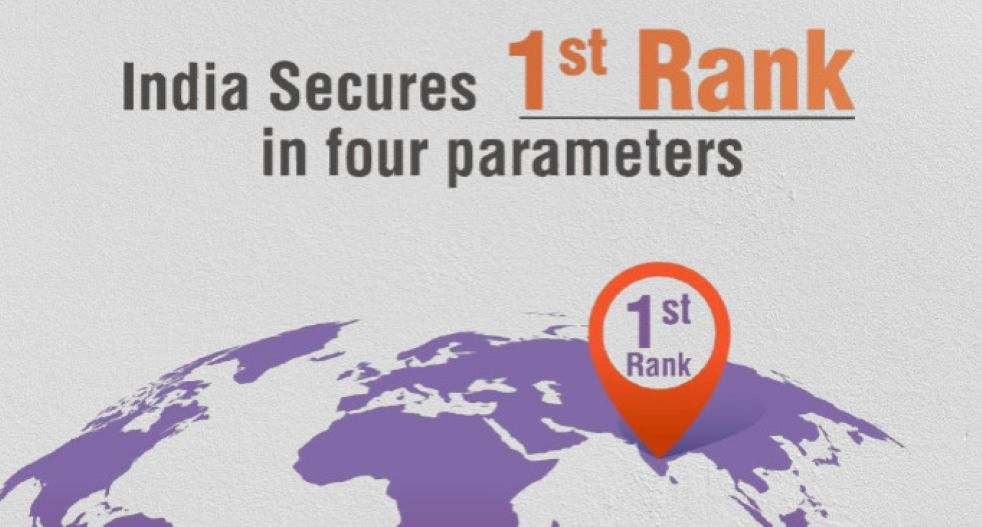
- Global Leadership Areas
- 1st rank in:
- Annual telecom investment.
- AI scientific publications.
- ICT services exports.
- E-commerce legislation.
- 1st rank in:
- 2nd rank in:
- FTTH (Fibre-to-the-Home) / building internet subscriptions.
- Mobile broadband traffic.
- International internet bandwidth.
- 3rd rank in domestic market scale.
- Reflects vast digitally active consumer base.
- Ranked 2nd among lower-middle-income countries.
ECI Form 7
Context
- Form 7 became controversial during Special Intensive Revision (SIR) of electoral rolls.
- Allegations of bulk and fraudulent deletion requests targeting eligible voters.
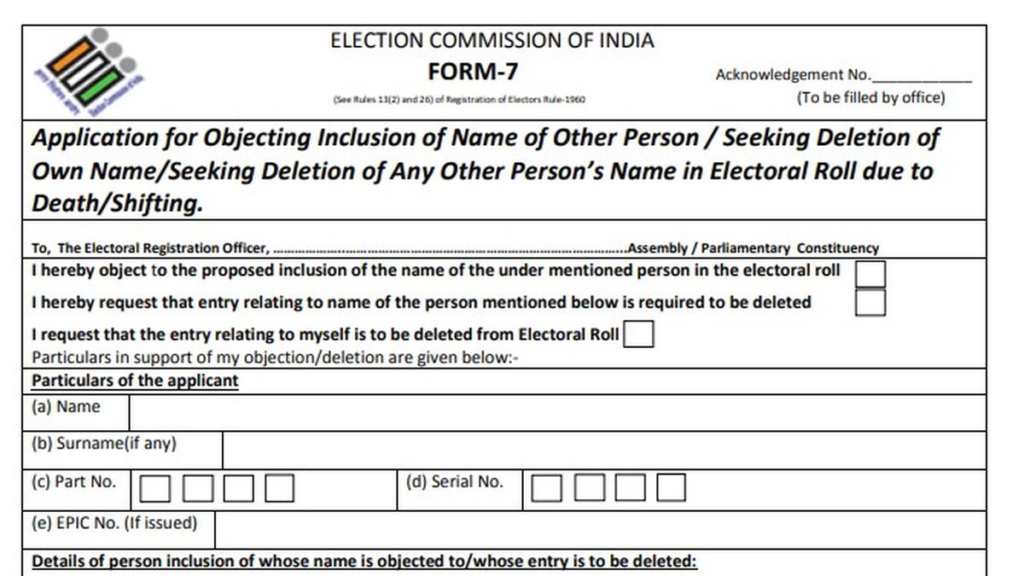
What is Form 7?
- Statutory form used to object inclusion of names in electoral rolls.
- Objections can be filed for self or another voter.
Legal Basis
- Governed by Election Commission of India (ECI).
- Prescribed under Registration of Electors Rules, 1960.
- Rules framed under Representation of the People Act, 1950.
- As per Section 13(2), only registered electors can file objections.
- Booth Level Agents (BLAs) are also authorised to submit Form 7.
Aim
- Ensure accuracy and integrity of electoral rolls.
- Remove duplicate, deceased, shifted, or ineligible voters.
- Prevent electoral fraud and ensure free and fair elections.
How Form 7 Works? (Procedure)
- Any registered elector of the constituency can file Form 7.
- Objection may target another voter or request self-deletion.
- Booth Level Officer (BLO) conducts field verification.
- Multiple visits may be undertaken for confirmation.
- Concerned voter receives notice from Electoral Registration Officer (ERO).
- Hearing opportunity is provided before final decision.
- Appeal lies with District Magistrate within 15 days.
Key Features
- Expanded scope (2022 amendment):
- Any voter in constituency can object, not just same booth.
- Mandatory verification:
- Required when more than five objections filed by one applicant.
- Grounds for deletion:
- Death.
- Shifted/absent residence.
- Duplicate entry.
- Underage voter.
- Non-citizenship.
- Due process safeguards:
- Physical verification, notices, hearings, appeal mechanism.
- Legal deterrence:
- False declaration punishable under Section 32, RP Act 1950.
- Penalty: Up to 1 year imprisonment / fine / both.
Kimberley Process (KP)

Context
- India selected as Chairperson of Kimberley Process from 1 January 2026.
- Marks the third time India will lead this global initiative.
What is Kimberley Process?
- Kimberley Process (KP) is a tripartite international initiative.
- Involves governments, diamond industry, and civil society.
- Seeks to prevent trade in conflict diamonds.
Establishment
- Established in 2003.
- Operationalised through Kimberley Process Certification Scheme (KPCS).
- Created pursuant to UN Security Council resolutions.
Aim
- Eliminate conflict diamonds from global supply chains.
- Prevent diamonds funding armed rebellions against legitimate governments.
Key Functions
- Certification Mechanism (KPCS)
- All rough diamond exports must carry valid KP certificate.
- Confirms diamonds are conflict-free in origin.
- Regulatory Enforcement
- Member states enact domestic laws.
- Control import and export of rough diamonds.
- Selective Trading System
- Trade allowed only among KP-compliant participants.
- Restricts entry of illicit and uncertified diamonds.
- Transparency & Data Exchange
- Members share statistical trade data regularly.
- Helps monitor flows and detect irregularities.
- Monitoring & Review Mechanism
- Peer review processes evaluate compliance.
- Working groups identify gaps and enforcement challenges.
Significance
- Covers 60 participants (European Union counted as one).
- Represents over 99% of global rough diamond trade.
- Reduced conflict diamond trade to negligible levels globally.
- Enhances ethical sourcing and consumer confidence.
- Strengthens credibility of the global diamond value chain.
