

PRELIMS
Global Plastics Treaty Negotiations
Why in News: Around 180 countries are negotiating a global plastics treaty to address plastic pollution.Talks are halfway through the final negotiation round, with little consensus achieved. The negotiation deadline is August 14.

Main Issues:
- Countries disagree on whether to include limits on plastic production or focus only on plastic pollution.
- Some countries insist on the principle of one vote per country with no voting mechanisms to override objections.
- Others argue voting is needed to progress consensus.
India’s Position:
- India supports limiting talks to plastic pollution only, opposing restrictions on plastic polymer production (Article 6).
- Warns that production limits affect the right to development of member states.
- Supports countries like Kuwait, Saudi Arabia, Iran, Russia, China, Bahrain in opposing production caps.
Negotiation Challenges:
- Draft treaty has 32 Articles, all lines must be agreed upon unanimously.
- Number of unresolved comments (‘brackets’) increased from 300 to 1500 recently.
- Most divisive issues relate to plastic supply/production controls.
- Article 6 (production limits) has not even been fully discussed yet.
Expert Opinion:
- Without curbing production and chemical use, plastic pollution will continue to proliferate.
Global Plastic Treaty – Key Points
What is it?
- An international initiative launched under the United Nations Environment Assembly (UNEA) in 2022 to tackle plastic pollution globally.
Objective:
- To create a legally binding treaty managing the entire lifecycle of plastics — from production to disposal.
Key Focus Areas:
- Reduce plastic production to limit new plastic supply.
- Promote recycling and reuse to reduce plastic waste.
- Manage hazardous chemicals associated with plastics.
- Eliminate harmful practices like open dumping and burning of plastic waste.
Stakeholders Involved:
- Member states, environmental organisations, and industry players participating in negotiations.
Expected Outcome:
- A global framework setting standards and policies for sustainable plastic management to mitigate environmental impacts.
Great Barrier Reef (GBR) Coral Decline
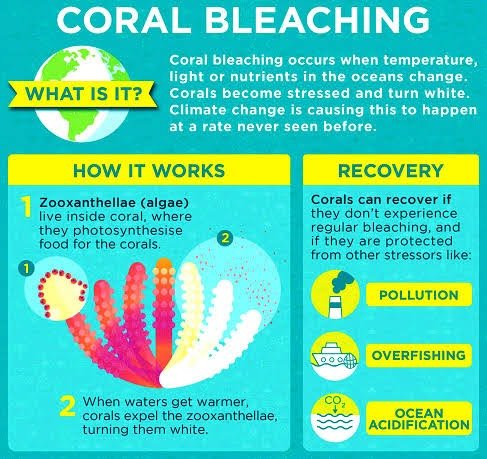
Why in News: GBR has faced its steepest coral cover decline in nearly 40 years (2024 bleaching event). Decline driven by climate change heat stress, cyclones, and crown-of-thorns starfish outbreaks.
Survey Findings (2024-2025):
- Surveyed 124 reefs across northern, central, and southern GBR.
- 48% reefs showed coral decline, 42% stable, 10% improved.
- Most intense bleaching in northern and central regions, some reefs with up to 60% bleaching.
Regional Declines:
- Northern GBR: Largest annual coral loss since 1986; decline by 24.8%; Lizard Island severely impacted.
- Central GBR: Decline of 13.9%; some reefs stable or slight recovery.
- Southern GBR: Sharpest relative loss of 30.6% due to extreme heat in Capricorn-Bunker sector.
Crown-of-Thorns Starfish Impact:
- Outbreaks damage reefs by eating stressed corals, especially in Swains sector.
- Starfish hinder coral recovery and reef resilience.
Acropora Corals:
- Fast-growing corals critical for recovery from 2017-2024.
- Severely affected by 2024 bleaching, cyclones, and starfish predation.
- Loss reduces reef’s ability to rebuild quickly.
Increasing Bleaching Frequency:
- GBR suffered mass bleaching in 2020, 2022, 2024, and 2025.
- Before 1990, bleaching was rare.
- Globally, 83% of coral reefs experienced bleaching-level heat stress (2023-2025).
Long-Term Monitoring:
- Coral cover shows extreme fluctuations over past 15 years.
- Indicates ecosystem under severe stress and vulnerability.
- Calls for urgent climate action to reduce heat stress and protect marine biodiversity
Corals and Coral Reefs – Key Points
What are Corals?
- Small (0.25–12 inches), soft-bodied marine invertebrates belonging to the Cnidaria group.
- Sessile animals, permanently attached to the ocean floor.
- Individual coral called a polyp, lives in colonies of hundreds to thousands of genetically identical polyps.
- Use tiny tentacles to catch food and bring it to their mouth.
Mutualistic Relationship with Algae:
- Coral polyps host microscopic algae called zooxanthellae inside their tissues.
- Corals provide compounds needed for photosynthesis.
- Zooxanthellae supply corals with carbohydrates for building calcium carbonate skeletons.
- Zooxanthellae give corals their unique colours.
Types of Corals:
Hard Corals (Hermatypic):
- Also called reef-building corals.
- Extract calcium carbonate from seawater to form hard, white skeletons.
Soft Corals:
- Resemble plants, attach to hard skeletons built by ancestors.
- Add own skeletons over time to form large structures.
- Together with hard corals, form the largest living structures on Earth.
Coral Reefs in India:
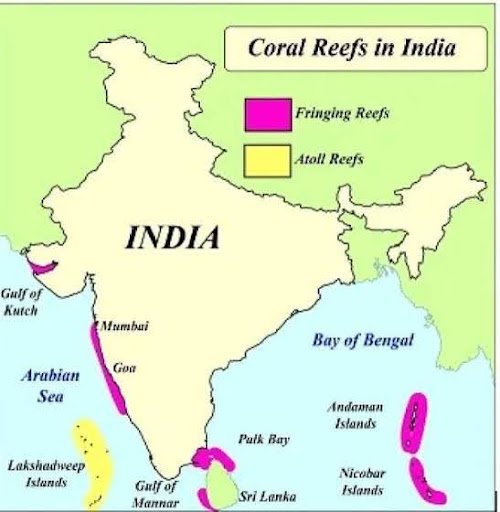
Found in seven regions: Goa coast, Kerala coast, Palk Bay, Gulf of Kutch, Gulf of Mannar, Lakshadweep islands and Andaman and Nicobar islands.
Multi-fungal Tolerant Pineapple

Why in News: Scientists from Bose Institute have discovered a gene AcSERK3 in pineapple that boosts its natural defence against the harmful fungus Fusarium moniliforme.
Who: Scientists from Bose Institute (an autonomous DST institute under Ministry of Science and Technology).
What: Identification of a gene called AcSERK3 in pineapple that helps defend against fungal attacks.
Pineapple Basics:
Scientific name: Ananas comosus L. Merr.
- Most economically significant fruit of the Bromeliaceae family.
- Provides nutritional benefits along with juicy flavour.
Threat:
- Pineapple farming threatened by Fusariosis infection caused by fungus Fusarium moniliforme.
Symptoms: Warping stems, blackened leaves, internal fruit rot.
Gene Function:
- AcSERK3 gene triggers pineapple’s self-defence mechanism.
- Part of Somatic Embryogenesis Receptor Kinase (SERK) family, involved in plant reproduction and stress survival.
- Somatic embryogenesis: Formation of embryos from somatic (body) cells.
Research Outcome:
- Overexpressing AcSERK3 gene enhances natural defence against Fusarium fungus.
- Result: Pineapple plants more resilient due to increased stress metabolites and scavenging enzyme activity.
Significance:
- Potential for developing fungal-resistant pineapple varieties, improving crop yield and sustainability.
Sarnath – UNESCO World Heritage Nomination
Why in News: India has officially nominated Ancient Buddhist Site, Sarnath for inscription in the UNESCO World Heritage List (2025–26 cycle). Sarnath has been on UNESCO’s tentative list since 1998.
Location:
- Near Varanasi, Uttar Pradesh.
- Site where Gautama Buddha delivered his first sermon (Dhammachakkappavattana).
Historical & Religious Significance:
- Also known as Rishipatana, Mrigadava, Mrigadaya.
- One of Buddhism’s four key pilgrimage sites: Lumbini (birth), Bodh Gaya (enlightenment), Sarnath (first sermon), Kushinagar (death).
- Buddha’s ashes enshrined in stupas at these sites.
Architecture & Monuments:
- Reflects styles from Mauryan to Kushan, Gupta, and Gahadavala periods.
Divided into two main groups:
Group A:
- Chaukhandi Stupa (16th century Mughal tower commemorating Humayun’s visit).
Group B:
- Dhamek Stupa (~500 CE) marking Buddha’s first sermon spot.
- Dharmarajika Stupa (3rd century BCE, built by Ashoka).
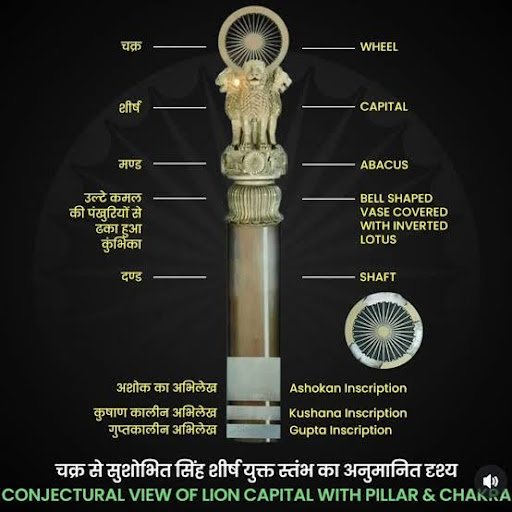
- Ashokan Pillar with Lion Capital (India’s National Emblem).
- Ancient monasteries, temples, and votive stupas (3rd century BCE – 12th century CE).
Historical Events:
- Promoted by Emperor Ashoka after Kalinga War.
- Flourished under Kushans, Guptas, Harshavardhana.
- Damaged during Mahmud of Ghazni’s raid (11th century), restored by Pala dynasty.
- Dharmachakra Jina Vihara built in 11th century by Kumaradevi.
Excavations & Museum:
- First excavated by Sir Alexander Cunningham (1834-36).
- Ashokan Lion Capital excavated by F.O. Oertel (1904-05).
- Lion Capital adopted as India’s State Emblem (1950).
- Sarnath Archaeological Museum houses key artefacts.
- Mulagandha Kuti Vihar has frescoes depicting Buddha’s life.
UNESCO World Heritage Sites – Basics:
- Sites of exceptional cultural or natural significance under World Heritage Convention, 1972.
- India ratified in 1977; currently has 40+ World Heritage Sites and 62 on tentative list.
- ASI is India’s nodal agency for World Heritage.
Nomination & Evaluation Process:
- Site must be on Tentative List first.
- Detailed nomination dossier reviewed by UNESCO World Heritage Centre.
Evaluated by advisory bodies:
- ICOMOS (cultural sites),
- IUCN (natural sites),
- ICCROM (conservation expertise).
- Final decision by World Heritage Committee (meets annually).
- India is a member of this Committee (2021–25).
Criteria:
- Must demonstrate Outstanding Universal Value (OUV).
- Meet at least one of the 10 criteria (merged cultural and natural criteria).
Quantum Magnetic Navigation System (QMNS) –
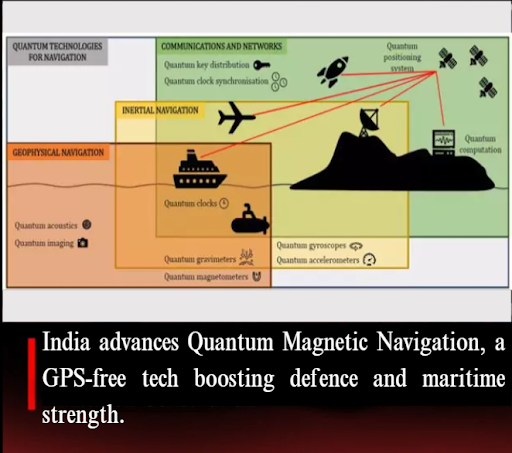
Why in News: India is developing Quantum Magnetic Navigation System to provide accurate, satellite-independent navigation for defence and strategic uses.
Context:
- Modern warfare relies on satellite navigation (GPS, Glonass, Galileo, BeiDou) for jets, missiles, and drones.
- Satellite signals vulnerable to jamming, spoofing, meaconing, and natural disruptions like solar flares.
Challenges in Satellite Navigation:
- Electronic warfare disrupts signals, especially in conflict zones (Ukraine, West Asia, South Asia).
- Alternatives like Inertial Navigation Systems (INS), terrain matching, and image guidance have limitations (drift, visibility, map dependency).
Principles of QMNS:
- Uses quantum sensors to detect tiny changes in Earth’s magnetic field.
- Measures magnetic variations with ultra-sensitive quantum magnetometers using atomic quantum properties.
- Matches local magnetic readings with magnetic anomaly maps to determine precise location without satellites.
- Combined with inertial navigation for accurate positioning in GPS-denied environments.
Applications:
- Defence: navigation for submarines, unmanned underwater vehicles (UUVs), drones in satellite-denied zones.
- Civilian: undersea mining, oil exploration, subsea cable inspection, maritime security, and autonomous operations.
Global Development:
- Research began in 1990s; military interest surged in 2010s.
- US DARPA plans deployment after 2027; China operational on submarines since 2018.
- UK and Germany developing quantum sensors for next-gen military platforms.
India’s Progress:
- Under the National Quantum Mission (₹6,000 crore) focusing on quantum sensing and navigation.
- DRDO developing atomic clocks and magnetometers; IIT Bombay working on portable quantum sensors for drones.
- Startups like QuBeats building quantum positioning systems for Indian Navy.
- Enhances India’s electronic warfare resilience and underwater domain awareness in Indian Ocean Region.
- Supports Blue Economy through deep-sea exploration and infrastructure.
