
New Consumer Price Index (CPI) Series
Context
- Ministry of Statistics and Programme Implementation released new CPI series. The base year revised to 2024 from earlier 2012.
- The retail inflation (January 2026) recorded at 2.75%. It is the first data release under revised CPI framework.
| About Consumer Price Index (CPI)CPI measures retail price changes in commonly consumed goods and services.It is India’s headline inflation indicator.Used for monetary policy decisions and inflation targeting. |
Why CPI Revision Was Needed
- Indian economy witnessed structural transformation in last decade.
- Consumption patterns, income levels and spending behaviour evolved.
- Rise in services, housing and digital consumption observed.
- CPI basket updated using Household Consumption Expenditure Survey (HCES) 2023–24.
Expansion of CPI Basket & Coverage
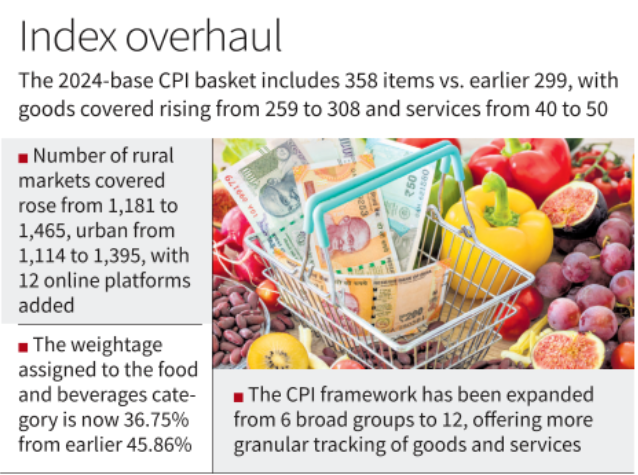
- Total items increased to 358 from earlier 299.
- Goods expanded to 308 (earlier 259).
- Services increased to 50 (earlier 40).
- Education, health, transport etc. now standalone categories.
- Enables deeper, more realistic inflation measurement.
Wider Data Collection Network
- Rural markets covered: 1,465 (earlier 1,181).
- Urban markets covered: 1,395 (earlier 1,114).
- 12 online marketplaces newly added.
- Reflects growing role of e-commerce and digital retail.
Major Weight Revisions
- Food & Beverages
- Weight reduced to 36.75% (from 45.86%).
- Reflects declining food share with rising incomes.
- Expected to reduce headline inflation volatility.
- Housing & Utilities
- Weight increased to 17.67% (from 10.07%).
- Now includes water, electricity, gas and fuels.
- Driven by higher rent and utility expenditure.
Ayushman Sahakar Scheme
About the Scheme
- Ayushman Sahakar is a healthcare financing scheme for cooperative societies.
- Launched in 2020.
- Implemented by: National Cooperative Development Corporation (NCDC) under Ministry of Cooperation.
- Supports creation and expansion of healthcare infrastructure.
Aim
- Promote affordable healthcare through cooperative institutions.
- Strengthen community-based health services.
- Expand participation of AYUSH systems in healthcare delivery.
Key Features
- Eligible: Registered cooperative societies with healthcare in bye-laws.
- Financial assistance provided as term loans for health infrastructure.
- Covers hospitals, clinics, diagnostic centres and AYUSH facilities.
- Loan tenure up to 8 years with moratorium provision.
- Funding support may extend up to 90% of project cost.
Petroleum and Natural Gas Regulatory Board (PNGRB)
About PNGRB
- Established under Petroleum and Natural Gas Regulatory Board Act, 2006.
- Headquarters located in New Delhi.
- Regulates downstream petroleum and natural gas sector in India.
Aim
- Protect consumer interests in petroleum and gas markets.
- Promote fair trade and competition among sector entities.
- Ensure adequate and uninterrupted fuel supply nationwide.
Key Functions
- Authorisation role: Approves entities to build pipelines, LNG terminals, CGD networks.
- Tariff regulation: Fixes transportation tariffs for common and contract carriers.
- Market regulation: Prevents restrictive trade practices and ensures competition.
- Technical oversight: Prescribes standards and safety norms for infrastructure.
- Data governance: Maintains sectoral database and monitors infrastructure expansion.
Idukki Hydroelectric Project
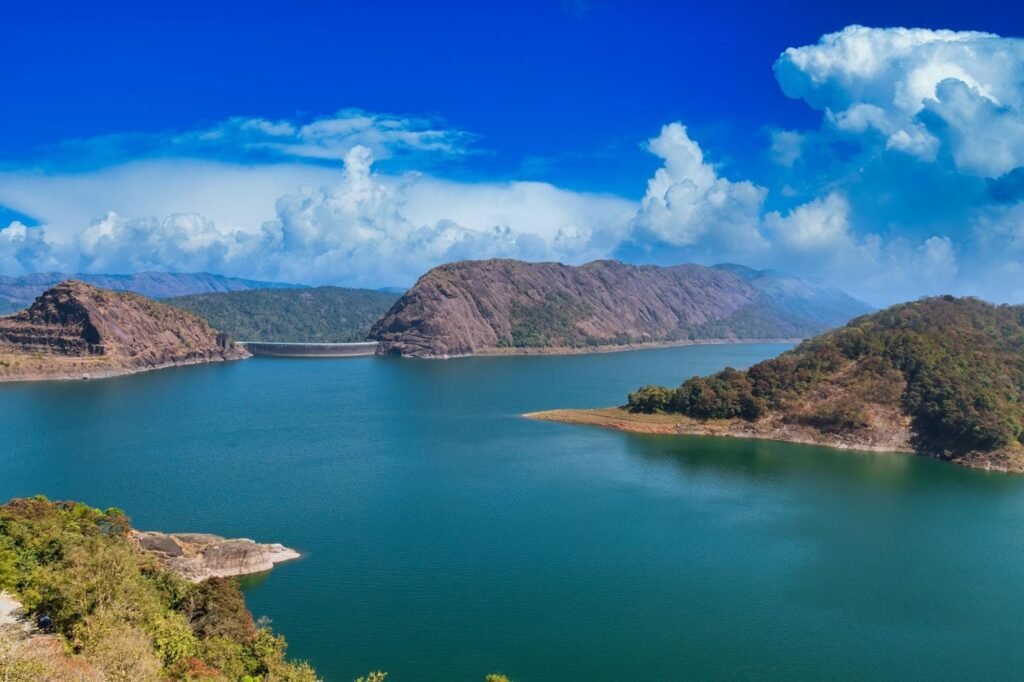
Context: Kerala’s largest hydropower project, the Idukki Hydroelectric Project, recently completed 50 years of operation.
Key Features
- The project is built across the Periyar River in Idukki district of Kerala.
- It is the largest hydroelectric project in the State.
- The powerhouse is located at Moolamattom. It is the longest underground power station in India.
- The total installed capacity of the project is 780 MW. Power generation is carried out through six units of 130 MW each.
- The project comprises three dams.
- These are the Idukki Arch Dam, Cheruthoni Dam, and Kulamavu Dam.
- The Idukki Arch Dam is among the highest arch dams in the world.
- It is also the third highest dam in India.
- It is Asia’s first double-curvature arch dam.
- It stands between the hills of Kuravanmala and Kurathimala.
Mud Volcano
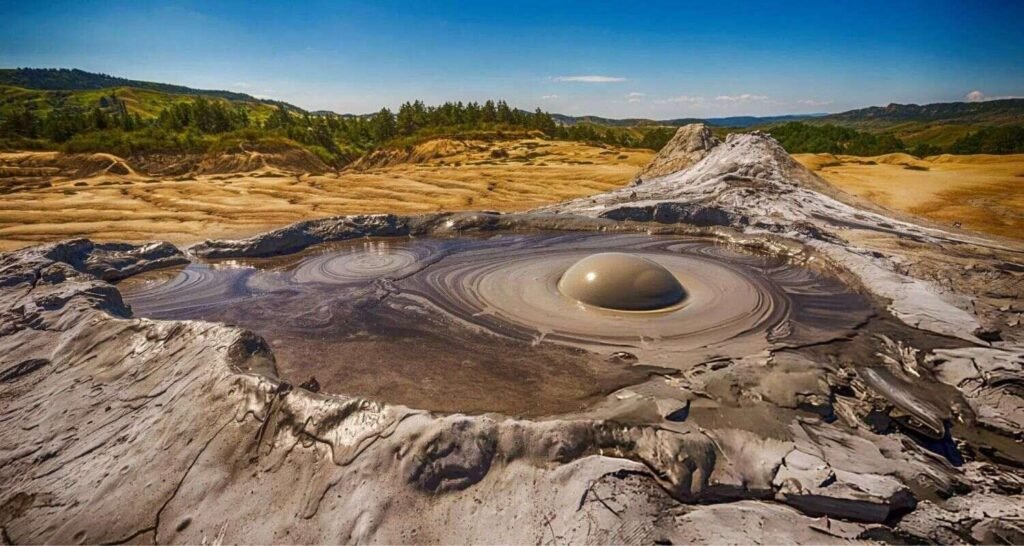
Context: A Mud Volcano eruption was recently reported in Diglipur, Andaman Islands, drawing attention to this rare geological phenomenon in India.
What is a Mud Volcano
- A mud volcano is a mound of mud pushed upward through overlying sediments.
- It forms when mud, gases, and water erupt to the surface from underground layers.
- Unlike magmatic volcanoes, it does not erupt lava. Instead, it releases mud, slurry, steam, and gases.
- Some eruptions can be forceful, even throwing flames due to gas ignition.
- Formation Mechanism
- Some mud volcanoes form due to hot spring activity. Gas and water react with rocks, producing boiling mud.
- Under compactional pressure, methane and hydrocarbon gases push mud upward, causing eruptions.
- The erupted mud may be hot and sometimes accompanied by steam emissions.
- Distribution
- Mud volcanoes occur on land and seabeds. Submarine eruptions may form islands or banks.
- Around 1,000 mud volcanoes have been identified globally.
- In India, the only known mud volcano is located at Baratang Island in the Andaman and Nicobar Islands.
Lion-Tailed Macaque
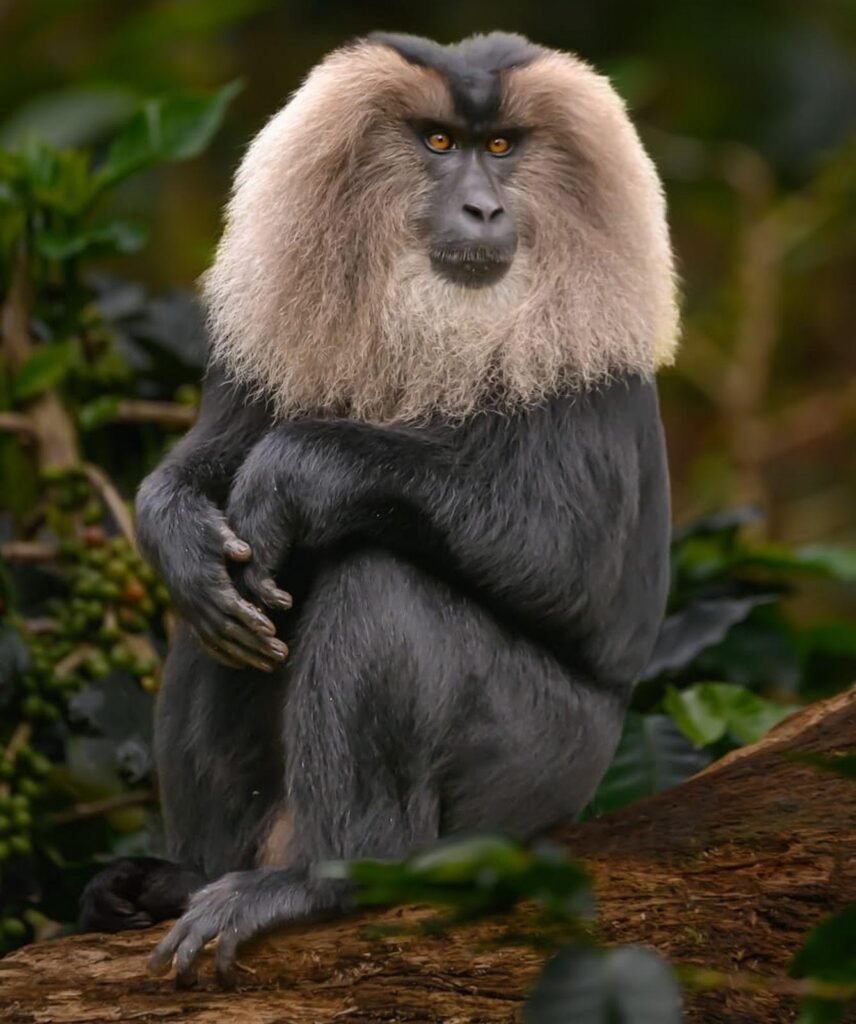
Context: Researchers have cautioned that the increasing presence of Lion-Tailed Macaques in human-dominated landscapes is driven by easy access to food linked to human activity.
About the species
- Lion-Tailed Macaque is an Old World monkey species.
- It is also called the “Beard Ape” due to its distinctive facial mane.
- It is one of the smallest macaque species.
- Distribution
- Endemic to the evergreen rainforests of the Western Ghats.
- Found in Karnataka, Kerala, and Tamil Nadu.
- Key Characteristics
- Arboreal species living mainly in the upper forest canopy.
- Diurnal in behaviour. Active during daytime.
- Feeds largely on fruits along with insects and small organisms.
- Conservation Status
- IUCN Red List: Endangered.
- CITES: Appendix I.
- Wildlife Protection Act, 1972: Schedule I.
