
Dhrupad Music
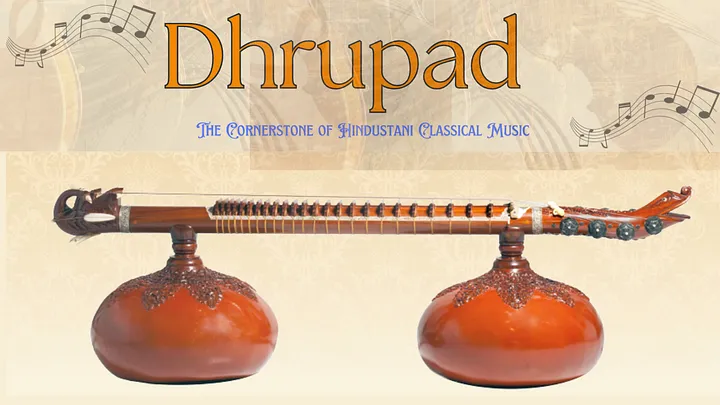
Context: Dhrupad is in the news as India’s oldest surviving Hindustani classical music form, preserved in near-original structure.
About
- Dhrupad is the most ancient vocal style of Hindustani classical music. It has survived in a relatively unchanged classical form.
- It is spiritual and devotional in character. The music is treated as an offering to the divine through sacred sound (Nada).
- Two main components:
- Alap:Slow, meditative development of the Raga.
- Bandish: Fixed lyrical composition rendered with rhythm.
- Origin
- Dhrupad traces its roots to the Samaveda. The vedic hymns were sung using melody and rhythm traditions.
- Gradual evolution of these chant traditions led to the emergence of Dhrupad music.
- Initially it was performed in temples as devotional singing but later received patronage under Mughal and Rajput rulers during medieval India.
- Key Characteristics
- Emphasis on purity and discipline of Raga rendition.
- Language gradually shifted from Sanskrit to Brij Bhasha between the 12th–16th centuries.
African Union (AU)

News: The African Union (AU) holds its annual summit in Ethiopia this weekend amid global uncertainities
About African Union
- The African Union (AU) is a continental organisation comprising 55 African countries.
It represents the collective political and economic voice of Africa. - Launched in 2002.
- It succeeded the Organisation of African Unity (OAU), established in 1963.
- Headquarters
- Located at Addis Ababa, Ethiopia.
- Key Objectives
- Promote unity and solidarity among African nations and peoples.
- Defend sovereignty, territorial integrity, and independence of member states.
- Advance democracy, good governance, and public participation.
- Promote peace, security, and stability across the continent.
- Accelerate political and socio-economic integration of Africa.
Maharshi Dayanand Saraswati
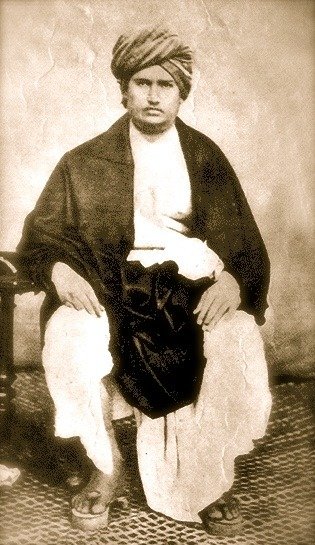
Context: Prime Minister paid tribute to Maharshi Dayanand Saraswati on his 202nd birth anniversary, recalling his role in social and educational reform.
Early Life
- Born on 12 February 1824 at Tankara, Kathiawar (Gujarat) in a Brahmin family.
- Questioned idol worship after a childhood temple experience.
- Later became disciple of Swami Virajananda, shaping his Vedic reform mission.
Core Philosophies
- Back to the Vedas: Considered Vedas the supreme source of knowledge and dharma.
- Opposed ritualism: Criticised superstition, blind faith, and meaningless rituals.
- Social equality: Rejected caste by birth. Supported merit-based social order.
- Women’s upliftment: Favoured women’s education and opposed child marriage.
- Ethical living: Emphasised truth, self-discipline, yoga, and moral conduct.
Socio-Religious Contributions
- Founded Arya Samaj (1875) to promote Vedic learning and social reform.
- Encouraged scriptural study, public debate, and rational thinking.
- Inspired later reformist and nationalist movements through cultural awakening.
Literary Works
- Authored more than 60 works.
- Most influential text: Satyarth Prakash.
- Other works include Sanskarvidhi and Vedic commentaries.
- Associated with Paropakarini Sabha (Ajmer) for publishing Vedic literature.
Death
- Died on 30 October 1883 in Ajmer after falling critically ill in Jodhpur.
Quorum Sensing
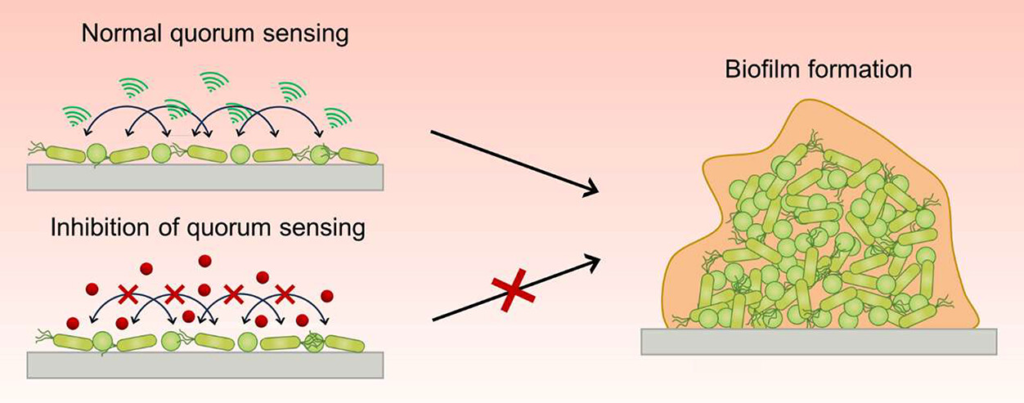
Context: Quorum sensing is in news as scientists are exploring anti-quorum sensing therapies as alternatives to conventional antibiotics.
What is Quorum Sensing
- Quorum sensing is a bacterial communication mechanism.
- It regulates gene expression based on population density using chemical signal molecules.
Basic Mechanism
- Bacteria release chemical signals called autoinducers into the environment.
- As bacterial population increases, signal concentration also rises.
- Once a threshold level is reached, bacteria detect these signals.
- This activates specific response genes, coordinating group behaviour.
Functions / Outcomes
- Regulates virulence in pathogens.
- Controls biofilm formation.
- Facilitates horizontal gene transfer.
- Enables competence (uptake of external DNA).
- These processes become effective only at critical population sizes.
Biological Significance
- Plays a major role in infection and disease progression.
- Also involved in symbiotic processes and microbial growth coordination.
- Medical Relevance
- Targeting quorum sensing can disrupt bacterial coordination.
- This opens pathways for non-antibiotic anti-infection therapies.
Dornier-228 Aircraft

Context: Ministry of Defence signed a ₹2,312 crore contract with Hindustan Aeronautics Limited (HAL) to procure 8 Dornier-228 aircraft for the Indian Coast Guard.
About Dornier-228
- Dornier-228 is a twin-engine turboprop Short Take-Off and Landing (STOL) utility aircraft.
- Used for maritime patrol, surveillance, search and rescue, and transport roles.
- Manufacturer
- Originally developed by Dornier GmbH (Germany).
- Currently licence-produced in India by HAL at Kanpur.
Key Features
- STOL capability: Operates from short and unprepared runways.
- Twin turboprop engines: Ensure reliability and fuel efficiency.
- Endurance: Around 5–6 hours.
- Capacity: Up to 19 passengers or cargo load.
- Mission equipment: Surveillance radar and maritime sensors (patrol variant).
Operational Significance
- Enhances coastal surveillance and EEZ monitoring.
- Supports search and rescue and maritime law enforcement.
- Procurement promotes indigenous defence manufacturing under Buy (Indian).
National Medicinal Plants Board (NMPB)

Context: The National Medicinal Plants Board (NMPB) organised a one-day Chintan Shivir at Vigyan Bhawan, New Delhi, to review sectoral development.
About NMPB
- Established in 2000 by the Government of India.
- Functions under the Ministry of AYUSH (Ayurveda, Yoga & Naturopathy, Unani, Siddha and Homoeopathy).
- It is the apex national body for promotion and development of medicinal plants sector.
- Mandate
- Ensures coordination among ministries, departments and organisations dealing with medicinal plants.
- Supports policy implementation and sectoral growth at Central and State levels.
- Promotes holistic development of medicinal and aromatic plant resources.
Key Functions
- Conservation: Promotes in-situ and ex-situ conservation of medicinal plants.
- Supports preservation of medicinal and aromatic species of therapeutic value.
- Resource Development: Encourages cultivation and sustainable availability of medicinal plant resources.
- Promotes R&D, training programmes and skill development in the medicinal plants sector.
- Awareness Promotion: Supports herbal awareness initiatives such as home and school herbal gardens.
- IPR Support: Encourages protection of patents and intellectual property rights related to medicinal plants.
- Documentation: Undertakes identification, inventorisation and quantification of medicinal plant resources.
