

Royal Indian Navy Mutiny (1946)
Basic Facts
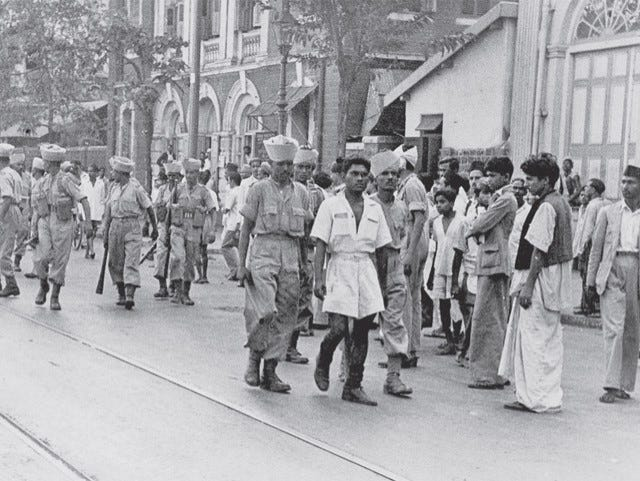
- The Royal Indian Navy Mutiny is also known as the Naval Uprising of 1946.
- It was a revolt of naval ratings against British colonial authority in India.
- The uprising began on 18 February 1946.
- It started at HMIS Talwar naval establishment in Bombay.
- It marked one of the final anti-colonial military uprisings before Independence.
About the Revolt
- Background of the Revolt
- The Second World War caused rapid expansion of the Royal Indian Navy.
- By 1945, naval strength increased nearly tenfold compared to 1939.
- Indian sailors were exposed to global ideas of democracy and freedom.
- Widespread resentment grew due to racial discrimination within naval services.
- Immediate Cause
- Ratings of HMIS Talwar launched a hunger strike against service conditions.
- Protests focused on poor food quality and racial discrimination.
- Spread of Revolt
- The uprising quickly spread to naval bases and ships across India.
- It involved around 78 ships and 20 shore establishments.
- Nearly 20,000 naval ratings participated in the revolt.
Key Demands
- Mutineers demanded release of INA prisoners.
- They sought freedom for all political prisoners.
- Ratings demanded equal pay with British sailors.
- They demanded better food and living conditions.
- Ending racial discrimination remained a central demand.
End of the Revolt
- The revolt was suppressed using overwhelming British military force.
- National political leadership did not support continuation of the uprising.
- Vallabhbhai Patel and Muhammad Ali Jinnah persuaded ratings to surrender peacefully.
- The mutiny formally ended on 23 February 1946.
Impact
- The revolt shook British confidence in loyalty of Indian armed forces.
- It influenced the decision to send the Cabinet Mission to India.
- The uprising accelerated the British decision to withdraw from India.
SAHI & BODH Initiative

Context: Union Health Minister launched two digital health initiatives SAHI and BODH at the India AI Impact Summit. These aim to advance safe, ethical, and evidence-based deployment of Artificial Intelligence in India’s healthcare ecosystem.
More in News
- The initiatives align with National Health Policy, 2017, which envisaged an interoperable, inclusive, and scalable digital health ecosystem nationwide.
- Ayushman Bharat Digital Mission (ABDM) launched in 2020 established robust digital public architecture for healthcare delivery across India.
SAHI (Strategy for Artificial Intelligence in Healthcare for India)
- SAHI is a national guidance framework for AI adoption in India’s healthcare sector.
- It promotes safe, ethical, and evidence-based use of Artificial Intelligence.
- Focuses on inclusive deployment across India’s public health system.
- Provides strategic direction on AI governance and regulatory mechanisms.
- Emphasises data stewardship and responsible data management practices.
- Guides validation and clinical evaluation of AI healthcare solutions.
- Supports deployment and monitoring of AI tools in healthcare delivery.
- Assists States and institutions in responsible AI adoption.
- Aligns AI deployment with national public health priorities.
BODH (Benchmarking Open Data Platform for Health AI)
- Developed by Indian Institute of Technology Kanpur in collaboration with National Health Authority.
- It is a benchmarking platform for evaluating Health AI models.
- It enables testing using diverse real-world health datasets.
- Operates through a privacy-preserving evaluation architecture.
- Underlying datasets are not shared during benchmarking processes.
- Note: BODH is a Digital Public Good under the Ayushman Bharat Digital Mission.
Significance of Initiatives
- Strengthens trust in AI-based healthcare solutions.
- Enhances transparency in algorithmic performance assessment.
- Ensures quality assurance in Health AI deployment.
- Promotes standardised evaluation frameworks for AI systems.
Rat-Hole Mining
Context
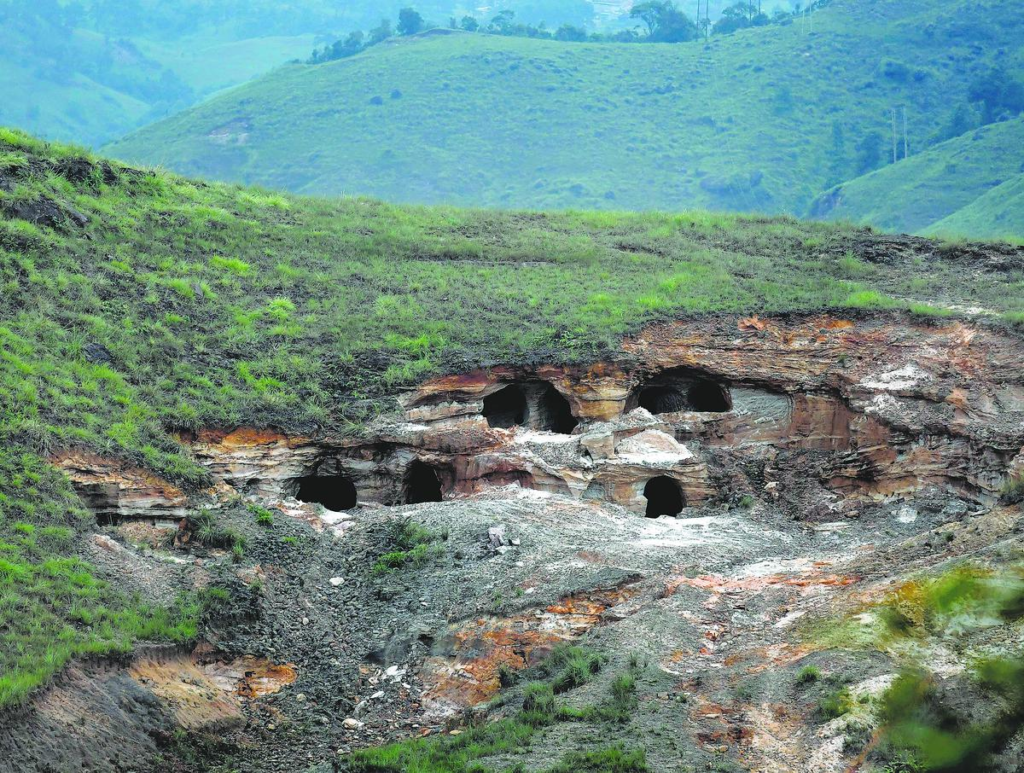
- An environmental activist flagged rat-hole coal mining along the Assam-Arunachal Pradesh boundary. The mining activities threaten forests near Dehing-Patkai National Park.
About Rat-Hole Mining
- Meaning
- Rat-hole mining is a primitive and unscientific coal extraction method.
- It involves digging narrow vertical pits to reach coal seams.
- Workers enter small horizontal tunnels to extract coal manually.
- Process of Extraction
- Land is cleared by removing surface vegetation cover.
- Vertical pits are dug to locate coal seams underground.
- Horizontal tunnels are created along hill slopes for extraction.
- Two main extraction methods are practiced:
- Side-cutting method
- Box-cutting method
Reasons for Continuation
- Coal seams in Meghalaya are thin and discontinuous.
- Rat-hole mining becomes economically viable over opencast mining.
- Lack of alternative livelihoods forces dependence on mining.
- Land ownership is fragmented and community-based.
Measures Taken
- Governed under Mines and Minerals (Development and Regulation) Act, 1957.
- National Green Tribunal banned rat-hole mining in 2014. The ban declared mining unscientific and unsafe for workers. The prohibition was later upheld by the Supreme Court.
Dehing-Patkai National Park
|
Graphics Processing Unit (GPU)
Context: The IndiaAI Mission will add 20,000 more Graphics Processing Units (GPUs) to the government-run “common compute” cluster accessible to local firms, researchers, and academia. The IT Minister announced that AI Mission 2.0 will focus heavily on research, innovation, AI diffusion, and strengthening computational infrastructure.
Basic Understanding of GPUs
- A Graphics Processing Unit (GPU) is an electronic circuit performing rapid mathematical computations.
- It is a chip component present inside modern computing devices.
- GPUs function alongside the Central Processing Unit (CPU).
- The CPU generally controls and directs GPU operations.
- Original Purpose
- GPU technology was originally designed to accelerate 3-D graphics rendering.
- It enhanced visual processing in gaming, animation, and display technologies.
Types of GPUs
- Traditional GPUs exist in two primary architectural forms.
- First are standalone GPUs installed as add-on cards in desktops. These provide high graphical processing power for intensive tasks.
- Second are integrated GPUs combined within the CPU chip package. These GPUs are common in laptops and gaming consoles.
Working Mechanism of GPUs
- GPUs operate using parallel processing architecture.
- Multiple processors simultaneously handle different segments of one computational task.
- This enables faster processing than sequential CPU computations.
- Memory Feature
- GPUs possess dedicated memory called Video RAM (VRAM).
- VRAM stores large volumes of graphics and computational data.
- It supports high-intensity visual and data processing workloads.
Key Applications of GPUs
- GPUs are used in high-performance computing systems.
- They support machine learning and Artificial Intelligence applications.
- GPUs assist in weather forecasting and climate modelling.
- They are also used in cryptocurrency mining operations.
Strait of Hormuz
Context: Iran announced the first-ever closure of the Strait of Hormuz amid escalating tensions during US-Tehran nuclear talks in Geneva.
Location & Geographical Setting
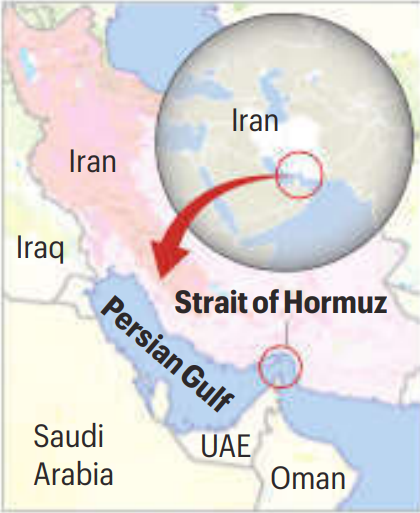
- The Strait of Hormuz is a narrow strategic waterway in West Asia.
- It lies between Iran and the Arabian Peninsula. Specifically, it separates Iran from United Arab Emirates and Oman (Musandam Peninsula).
- The strait links the Persian Gulf to the Gulf of Oman.
- It further connects to the Arabian Sea southeastwards.
- It is the only sea passage from the Persian Gulf outward.
Physical Characteristics
- The strait is approximately 167 kilometres long.
- At its narrowest point, width is about 29 nautical miles.
- Navigable shipping lanes are about 2 miles wide each.
- A 2-mile buffer zone separates inbound and outbound channels.
Important Islands
- Key islands include Hormuz, Qishm, and Hengam.
- These islands hold strategic and navigational significance.
Economic & Strategic Importance
- The Strait of Hormuz is a major global maritime choke point.
- Around 25% of global crude oil trade passes through it.
- Nearly 30% of global liquefied natural gas transits this route.
- It is critical for global energy security and supply chains.
