
India’s Updated Climate Targets (NDC)
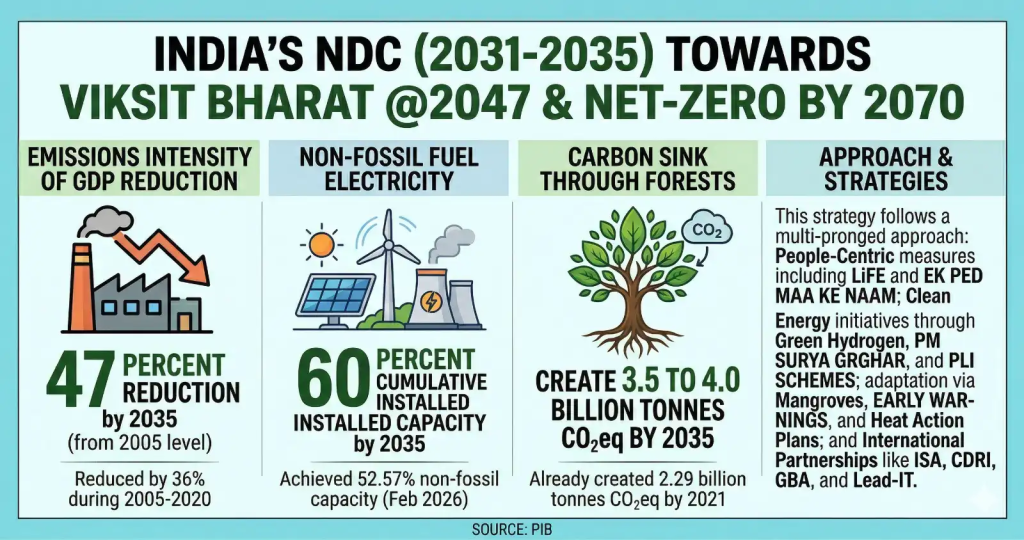
Why in News: India has updated its climate commitments under its Nationally Determined Contributions, setting targets for 2035.
Nationally Determined Contributions (NDCs)
- NDCs are climate targets communicated to the United Nations Framework Convention on Climate Change.
- They outline national actions towards emission reduction and energy efficiency improvement.
- India submits NDCs as part of its commitment under the Paris Agreement.
India’s Climate Targets: 2030 and 2035
- Targets for 2035
- 60% installed electric capacity from non-fossil fuel sources.
- 47% reduction in emissions intensity of GDP from 2005 levels.
- Carbon sink of 3.5 to 4 billion tonnes CO₂ equivalent.
- Existing Targets for 2030
- 50% installed electric capacity from non-fossil sources.
- 44% reduction in emissions intensity of GDP from 2005 levels.
- Carbon sink of 2.5 to 3 billion tonnes CO₂ equivalent.
India’s Current Status and Energy Profile
- 52% of installed electric capacity is already from non-fossil sources.
- Only about 25% of actual electricity generation is non-fossil.
- 36% reduction in emissions intensity achieved during 2005–2020.
- 1.97 billion tonnes CO₂ equivalent carbon sink created between 2005 and 2019.
- Non-fossil sources include: solar, wind, hydropower, biomass and nuclear power.
Global Climate Process and Key Facts
- Conference of Parties (CoP) meets annually to discuss climate issues and energy transition.
- As of December 31, 2025:
- India and Argentina had not announced 2035 NDCs.
- 128 parties submitted new NDCs.
- These covered about 78% of global greenhouse gas emissions.
- Included 21 Small Island Developing States, 19 Least Developed Countries and 18 G20 members.
Forest and Carbon Sink Status
- Forest and tree cover is 24.6% of geographical area (2021).
- Increased from 21% in 2005.
- Below the national policy goal of 33% forest cover.
UDAN Scheme Revamp
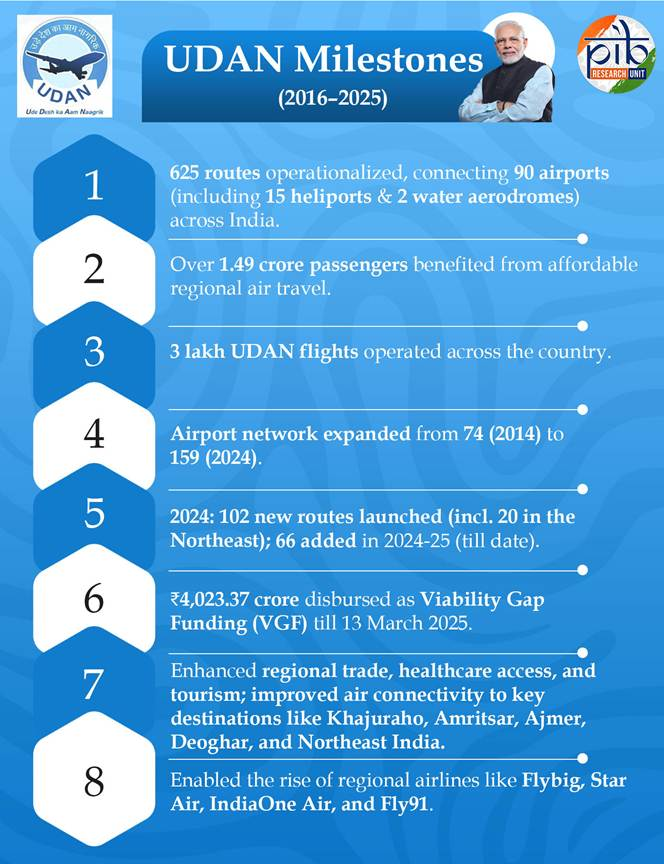
Context: The Union Cabinet has approved a modified UDAN scheme with an outlay of ₹28,840 crore, introducing key changes in subsidy structure and duration.
More in News
- Subsidy support for airlines on select Tier-2 and Tier-3 routes extended from 3 years to 5 years.
- Shift in subsidy mechanism from Regional Connectivity Scheme (RCS) levy in airfares to direct budgetary support from the exchequer.
- Earlier, subsidies were funded through a levy on non-UDAN routes.
About UDAN Scheme
- UDAN stands for Ude Desh ka Aam Nagrik.
- Launched in 2016 under National Civil Aviation Policy (NCAP).
- Aims to enhance regional air connectivity and make air travel affordable.
- Focuses on connecting unserved and underserved airports.
- Operates on Viability Gap Funding (VGF) model to support airlines.
- Promotes regional development, tourism, trade, and job creation.
Key Features of UDAN Scheme
- Viability Gap Funding (VGF): Financial support to airlines to ensure route viability.
- Airfare Cap: Limits ticket prices for affordability.
- Collaborative Model: Involves Centre, States, Airports Authority of India, and private operators.
Incentives to Stakeholders
- Airport Operators: Waiver of landing, parking, and navigation charges.
- Central Government: Excise duty on ATF capped at 2%.
- State Governments: VAT on ATF reduced to 1% or lower for 10 years.
Phases of UDAN Scheme
- UDAN 1.0 (2017): 128 routes across 70 airports; first flight Shimla–Delhi.
- UDAN 2.0 (2018): Expanded to underserved airports; included helipads.
- UDAN 3.0 (2019): Introduced tourism routes and seaplanes.
- UDAN 4.0 (2020): Focus on hilly, island, and border regions.
- UDAN 5.0 Series (2023–2025): Focus on efficiency and connectivity expansion.
Recent Developments
- Removal of 600 km distance cap.
- Emphasis on helicopter and small aircraft connectivity.
- Expansion of seaplane operations and water aerodromes.
Cauvery River System
Overview
- The Cauvery (Kaveri), known as the “Ganga of the South”.
- It originates at Talakaveri (Brahmagiri hills, Karnataka) at about 1,341 m.
- The river flows for nearly 800 km in a southeasterly direction through Karnataka and Tamil Nadu before draining into the Bay of Bengal, forming a fertile delta.
Basin and Physiography
- The basin extends over Karnataka, Tamil Nadu, Kerala, and Puducherry, covering about 81,000 sq. km, bounded by the Western Ghats (west) and Eastern Ghats (east and south).
- The Nilgiri hills divide the basin into the Karnataka plateau (north) and Tamil Nadu plateau (south), with three physiographic divisions: Western Ghats, Mysore plateau, and delta region.
- The delta is the most fertile region, often referred to as the “garden of southern India”.
Flow and Course
- The river is almost perennial, as the upper basin receives rainfall from the south-west monsoon and the lower basin from the north-east monsoon, ensuring relatively stable flow.
- It descends through Sivasamudram Falls, forms the Mekedatu gorge, flows along the Karnataka–Tamil Nadu boundary, and enters plains near Mettur reservoir.
- Near Tiruchirapalli, it splits into the Kollidam (Coleroon) distributary and main Cauvery branch, forming a wide delta before entering the sea.
Tributaries
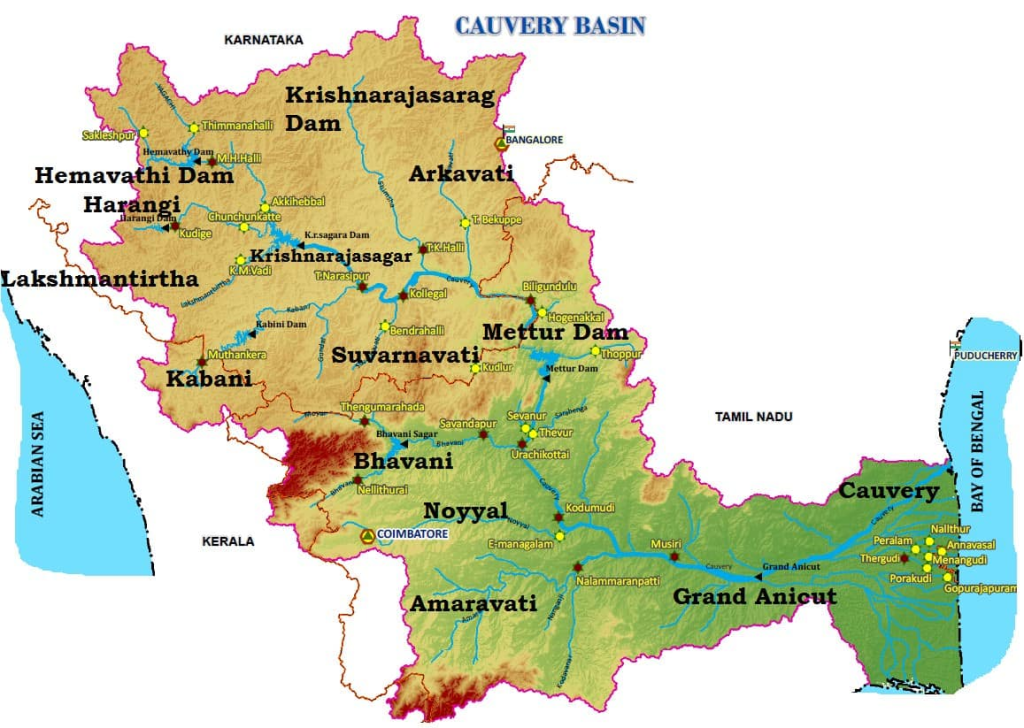
- Major tributaries include Harangi, Hemavati, Shimsha, Arkavati (left bank) and Lakshmantirtha, Kabini, Suvarnavati, Bhavani, Noyyal, Amaravati (right bank).
Economic Importance and Projects
- Nearly 66% of the basin area is under agriculture, supported by irrigation from the river system.
- The river is among the best-regulated systems, with extensive utilization for irrigation and hydropower through projects such as Krishnarajasagar and Mettur dams.
Cauvery Water Dispute
- A major inter-state river dispute involving Karnataka, Tamil Nadu, Kerala, and Puducherry, with the Cauvery Water Disputes Tribunal (1990) giving its award in 2007.
Microplastics

About
- Microplastics are small plastic particles, generally less than 5 mm in size.
- They are persistent, highly mobile, and difficult to remove from the environment.
Types of Microplastics
- Primary Microplastics:
- Manufactured as small particles for commercial use such as cosmetics and microfibers from textiles.
- Enter the environment directly through product use, manufacturing spills, transport losses, and washing processes.
- Secondary Microplastics:
- Formed by the breakdown of larger plastic items such as water bottles.
- Degradation occurs due to sunlight exposure and ocean wave action.
Environmental Impact
- Microplastics do not biodegrade and tend to accumulate in natural systems.
- They are ingested by marine organisms, affecting aquatic life.
- Lead to bioaccumulation across the food chain.
- Can carry toxic chemicals and pollutants, increasing ecological risks.
Mineral Water
About
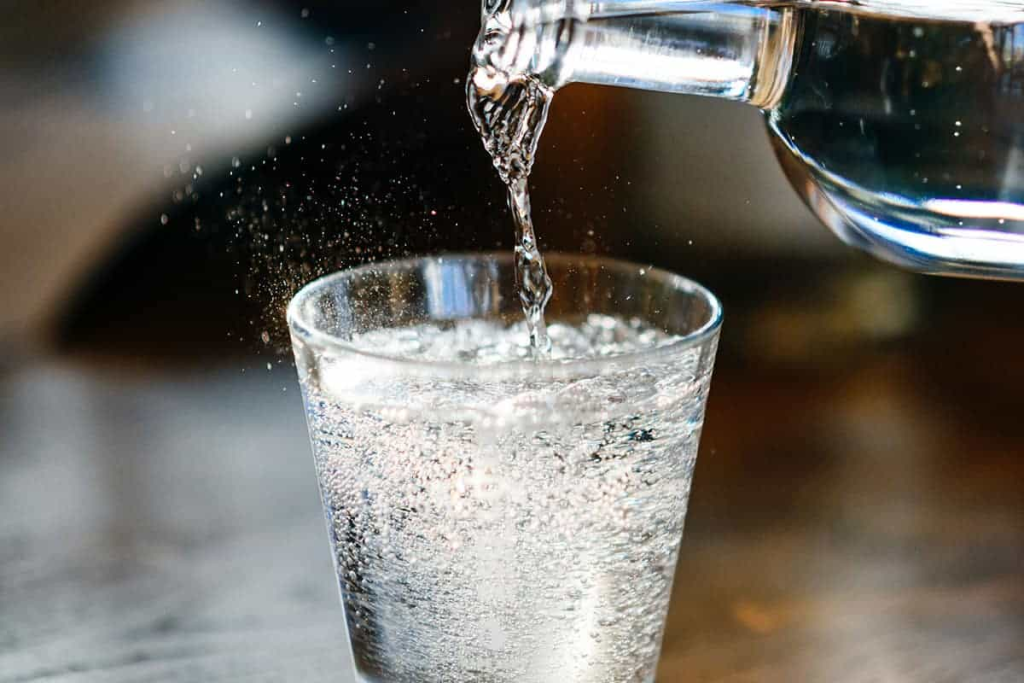
- Mineral water is water containing naturally dissolved minerals and trace elements, sourced from protected underground reservoirs such as springs or aquifers.
- It retains minerals acquired through geological processes over long periods, unlike treated tap water.
Formation
- Formed when rainwater percolates through rock layers like limestone, granite, sandstone, or basalt, dissolving minerals.
- Stored underground or emerges as natural springs due to pressure conditions.
Regulation in India
- Governed by FSSAI and BIS standards (IS 13428).
- Key conditions:
- Must originate from protected underground sources.
- Must maintain stable mineral composition and TDS levels.
- Chemical treatment is not allowed; only filtration, aeration, and sterilisation permitted.
- Requires FSSAI license, BIS certification, and ISI mark.
- Labels must mention source and mineral composition.
Key Characteristics
- Contains minerals such as calcium, magnesium, sodium, potassium, bicarbonates, sulphates, and chlorides.
- Mineral content determines Total Dissolved Solids (TDS) and water properties.
- Differs from:
- Packaged drinking water (treated and re-mineralised).
- Spring water (natural source but less strict composition standards).
Related Concepts
- Artesian water: groundwater that rises to the surface due to pressure from impermeable rock layers.
- Distilled water: nearly pure H₂O without dissolved minerals, obtained by evaporation and condensation.
IVFRT Scheme
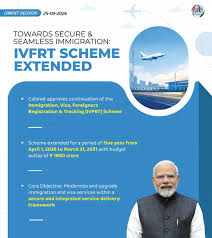
Context: The Union Cabinet has approved the extension of the Immigration, Visa, Foreigners Registration & Tracking (IVFRT) scheme for 5 years (2026–2031) with an outlay of ₹1,800 crore.
About IVFRT Scheme
- IVFRT aims to interlink and optimise functions related to immigration, visa issuance, registration and tracking of foreigners.
- Launched in 2010 to modernise and upgrade immigration and visa services.
- Provides a secure and integrated service delivery framework.
- Facilitates online visa services including appointment scheduling and payment.
- Supports immigration control and management of illegal migration.
- Implemented as a Mission Mode Project under the National e-Governance Plan (NeGP) by the Ministry of Home Affairs.
Coverage and Infrastructure
- Covers Immigration Posts, Indian Missions abroad, FRROs and FROs/SPs/DCPs across the country.
- Enables coordination between immigration checkpoints and foreigner registration authorities.
Inflation Targeting Framework
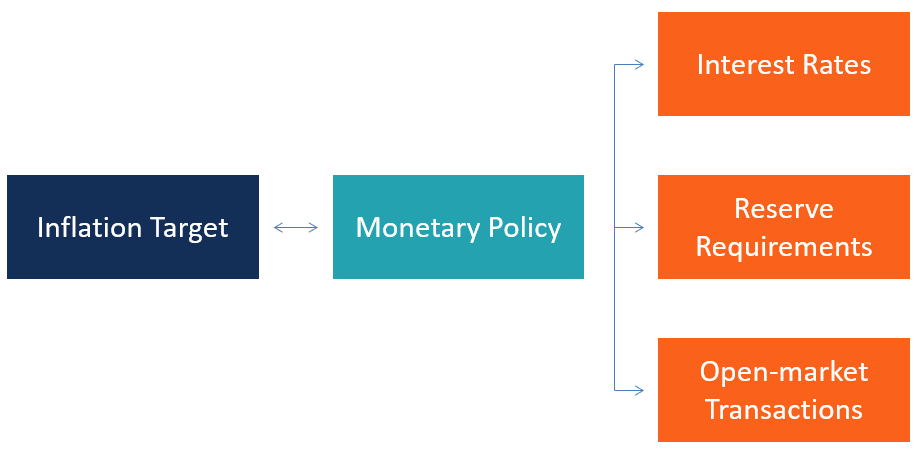
Context: The Union Government has retained the retail inflation target at 4% (±2%) for 2026–2031, continuing the existing framework.
Inflation Targeting in India
- India adopted a formal inflation-targeting framework in 2016.
- RBI is mandated to maintain retail inflation at 4% with a tolerance band of ±2%.
- Current target:
- 4% inflation rate
- Upper limit: 6%
- Lower limit: 2%
- The target is notified by the government in consultation with RBI.
- The framework has been retained multiple times since 2016.
About Monetary Policy Committee (MPC)
- MPC is a statutory body under the RBI Act, 1934 (amended in 2016) responsible for setting the policy repo rate to control inflation.
- Composition- 6 members:
- RBI Governor (Chairperson)
- RBI Deputy Governor (monetary policy)
- One RBI-nominated member
- Three external members nominated by Government of India
- Tenure
- External members: 4 years
- RBI officials: ex-officio members
- Meetings and Decision-Making
- Meets at least four times a year.
- Quorum: 4 members, with Governor or Deputy Governor present.
- Decisions taken by majority vote; Governor has casting vote in case of tie.
- Functions
- Determines repo rate to maintain inflation within target range.
- Its decisions are binding on RBI.
- Assisted by the Monetary Policy Department (MPD).
Central Consumer Protection Authority (CCPA)

About
- The Central Consumer Protection Authority (CCPA) is established under Section 10 of the Consumer Protection Act, 2019.
- The Consumer Protection Act, 2019 replaced the 1986 Act and came into force on July 20, 2020.
- Nodal Ministry: Ministry of Consumer Affairs, Food and Public Distribution.
Functions and Powers
- Protects, promotes, and enforces consumer rights as a class.
- Prevents unfair trade practices and misleading advertisements.
- Ensures that no entity publishes or disseminates false or misleading advertisements.
- Can initiate class-action suits, including recall of goods, refund of price, and cancellation of licenses.
- Conducts inquiries and investigations through an Investigation Wing headed by a Director-General.
- Can order discontinuation of unfair practices and impose penalties on violators.
Composition
- Headed by a Chief Commissioner.
- Assisted by two Commissioners:
- One for goods-related matters.
- One for services-related matters.
Antimatter
About
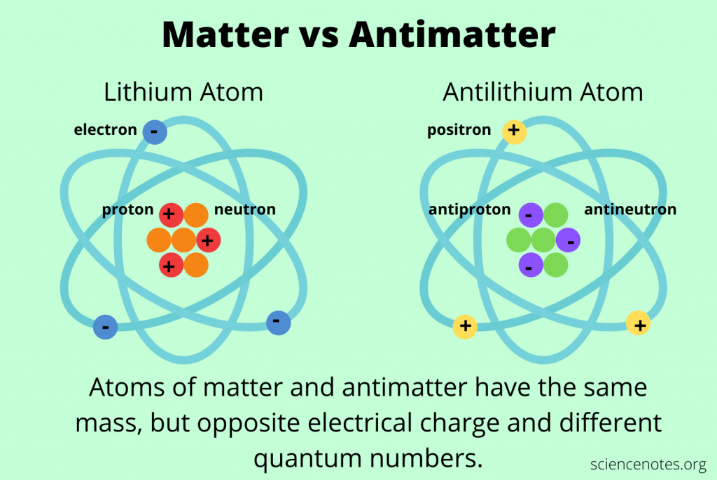
- Antimatter consists of particles that are counterparts of ordinary matter with same mass and spin but opposite charge and quantum numbers.
- When a particle meets its antiparticle, they undergo annihilation, converting mass into energy in the form of photons and subatomic particles.
Basic Properties
- Every particle has a corresponding antiparticle with opposite electric charge, baryon number, and lepton number.
- Examples include positron (electron’s antiparticle), antiproton, and antihydrogen.
- Governed by same physical laws, though certain symmetries like CP symmetry show slight violation.
Production and Storage
- Produced in particle accelerators, radioactive decay, and cosmic-ray interactions.
- Stored using magnetic and electric fields, ultra-high vacuum, and cryogenic systems to prevent contact with matter.
- Any contact with matter leads to instant annihilation, making storage extremely challenging.
Annihilation and Energy
- Matter–antimatter annihilation follows E = mc², releasing enormous energy.
- Example: annihilation of 1 kg matter with antimatter releases ~1.8 × 10¹⁷ joules.
- Large-scale energy use is impractical due to high production and storage costs.
Types of Antimatter
- Antiparticles: positrons, antiprotons, antineutrons.
- Antiatoms: e.g. antihydrogen.
- Antinuclei: combinations of antiprotons and antineutrons.
- Virtual antiparticles: short-lived quantum entities in theoretical models.
Scientific Significance
- Helps explain matter–antimatter asymmetry in the universe.
- Related to theories of baryogenesis involving symmetry violations.
- Used to test CPT symmetry (Charge, Parity, Time).
Recent Developments
- Experiments at CERN successfully created and trapped antihydrogen atoms.
- Studies show antimatter behaves like normal matter under gravity, ruling out antigravity hypothesis.
