
Essential Services Maintenance Act (ESMA)

About the Act
- ESMA is an Act of Parliament enacted in 1968 to ensure the continuity of essential services, disruption of which would affect normal life.
- Objective
- To prohibit strikes in essential services and ensure uninterrupted delivery of critical public services.
- Employees cannot refuse to work citing bandhs or curfews once ESMA is enforced.
- Includes services related to:
- Public health and sanitation, water supply, hospitals, national defence
- Production and distribution of petroleum, coal, electricity, steel, fertiliser
- Banking services
- Communication and transport services
- Government activities related to food grain distribution
Implementation
- Both Central and State Governments can invoke ESMA.
- States have their own ESMA laws with slight variations.
- States can enforce ESMA for localised disruptions.
- In case of nationwide disruptions (e.g., railways), the Central Government may invoke ESMA.
- States can decide which services to classify as essential under the Act.
Penal Provisions
- Participation or instigation of strike becomes illegal after ESMA is invoked.
- Offenders are liable for disciplinary action, including dismissal.
- Legal action can be initiated against violators.
- Police can arrest without warrant.
- Punishment may include imprisonment up to 1 year, or fine, or both.
Bt Cotton

About
- Bt Cotton is a genetically modified (GM) crop developed by inserting genes from Bacillus thuringiensis (soil bacterium).
- These genes enable the plant to produce Cry proteins (insecticidal toxins) that target specific pests.
- Mechanism
- Bt genes produce Cry proteins, which are toxic to certain insect larvae.
- Effective against major cotton pests such as tobacco budworm and bollworm larvae.
Types of Bt Cotton
- Bollgard I (1996):
- Produces Cry1Ac toxin.
- Effective against tobacco budworm and pink bollworm.
- Bollgard II (2003):
- Contains additional gene producing Cry2Ab toxin.
- Broader pest resistance compared to earlier version.
Key Features and Advantages
- Reduced pesticide use, lowering costs and risk to farmers and animals.
- Higher yields due to improved pest control.
- Supports Integrated Pest Management (IPM) practices.
- No observed adverse impact on soil invertebrates, microflora, or animal health (as per studies including ICAR).
- Environment-friendly, with reduced dependence on chemical insecticides.
- Biosafety studies indicate no harmful effects on livestock and poultry.
Bt Cotton in India
- Cotton is a major cash crop, supporting over 60 million people and contributing significantly to the textile sector.
- Bt cotton is the only GM crop approved for commercial cultivation in India.
- Approved by the Genetic Engineering Appraisal Committee (GEAC) in 2002.
- Regulation involves from Department of Biotechnology (Ministry of Science and Technology) and Ministry of Environment, Forest and Climate Change
- Production Trends
- Bt cotton adoption reached about 95% of total cotton area.
- Yield increased from 278 kg/ha (2000–01) to 566 kg/ha (2013–14).
- Post-2013, yields declined to about 447 kg/ha (2022–23).
- Decline attributed to pest resistance (especially pink bollworm) to Bt toxins.
- Benefits of Bt Cotton in India
- Employment generation, particularly increasing participation of women in agricultural activities.
- Leads to higher farmer incomes due to improved productivity and reduced crop losses.
- Replacement of traditional varieties with Bt hybrids across major cotton-growing regions.
- Reduction in insecticide use, especially against bollworm pests.
- Higher yields due to effective pest control.
- Limitations of Bt Cotton in India
- Effective mainly against bollworms, but not resistant to other pests, requiring continued pesticide use.
- Indian conditions have diverse pest population, unlike limited pest environment in some developed countries.
- Concerns over incompatibility with Indian agro-climatic conditions.
- High risk of pest resistance development over time, reducing long-term effectiveness.
About Herbicide-Tolerant (HT) Bt Cotton
- A modified variant of Bt cotton that is resistant to herbicide glyphosate.
- Developed by inserting Cp4-EPSPS gene from Agrobacterium tumefaciens.
- Not approved for commercial cultivation in India.
- Concerns Related to HT Bt Cotton
- Increasing illegal cultivation, estimated around 15% of cotton area.
- Glyphosate associated with health concerns, including carcinogenic risks.
- Risk of herbicide resistance spreading to nearby plants, leading to superweeds.
- Unregulated seed sales may result in poor quality seeds and environmental issues.
- Causes revenue loss to government and affects legitimate seed industry.
Pink Bollworm (Pectinophora gossypiella)
- Pink bollworm (PBW) is a moth species that acts as a major pest of cotton crops globally.
- Identification
- Larvae are small caterpillars with eight pairs of legs.
- Initially white, they develop distinct pink bands as they mature, giving the name “pinky”.
- Life Cycle and Damage
- Adult moth lays eggs on cotton bolls.
- After hatching, larvae bore into bolls and squares.
- Feed on seeds and internal tissues, leading to:
- Destruction of seeds
- Staining and deterioration of cotton lint
World Gold Council (WGC)

About
- The World Gold Council (WGC) is a non-profit association of leading global gold producers.
- Established in 1987 by major mining companies.
- Headquarters: London, United Kingdom.
- Key Contribution: Credited with creating the first gold Exchange-Traded Fund (ETF).
Nature and Composition
- Functions as a market development organisation for the gold industry.
- Comprises 33 members, primarily gold mining companies.
- Covers markets accounting for about three-fourths of global gold consumption.
Objectives
- To promote demand and usage of gold across sectors.
- To maximize growth potential of the gold industry.
- To monitor and support existing gold consumption patterns.
Functions and Activities
- Develops and promotes gold standards and policies.
- Ensures fairness and sustainability in gold mining practices.
- Provides research, market analysis, and industry insights.
- Publishes quarterly reports on gold demand and market trends.
- Supports research for new uses and applications of gold.
- Acts as a global authority on gold-related data and analysis.
S-400 ‘Sudarshan Chakra’ Air Defence System
About
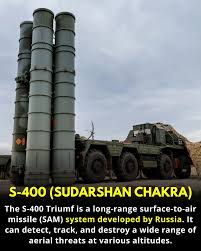
- The S-400 Triumf is a long-range, multi-layered surface-to-air missile (SAM) system developed by Russia.
- NATO codename: SA-21 Growler.
- Developed by Almaz-Antey Air and Space Defence Corporation.
- Inducted into Russian service in 2007.
- In India, it is known as ‘Sudarshan Chakra’.
India’s Procurement
- Deal signed in October 2018 worth about ₹35,000 crore.
- 5 squadrons ordered, with 3 delivered so far.
- Remaining units expected by 2026 and 2027.
Purpose and Role
- Designed to neutralise aerial threats including:
- Fighter aircraft
- Ballistic missiles
- Cruise missiles
- Unmanned Aerial Vehicles (UAVs)
- Provides airspace denial and strategic deterrence.
- Protects critical infrastructure, cities, and military installations.
Key Features
- Detection Range: Up to 600 km.
- Engagement Range: Up to 400 km with multiple missile types.
- Multi-target capability: Can track and engage up to 80 targets simultaneously.
- Capable of countering stealth aircraft, drones, and hypersonic threats.
- Rapid response system with quick tracking-to-launch cycle.
- Uses active and semi-active radar guidance.
- System Components includes:
- Command and control vehicle
- Long-range surveillance radar
- Engagement radar
- Launcher vehicles
- Each squadron consists of multiple mobile units (16+ vehicles).
Deployment in India
- Deployed in strategic locations such as:
- Pathankot
- Siliguri Corridor
- Western front
- Used for air defence operations against aerial threats.
Registrar General of India (RGI)
About
- The Registrar General of India (RGI) is a permanent office established in 1949 under the Ministry of Home Affairs.
- Headed by the Registrar General and Ex-Officio Census Commissioner of India.
- Responsible for systematic collection of population data, including size, growth, and distribution.
- The Registrar General is typically a civil servant of Joint Secretary rank.
Key Responsibilities
- Conducts the decennial Census of India, providing data on demographic, socio-economic, and geographic characteristics.
- Implements the Registration of Births and Deaths Act, 1969.
- Undertakes demographic and linguistic surveys across the country.
Major Functions
- Census of India
- Provides comprehensive data on population characteristics.
- Conducted every 10 years.
- Linguistic Survey of India (LSI)
- Documents linguistic diversity of India.
- First survey conducted by George Abraham Grierson (completed in 1928).
- Civil Registration System (CRS)
- System for registration of births and deaths.
- Functions as a continuous and real-time population data system.
- Birth certificate issued under Section 12 of Registration of Births and Deaths Act, 1969.
- Amendment (2023): Mandatory registration of all births and deaths on a centralised portal from October 1, 2023.
Indian Cyber Crime Coordination Centre (I4C)
About
- The Indian Cyber Crime Coordination Centre (I4C) was launched in 2020 under the Ministry of Home Affairs.
- It serves as a centralised framework to address cyber crimes in a coordinated manner, including cyber fraud.
Objectives and Functions
- Acts as a nodal agency to combat cybercrime in the country.
- Focuses on cybercrimes against women and children.
- Facilitates online reporting of cybercrime complaints.
- Identifies cybercrime trends and patterns for better policy response.
- Functions as an early warning system for law enforcement agencies.
- Promotes public awareness on cybercrime prevention and cyber hygiene.
- Supports capacity building of police, prosecutors, and judicial officers in cyber forensics and investigation.
Core Components of I4C
- National Cybercrime Threat Analytics Unit (TAU): Analyses and reports cybercrime threats and trends.
- National Cybercrime Reporting Portal (NCRP): Enables 24×7 online reporting of cybercrime complaints across India.
- National Cybercrime Training Centre (NCTC): Provides training to law enforcement and government officials.
- National Cybercrime Research and Innovation Centre: Develops indigenous tools and technologies for cybercrime prevention.
- Platform for Joint Cyber Crime Coordination Team: Facilitates coordination and information sharing among States/UTs law enforcement agencies.
- Cybercrime Ecosystem Management Unit: Promotes public awareness and cyber hygiene practices.
- National Cybercrime Forensic Laboratory Ecosystem: Supports cyber forensic investigation by law enforcement agencies.
Other Key Initiatives under I4C
- Citizen Financial Cyber Fraud Reporting and Management System: Enables immediate reporting of financial frauds and helps prevent fund diversion in near real time.
- National Helpline ‘1930’: Provides assistance for reporting cyber fraud complaints.
- “CyberDost” Initiative: Social media platform for disseminating cyber safety awareness.
- Cyber Crime Volunteers Program: Encourages citizen participation in reporting and preventing cybercrime.
National Securities Depository Limited (NSDL)
About
- NSDL is India’s first securities depository, established under the Depositories Act, 1996 and operational since 1996.
- Introduced the system of dematerialisation (demat) of securities in India.
- Functions as a market infrastructure institution for electronic holding and transfer of securities.
- Earlier system based on physical share certificates faced issues like loss, theft, forgery, delays, and bad deliveries.
- NSDL enabled a shift to a secure, efficient, electronic system, reducing risks and inefficiencies.
- Regulation and Oversight
- Regulated by the Securities and Exchange Board of India (SEBI).
- Coordinates with the Reserve Bank of India (RBI) in matters related to banking and government securities.
Core Functions
- Provides electronic custody of securities through demat accounts.
- Enables electronic transfer of securities (book-entry system).
- Facilitates settlement of trades on stock exchanges.
- Supports pledge and hypothecation of securities for loans.
- Handles corporate actions such as dividends, bonus, and rights issues.
- Role in Banking and Financial System
- Banks act as Depository Participants (DPs) linking investors with NSDL.
- Facilitates use of demat securities as collateral, improving liquidity and risk management.
Significance
- Reduced settlement risks, fraud, and transaction costs.
- Improved market efficiency, liquidity, and investor participation.
- Supports growth of mutual funds, ETFs, and capital markets.
- Contributes to capital formation and economic growth.
