

Waqf Board
Context: The Indian Union Muslim League (IUML) and United Democratic Front (UDF) face a precarious position regarding nomination of two non-Muslim members to the State Waqf Board following the Waqf (Amendment) Act, 2025.
About Waqf
- Definition: Waqf refers to an endowment made by a Muslim for charitable or religious purposes, such as building mosques, schools, hospitals, or other public institutions.
- Waqf property is inalienable, meaning it cannot be sold, gifted, inherited, or encumbered.
About Waqf Board
- Waqf Boards are statutory bodies established in States/UTs to manage waqf properties and oversee waqf-related administrative, supervisory, and quasi-judicial functions.
- Governed by the Waqf Act, 1995 (original legislation).
- Further reformed by the Waqf (Amendment) Act, 2025.
Key Provisions of Waqf (Amendment) Act, 2025
- Diverse Representation in Waqf Boards
- Two Non-Muslim Members: Section 14(1)(f) mandates inclusion of two non-Muslim members in Waqf Boards (excluding ex officio members).
- Women Representation: At least two members must be women from the Muslim community.
- Community Representation: Representation from Shia, Sunni, Bohra, Aghakhani, and OBC Muslim communities mandated.
- Separation of Trusts from Waqf
- Muslim-created trusts under any law will no longer be considered Waqf.
- Individuals retain full control over their trusts.
- Eligibility for Waqf Dedication
- Only practicing Muslims (for at least five years) can dedicate property to Waqf.
- Property Registration and Disputes
- Properties already registered with Waqf Boards remain so unless disputed or identified as government land.
- Section 40 Removal: Section 40 of the original Waqf Act (1995)—which gave Waqf Boards authority to unilaterally declare properties as Waqf—has been removed.
- Prevents Waqf Boards from arbitrarily claiming properties.
- Women’s Rights in Family Waqf
- Women must receive their inheritance before Waqf dedication.
- Special provisions for widows, divorced women, and orphans.
- Government Land and Waqf Disputes
- An officer above the rank of Collector investigates government properties claimed as Waqf.
- Prevents unwarranted claims on government land.
Waqf Tribunals
- Composition:
- District Judge (Chairperson).
- State government officer at Joint Secretary level.
- Expert in Muslim law and jurisprudence.
- Appeals: Aggrieved parties can appeal directly to the concerned High Court within 90 days of receiving the Tribunal’s order.
- Annual Audit Reforms: Waqf institutions earning over ₹1 lakh must undergo audits by State-appointed auditors.
Veblen Goods

About Veblen Goods
- Veblen goods are a concept introduced by American economist Thorstein Veblen in the late 19th century.
- Unlike traditional goods, demand for Veblen goods increases as prices rise, defying the law of demand.
- They are associated with conspicuous consumption, where consumers display social status and affluence through spending.
- Examples include diamonds, luxury cars, flagship smartphones (iPhones, Samsung Galaxy Fold), and luxury brands like Louis Vuitton, Gucci, and Chanel.
Veblen Goods vs Giffen Goods
- A Giffen good is an inferior product with no readily available substitutes, whereas a Veblen good is typically a high-quality, valued commodity.
Characteristics of Veblen Goods
- Positive Price-Demand Relationship: Demand rises with price, contrary to the law of demand.
- Conspicuous Consumption: Purchases serve as a status symbol reflecting social prestige.
- High Income Elasticity: Demand rises significantly with increased income.
- Absence of Substitution Effect: Veblen goods lack close substitutes, reinforcing prestige-driven demand.
India Semiconductor Mission (ISM) 2.0

Context: Union Minister Ashwini Vaishnaw stated that more companies are likely to invest in memory chip manufacturing in India to address the global demand-supply gap.
More in News
- Global shortage of high bandwidth memory chips required for AI data centres has driven up production costs of electronics like smartphones and laptops.
- India’s data centre investments are expected to cross $200 billion soon.
- ISM 1.0 helped about 48 startups work on semiconductor tech products.
About ISM 2.0
- ISM 2.0 aims to position India as a competitive player in the global semiconductor value chain, aligning with Aatmanirbhar Bharat and Make in India.
- Key focus areas include indigenous manufacturing, full-stack IP development, research and skills, and supply chain resilience.
About ISM 1.0
- ISM 1.0 was approved in December 2021 with an incentive outlay of ₹76,000 crore, offering up to 50% fiscal support.
- As of December 2025, 10 projects worth ₹1.60 lakh crore have been approved across six states, covering silicon fabs, compound semiconductors, advanced packaging, and testing facilities.
Market Size and Targets
- India’s semiconductor market grew from $38 billion (2023) to $45-50 billion (2024-25), projected to reach $100-110 billion by 2030.
- India targets 70-75% self-sufficiency in domestic chip demand by 2029 and aims for 3nm and 2nm manufacturing capabilities by 2035.
Arbitrage Funds
About Arbitrage Funds
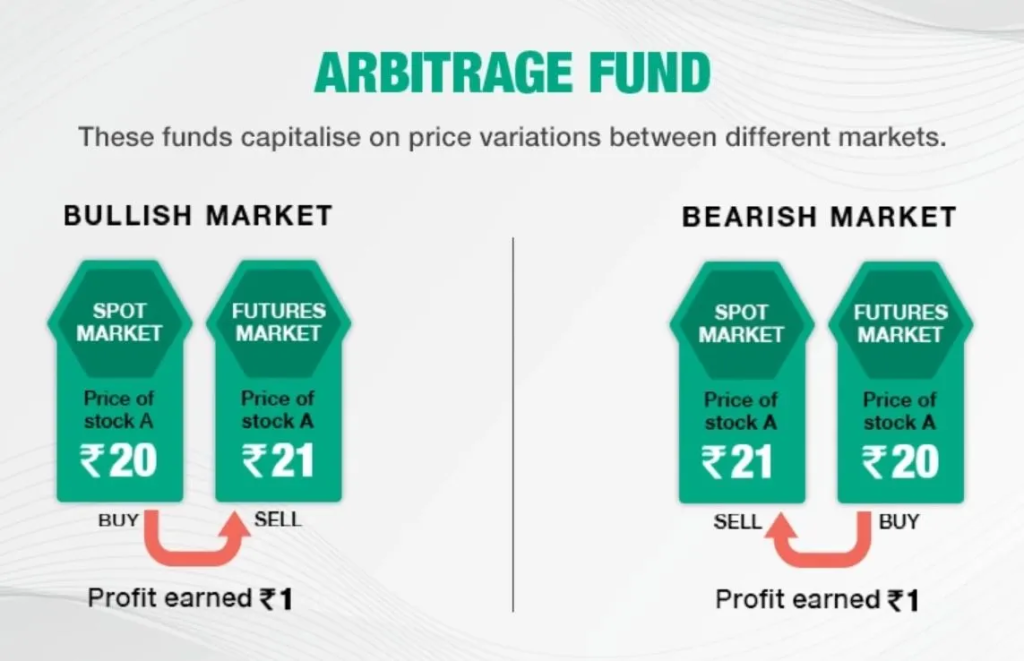
- Arbitrage funds aim to exploit mispricing between futures contracts and their underlying assets.
- The average annual return on arbitrage funds is around 6.5%.
- These funds have typically low market risk and no credit risk, as returns are generated regardless of market direction.
- When arbitrage opportunities are unavailable, such funds invest in money market instruments like treasury bills, earning lower returns.
Alpha Returns
- Alpha refers to the excess returns a fund generates over its appropriate benchmark.
- Empirical evidence suggests more than 85% of returns from active funds can be attributed to benchmark index movements.
Fee Structure Comparison
- Average fees: large-cap active funds (~1%), index funds (~0.25%), ETFs (less than 0.10%).
- Active funds charge higher fees on the entire portfolio, including the benchmark return, not just the alpha component.
