


Prototype Fast Breeder Reactor (PFBR) – India’s Three-Stage Nuclear Programme
Context and Recent Development
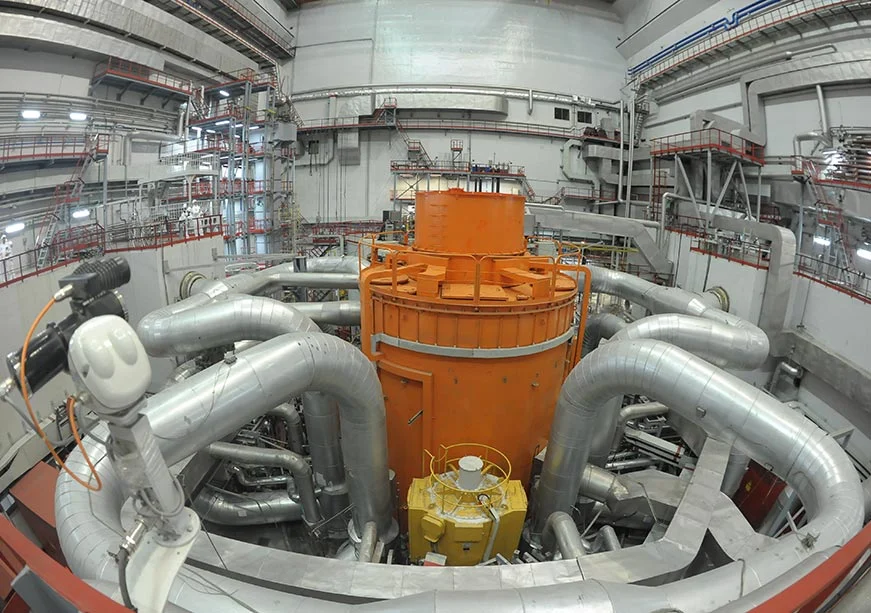
- India’s Prototype Fast Breeder Reactor (PFBR) at Kalpakkam (Tamil Nadu) has attained criticality, marking a defining milestone in the second stage of India’s nuclear programme.
- Criticality signifies that the nuclear chain reaction has become self-sustaining, paving the way for future electricity generation.
- The reactor will undergo low-power testing and regulatory evaluation before full commercial operation.
Features and Technical Characteristics
- Type: Sodium-cooled, pool-type Fast Breeder Reactor
- Capacity: 500 MW(e)
- Design & Development:
- Designed by Indira Gandhi Centre for Atomic Research (IGCAR)
- Built and operated by BHAVINI under Department of Atomic Energy (DAE)
- Fuel System:
- Uses Mixed Oxide (MOX) fuel (Uranium + Plutonium)
- Utilises spent/depleted uranium from PHWRs
- Coolant:
- Uses liquid sodium, unlike PHWRs which use heavy water
- Enables handling of high तापमान (heat) efficiently
- Design Life: ~40 years
Role in India’s Three-Stage Nuclear Programme
- India’s nuclear programme aims to achieve energy independence and thorium utilisation.
- Stage 1: PHWRs (Pressurised Heavy Water Reactors)
- Use natural uranium
- Produce plutonium as by-product
- Stage 2: Fast Breeder Reactors (FBRs)
- Use plutonium-based fuel
- Convert U-238 into plutonium (breeding)
- PFBR acts as a critical bridge stage
- Stage 3: Thorium-Based Reactors
- Use thorium reserves to produce U-233
- Aim for long-term sustainable energy security
- PFBR is crucial for reducing dependence on imported uranium and unlocking India’s vast thorium potential.
Working Principle and Efficiency Gains
- Breeder Concept:
- Produces more fissile material (plutonium) than it consumes.
- Fuel Efficiency:
- PHWRs extract <1% energy from uranium
- PFBR can increase extraction to ~10% per cycle, significantly improving utilisation.
- Energy Output Improvement:
- Energy extraction increases from ~8,000 units (PHWR) to ~100,000 units (FBR)
- Reprocessing Cycle:
- Spent fuel is reprocessed and reused, forming a closed fuel cycle
India’s Crude Oil Imports – Dependence, Sources, and Energy Security Challenges
Context and Key Data
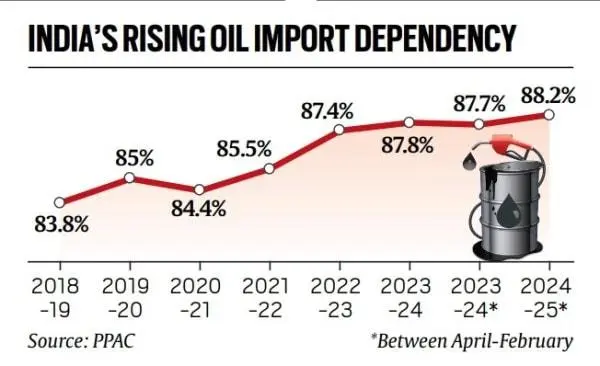
- India’s crude oil import dependence reached ~91% in February 2026, marking a historic high. The West Asia accounted for ~54.4% of total imports, indicating high regional concentration.
- The total imports rose to 205.3 lakh tonnes, reflecting a ~33% increase year-on-year. The situation has become critical due to geopolitical tensions (Iran conflict) affecting supply chains.
India’s Oil Import Structure
- India is the third-largest oil consumer globally and depends heavily on imports for energy needs.
- Import Share in Refining:
- About 90.8% of crude processed in refineries is imported.
- Major Sources of Imports:
- West Asia: Iraq, Saudi Arabia, UAE, Kuwait, Qatar
- Russia: Significant contributor post-Ukraine conflict
- Trend Shift:
- Earlier diversification towards Russian oil (discounted)
- Recent shift back to West Asian dependence, increasing vulnerability
- The Indian Basket represents the weighted average price of crude oils imported by India.
- It includes: Oman and Dubai crude (sour grade) and Brent crude (sweet grade)
Implications of High Import Dependence
- Energy Security Risks: Overdependence on a single region (West Asia) exposes India to geopolitical disruptions.
- Price Volatility: Global conflicts can lead to sharp rise in crude prices, impacting inflation.
- Fiscal Impact: Higher import bills worsen current account deficit (CAD).
- Supply Chain Constraints: War-related disruptions can affect availability and logistics of crude supply.
Article 17 – Abolition of Untouchability, Scope, and Related Provisions
Context: The Supreme Court, while hearing matters related to Sabarimala, observed that Article 17 cannot be applied selectively or temporarily (e.g., for “3-day untouchability”), reaffirming its absolute and fundamental nature.
Constitutional Provision and Nature
- Article 17 provides for the abolition of “untouchability” and prohibits its practice in any form.
- It mandates that any disability arising out of untouchability shall be an offence punishable by law.
- Key Features:
- It is a part of the Right to Equality (Articles 14–18).
- It is an absolute right (no exceptions permitted).
- It is self-executory, i.e., enforceable without requiring further legislation (though laws support enforcement).
- Important Note:
- The term “untouchability” is not explicitly defined in the Constitution.
Scope and Interpretation
- The term is interpreted not in a literal sense, but in its historical and social context, particularly linked to the caste system.
- It refers to social disabilities imposed on certain classes, historically treated as “untouchables”.
- Courts have clarified that Article 17 applies to caste-based discrimination, not to all forms of social exclusion.
- The provision reflects a commitment to social justice, dignity, and human equality.
Related Constitutional Provisions
- Article 15(2):
- Prohibits denial of access to shops, restaurants, public places, wells, tanks, roads, etc. on grounds of religion, race, caste, sex, or place of birth.
- Complements Article 17 in eliminating social discrimination in public spaces.
- Article 17 is often compared to the 13th Amendment of the U.S. Constitution, which abolished slavery, due to its transformative social impact.
Mahatma Jyotiba Phule – Social Reforms, Satyashodhak Samaj, and Literary Works
Personality and Historical Significance
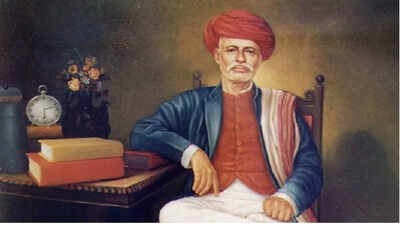
- Mahatma Jyotirao Phule (1827–1890) was a pioneering social reformer, educationist, thinker, and writer from Maharashtra.
- Known as the “Father of Indian Social Revolution” for his efforts against caste oppression and social inequality.
- He was among the first leaders to use the term “Dalit” for oppressed castes.
- Worked extensively for the upliftment of Dalits, women, farmers, and labourers.
Early Life and Education
- Born: 11 April 1827, Pune (Maharashtra), in the Mali (gardener) caste.
- Educated at Scottish Mission School, Pune; completed education in 1847.
- Married Savitribai Phule (1840), who later became India’s first female teacher.
Key Contributions and Reforms
- Education and Women Empowerment
- Established India’s first school for girls (Pune, 1848).
- Opened night schools for farmers and labourers.
- Advocated universal, compulsory, and practical education, especially for women and backward classes.
- Social Reform
- Strongly opposed:
- Caste discrimination and untouchability
- Brahminical patriarchy
- Founded Satyashodhak Samaj (1873) to promote:
- Equality and social justice
- Rationalism and anti-caste ideology
- Promoted:
- Widow remarriage
- Anti-infanticide measures
- Establishment of orphanages
- Strongly opposed:
- Agriculture and Rural Reforms
- Authored “Shetkaryacha Asud” highlighting agrarian distress.
- Suggested:
- Construction of dams and irrigation systems
- Use of state resources (including military labour) for rural development
- Emphasised economic empowerment and agricultural education.
- Political and Labour Advocacy
- Opposed the filtration theory of education (elitist education model).
- Submitted recommendations to the Hunter Commission (1882).
- Served as a Municipal Member in Pune; worked on:
- Public health and sanitation
- Water supply systems
- Co-founded the Bombay Millhands Association with Narayan Meghaji Lokhande for labour rights.
Literary Contributions
- Gulamgiri (Slavery): Critique of caste oppression; dedicated to African-American freedom struggle.
- Shetkaryacha Asud: Focus on farmers’ exploitation and reforms.
- Sarvajanik Satya Dharma Pustak: Advocates universal religion based on justice and rationality.
- Other works: Tritiya Ratna, Powada on Shivaji Maharaj, essays on education and reform.
Organisations and Legacy
- Satyashodhak Samaj: Promoted inter-caste marriages, non-Brahmin priesthood, and social equality.
- Started Din Bandhu newspaper (1877) to highlight issues of oppressed sections.
- Influenced leaders such as Dr. B.R. Ambedkar and supported by Chhatrapati Shahu Maharaj.
Levant Region – Geography, Countries, and Geopolitical Significance
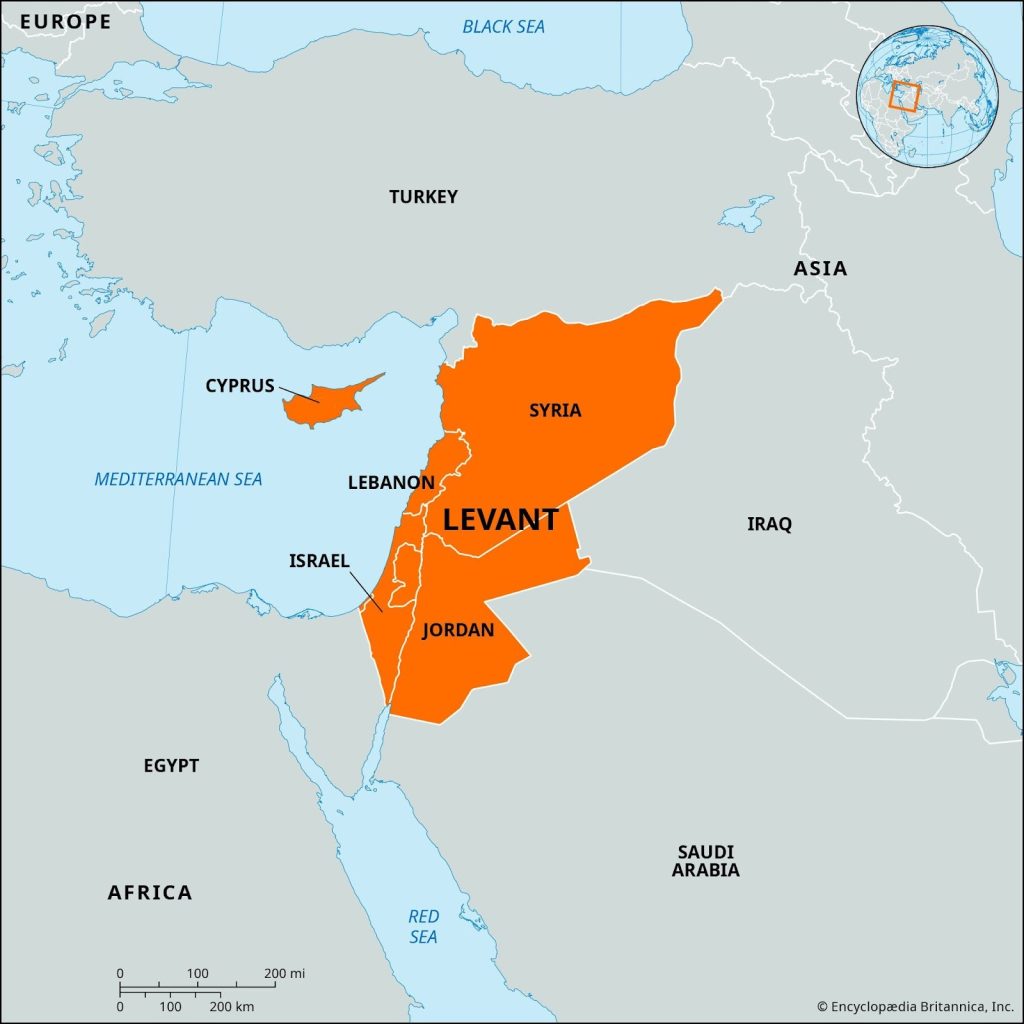
Concept and Definition
- The Levant is a historical and geographical term referring to the eastern Mediterranean region.
- It broadly includes countries along the eastern shores of the Mediterranean Sea.
- The term is widely used in geopolitical and current affairs contexts.
Geographical Extent
- Core Countries: Syria, Lebanon, Israel, Palestine, Jordan
- Extended Interpretation (sometimes included): Parts of southern Turkey and Cyprus
- The Levant represents the bridge between Asia, Europe, and Africa, making it a strategic crossroads.
Comparative Regional Classification
- Levant: Eastern Mediterranean coastal region
- Maghreb: North-West Africa (Morocco to Mauritania), west of Egypt
- Persian Gulf Region: Countries around the Persian Gulf (Saudi Arabia, UAE, Iran, etc.)
- Horn of Africa: East Africa (Somalia, Ethiopia, Eritrea, Djibouti)
- Mediterranean Region: Larger region including Southern Europe, North Africa, and Levant
