


Yamuna River – Origin, Course, Tributaries, and Pollution Issues
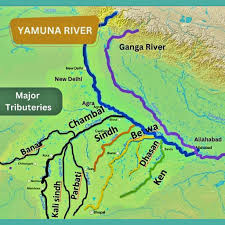
Context: A boat capsized in the Yamuna River near Keshi Ghat (Mathura, Uttar Pradesh), leading to casualties. The accident was caused due to overcrowding and collision with a pontoon bridge, highlighting risks in inland water transport.
About Yamuna River
- The Yamuna River is a major tributary of the Ganga River.
- It originates from the Yamunotri Glacier in the high Himalayas at an elevation of 4,421 m.
- The total length of the river is approximately 1,376 km.
- The river flows entirely within India.
Course and Tributaries
- The river flows through Uttarakhand, Haryana, and Uttar Pradesh.
- It initially flows southward through the Himalayan foothills, then enters the Indo-Gangetic Plain.
- It flows along the border between Uttar Pradesh and Haryana, where:
- Eastern Yamuna Canal and Western Yamuna Canal are drawn.
- The river passes through Delhi and feeds the Agra Canal.
- It later flows entirely in Uttar Pradesh, turning southeastward.
- It joins the Ganga at Prayagraj, forming a sacred confluence (Sangam) associated with Kumbh Mela.
- Major Tributaries
- Tons River (largest tributary, joins near Dehradun).
- Chambal River (largest right-bank tributary).
- Other tributaries:
- Right bank → Hindon, Sarda, Giri
- Left bank → Betwa, Sindh
Impeachment of Judges – Constitutional Provisions, Procedure, and In-House Inquiry
Constitutional Basis
- Judicial impeachment refers to the formal process of removing a Supreme Court or High Court judge for proved misbehaviour or incapacity.
- The term “impeachment” is not explicitly mentioned in the Constitution, but is commonly used to describe this process.
- The objective is to ensure judicial accountability while preventing political interference.
- Constitutional Provisions:
- Article 124(4) → Removal of Supreme Court judges.
- Article 218 → Extends the same provisions to High Court judges.
- Judges (Inquiry) Act, 1968 → Provides the procedural framework.
- Grounds for removal:
- Proved misbehaviour (serious ethical/professional misconduct).
- Incapacity (physical or mental inability to perform duties).
Impeachment Procedure
- Initiation of Motion
- A motion can be introduced in Lok Sabha or Rajya Sabha.
- It must be supported by:
- 100 MPs (Lok Sabha) or
- 50 MPs (Rajya Sabha).
- The motion proceeds only after admission by Speaker/Chairman.
- Inquiry Committee
- A three-member committee is constituted under the Judges (Inquiry) Act, 1968.
- Composition:
- A Supreme Court judge (or Chief Justice of India)
- A Chief Justice of a High Court
- An eminent jurist
- The committee conducts a quasi-judicial inquiry into the charges.
- Parliamentary Approval
- If the judge is found guilty:
- The motion is debated in Parliament.
- It must be passed in both Houses by a special majority:
- Majority of total membership, and
- Two-thirds of members present and voting
- If the judge is found guilty:
- Final Removal: After Parliamentary approval, the President issues the removal order.
In-House Inquiry Mechanism
- Introduced by the Supreme Court in 1999.
- Triggered by C. Ravichandran Iyer v. Justice A.M. Bhattacharjee (1995).
- Designed to address misconduct below impeachment threshold.
- Screening of Complaints
- Complaints are examined by:
- Chief Justice of India (CJI) or
- Chief Justice of concerned High Court
- Frivolous complaints are rejected, while serious ones require explanation from the judge.
- Complaints are examined by:
- Inquiry Committee Composition
- High Court Judge: 2 Chief Justices of other High Courts + 1 High Court judge.
- High Court Chief Justice: 1 Supreme Court judge + 2 High Court Chief Justices.
- Supreme Court Judge: 3 Supreme Court judges.
- Chief Justice of India: No specific in-house procedure defined.
- Outcomes
- If misconduct is proved:
- Judge may be advised to resign or take voluntary retirement.
- On refusal, judge may be relieved of judicial work.
- CJI may recommend impeachment if required.
- If misconduct is minor:
- Judge is cautioned and report is recorded.
- If misconduct is proved:
Key Limitations
- If a judge resigns during the process, proceedings generally lapse.
- No judge has been successfully impeached in India so far.
- The high voting threshold makes removal extremely difficult.
Great Nicobar Island – Strategic Importance, Ecology, and Development Project
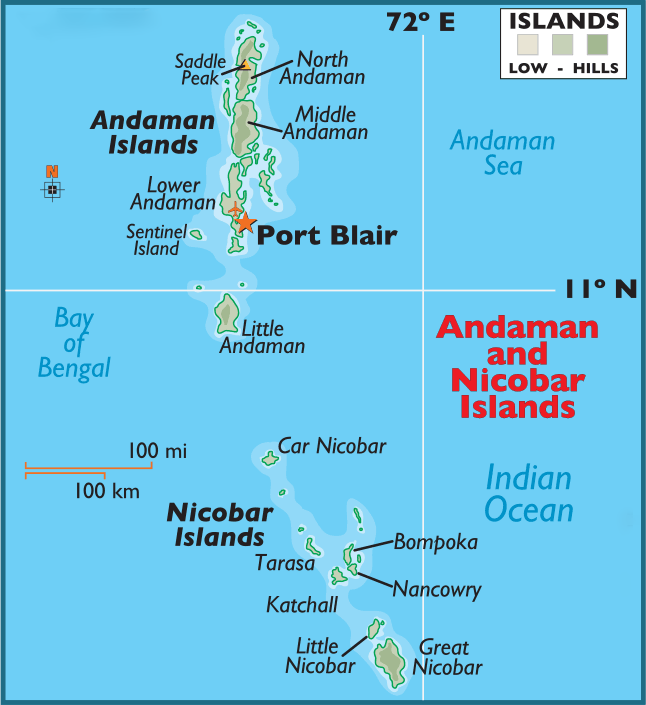
Context: The Government has proposed a draft master plan for Great Nicobar Island under a ₹92,000-crore mega infrastructure project. The plan aims to develop the island with tourism as the primary economic driver.
More in News
- The plan targets a population of 3.36 lakh by 2055, with large-scale job creation to encourage settlement. It envisions an annual inflow of over 1 million tourists.
- Multiple tourism models are proposed:
- Wellness tourism, beach tourism, nature tourism
- Adventure, business, and gaming tourism
- Family entertainment hubs and theme parks
About Great Nicobar Island
- Great Nicobar Island is one of the largest islands (910 sq. km) in the Andaman & Nicobar archipelago.
- The Andaman & Nicobar Islands consist of 836 islands in the Bay of Bengal.
- It is located at the southernmost tip of the Nicobar group, about 520 km from Port Blair.
- Indira Point (formerly Pygmalion Point), located here, is the southernmost point of India.
- The administrative headquarters is Campbell Bay.
- Indigenous tribes include: Shompen, Nicobarese
- Main activities include: Agriculture, Horticulture, Fishing
Ecological Characteristics
- The island has tropical wet evergreen forests, coastal plains, and hills.
- Mt. Thullier (642 m) is the highest point.
- Fauna includes:
- Crab-eating macaque, Nicobar tree shrew, Dugong, Nicobar megapode, Serpent eagle, Saltwater crocodile, Marine turtles
- Flora includes:
- Tree ferns (Cyathea albosetacea), Orchids (Phalaenopsis speciosa), Gymnosperms, bryophytes, and lichens
Ecological Importance
- The island hosts:
- Great Nicobar Biosphere Reserve
- Campbell Bay National Park
- Galathea National Park
- It was included in the UNESCO World Network of Biosphere Reserves (2013) under the Man and Biosphere Programme.
Migratory Birds in India – Flyways, Species, and Conservation Efforts
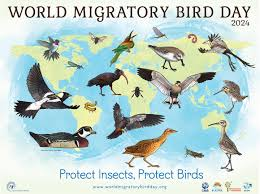
About Migratory Birds in India
- Major migratory birds include:
- Northern Shoveler, Gadwall, Greylag Geese, Pallas’s Gulls, Brown-headed and Black-headed Gulls, Coots
- India serves as a wintering ground for several migratory species, including:
- Siberian Crane, Greater Flamingo, Demoiselle Crane
Migration Patterns
- Birds migrate to India during winter and summer seasons.
- Migration occurs for:
- Food availability, Breeding, Nesting purposes
Major Global Flyways
- Americas Flyway: Connects North America with Caribbean, Central and South America.
- African-Eurasian Flyway: Connects Europe and northern Asia with Mediterranean, Middle East, and Africa.
- Central Asian Flyway: Connects northern Asia with South Asia and the Middle East.
- East Asian-Australasian Flyway: Connects northeast Asia with Southeast Asia, Australia, and New Zealand.
Wildlife Institute of India (WII) – Role, Objectives, and Research Areas

About Wildlife Institute of India
- The Wildlife Institute of India is an autonomous institution established in 1982.
- It functions under the Ministry of Environment, Forest and Climate Change, Government of India.
- The institute is located in Dehradun, Uttarakhand.
- It is an internationally recognised institution that provides:
- Training programmes
- Academic courses
- Advisory services in wildlife research and management
- The institute conducts nationwide research on biodiversity-related issues.
- Major areas of research include:
- Biodiversity conservation
- Wildlife policy and management
- Endangered species studies
- Wildlife forensic research
- Eco-development
- Spatial modelling
- Climate change-related studies
- The governing board is:
- Chaired by the Union Minister
- Includes representatives from Central and State Governments, institutions, and academia
Objectives of WII
- To develop scientific knowledge on wildlife resources.
- To train personnel at different levels for wildlife conservation and management.
- To undertake research relevant to wildlife management, including development of techniques suited to Indian conditions.
- To provide advice and information on wildlife management issues.
- To collaborate with international organisations on wildlife research and training.
- To emerge as a regional centre of international importance in wildlife conservation.
Systematic Investment Plan (SIP) – Features, Benefits, and Mutual Funds

About SIP
- SIP is an investment method offered by mutual funds in which an investor contributes a fixed amount at regular intervals (e.g., monthly).
- It provides an alternative to lump sum investment by allowing periodic investments.
- The minimum investment can be as low as ₹500 per month.
- SIP operates similarly to a recurring deposit, promoting gradual wealth accumulation.
- It helps investors achieve financial goals by building a corpus over time through small, consistent investments.
Features and Benefits of SIP
- SIP promotes financial discipline through regular investments.
- It is typically associated with open-ended mutual fund schemes, allowing flexibility.
- Investors can:
- Start, stop, or continue SIPs as per their convenience.
- Withdraw funds (full or partial) during or after the investment period.
- Modify the investment amount (increase or decrease).
- There is no fixed tenure, providing flexibility in investment duration.
About Mutual Funds
- A mutual fund is a pool of money collected from multiple investors with a common investment objective.
- It is managed by a professional fund manager.
- Investments are made in:
- Equities
- Bonds
- Money market instruments
- Other securities
- Returns generated are distributed proportionately among investors, after deducting applicable expenses.
Darfur Region – Geography, Conflict, and Humanitarian Issues
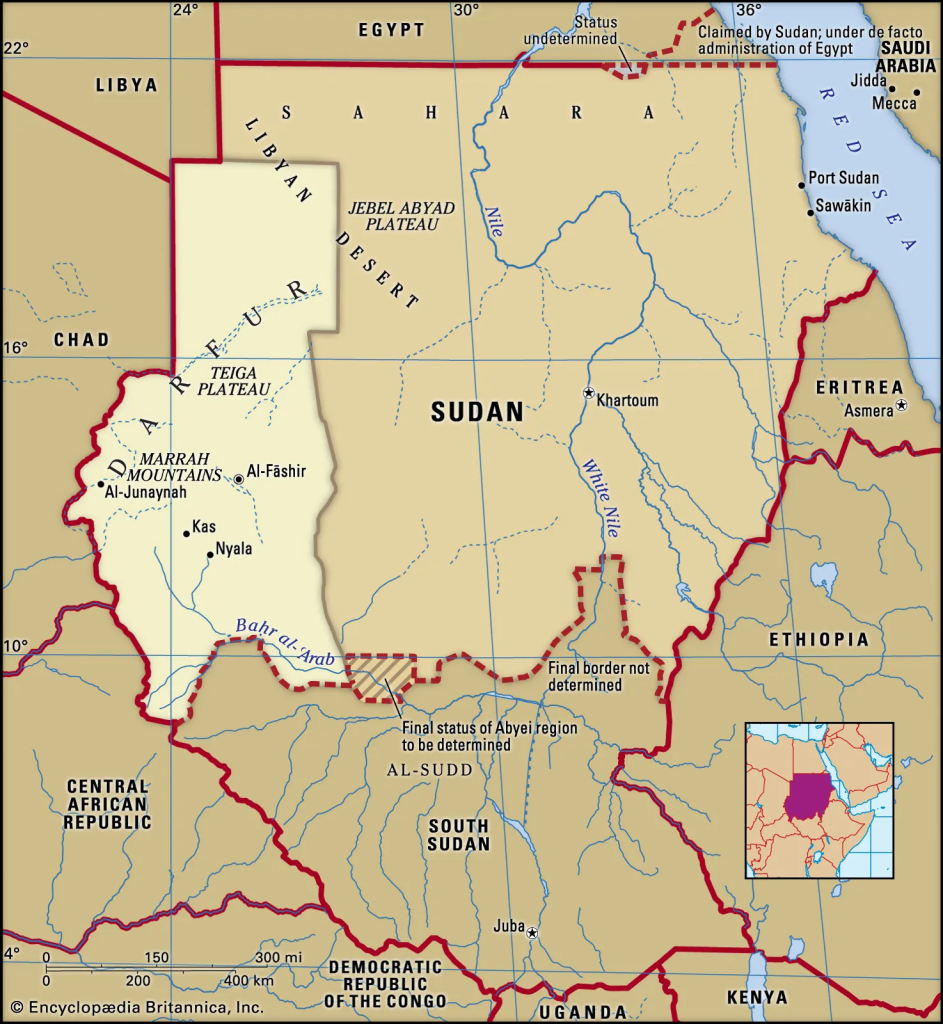
Location and Physical Features
- Darfur is located in western Sudan.
- It lies between:
- Kordofan (east)
- Wadai (west)
- It extends:
- Northward to the Libyan Desert
- Southward to the Al-Ghazāl (Gazelle) River
- The region covers an area of about 440,000 sq. km.
- It consists mainly of an immense rolling plain.
- The Marrah Mountains (volcanic highlands) dominate the central part of the region.
Historical Background
- Darfur was an independent sultanate before being annexed by Sudan in 1916.
- The name “Darfur” is derived from the Arabic term “Dar Fur”, meaning “Land of the Fur”.
- The Fur tribe ruled the region until the death of the last Sultan in 1916.
Demographic Features
- Darfur is home to around 80 tribes and ethnic groups.
- It includes both:
- Nomadic communities
- Settled (sedentary) populations
- Regional distribution:
- Northern Darfur → Predominantly Arab population
- Southern Darfur → Mix of Arabs and Fur
- Other important ethnic groups: Beja, Zaghawa, Nubian, Daju
Kabuki Theatre – UNESCO Intangible Heritage, Features, and Japanese Culture

Overview
- Kabuki Theatre of Japan is inscribed on the UNESCO Representative List of the Intangible Cultural Heritage of Humanity (2008).
- It was originally proclaimed as intangible heritage in 2005.
About Kabuki Theatre
- Kabuki is a traditional Japanese theatre form that originated during the Edo period (early 17th century).
- It was initially popular among townspeople.
- In its early phase, both men and women performed, but later only male actors performed, a tradition that continues today.
Features and Performance Style
- Male actors performing female roles are called Onnagata.
- Major role types include:
- Aragoto → Rough, bold acting style
- Wagoto → Soft, realistic acting style
- Kabuki plays focus on:
- Historical events
- Moral conflicts in human relationships
- Evolution
- After 1868 (Meiji period), Kabuki adapted to Western influences and aimed to gain acceptance among upper classes.
- It evolved by blending traditional styles with modern elements.
- Today, Kabuki remains the most popular traditional form of Japanese drama.
Special Intensive Revision (SIR) 2.0 – Electoral Roll Revision, Process, and Legal Framework

Context: The Election Commission of India conducted Special Intensive Revision (SIR) of electoral rolls across multiple States/UTs. Electoral rolls saw large-scale deletions (~5.58 crore voters), with significant changes in states like Gujarat and Uttar Pradesh.
About SIR 2.0
- SIR is a comprehensive house-to-house verification of electoral rolls conducted by ECI.
- SIR 2.0 is being implemented in 12 States/UTs, including:
- Andaman & Nicobar Islands, Chhattisgarh, Goa, Gujarat, Kerala, Lakshadweep, Madhya Pradesh, Puducherry, Rajasthan, Tamil Nadu, Uttar Pradesh, West Bengal
- SIR 1.0 was earlier conducted in Bihar.
- Assam is excluded due to its NRC-related unique situation.
- Objective:
- To ensure only eligible citizens are included
- To remove ineligible or duplicate entries
- The process is carried out by Booth Level Officers (BLOs).
Process and Provisions of SIR 2.0
- Step-wise Process
- House-to-house enumeration by BLOs and distribution of forms.
- Publication of draft electoral roll.
- Claims and objections period for corrections.
- Verification and hearing (notice phase).
- Publication of final electoral roll.
- If a voter’s name is deleted:
- First appeal → District Magistrate (DM)
- Second appeal → Chief Electoral Officer (CEO)
Legal Framework
- Article 324 empowers ECI to conduct free and fair elections.
- Section 21, Representation of the People Act, 1950 deals with preparation and revision of electoral rolls.
- Registration of Electors Rules, 1960 provides detailed procedures for electoral roll management.
