


Article 142 – Powers of Supreme Court for Complete Justice (Landmark Cases)

Context: Following the gherao of judicial officers in Malda (West Bengal), the Supreme Court invoked Article 142.
About Article 142
- Concept and Constitutional Provision
- Article 142 empowers the Supreme Court of India to pass any order or decree necessary for doing “complete justice” in any case pending before it.
- This power is discretionary and is unique to the Supreme Court (not available to High Courts).
- It enables the Court to go beyond procedural limitations to ensure substantive justice.
- Constitutional Philosophy and Evolution
- The provision reflects the vision of the framers of the Constitution, particularly Dr. B.R. Ambedkar, who intended to vest this extraordinary power solely in the Supreme Court.
- Over time, judicial jurisprudence under Article 142 has evolved, with the Court exercising self-imposed restraint to prevent misuse.
- It reinforces the Supreme Court’s role as the guardian of the Constitution.
Meaning of “Complete Justice”
- The term “complete justice” implies delivering justice beyond technicalities of law.
- It allows the Court to:
- Fill legislative gaps where no clear law exists
- Interpret laws expansively
- In exceptional situations, override existing legal provisions to uphold constitutional values
- The focus remains on protection of fundamental rights, fairness, and social welfare.
Significance in Governance and Justice
- Enables intervention in cases involving:
- Public interest
- Human rights violations
- Breakdown of governance or justice delivery
- Strengthens democratic values by:
- Protecting minority rights
- Ensuring equality before law
- Acting as a check on executive and legislative excesses
- Promotes judicial innovation by allowing:
- Issuance of guidelines and directions
- Filling policy gaps until legislation is enacted
National Green Tribunal (NGT) – Composition, Powers, and Jurisdiction

Context: The National Green Tribunal (NGT) recently held that the NHAI violated environmental norms by encroaching upon a wetland in Delhi, highlighting its role in environmental governance and accountability.
Overview of NGT
- The NGT is a specialized judicial body for the expeditious disposal of environmental cases.
- Established: 18 October 2010 under the National Green Tribunal Act, 2010.
- Headquarters: New Delhi; Regional benches at Bhopal, Pune, Kolkata, and Chennai.
- India became the third country globally (after Australia and New Zealand) and the first developing country to establish such a tribunal.
Objectives and Functions
- The NGT aims to ensure effective environmental protection and sustainable development.
- It is mandated to dispose of cases within 6 months.
- Key functions include:
- Adjudicating environmental disputes
- Protecting forests and natural resources
- Enforcing key principles such as:
- Polluter Pays Principle
- Precautionary Principle
- Handling issues related to:
- Environmental clearances
- Air and water pollution
- Waste management and biodiversity conservation
Composition and Appointment
- The Tribunal consists of:
- Chairperson
- Judicial Members (10–20)
- Expert Members (10–20)
- Chairperson: Must be a Supreme Court Judge or Chief Justice of a High Court.
- Judicial Members: Must be SC Judges or HC Judges/Chief Justices.
- Expert Members: Must have technical qualifications and experience in environmental fields.
- Appointment:
- Chairperson → By Central Government in consultation with CJI
- Others → Through Selection Committee
- Tenure:
- Maximum 5 years or up to 65 years of age, whichever is earlier
- No reappointment allowed
Powers and Jurisdiction
- Original Jurisdiction: Handles civil cases related to environmental protection.
- Suo Motu Power: Recognized by the Supreme Court (2021).
- Appellate Jurisdiction: Appeals against NGT orders lie only with the Supreme Court (within 90 days).
- Penalties:
- Imprisonment up to 3 years, or
- Fine up to ₹10 crore, or both.
Acts under Jurisdiction
- Covered Acts:
- Water Act, 1974
- Air Act, 1981
- Environment Protection Act, 1986
- Forest Conservation Act, 1980
- Biological Diversity Act, 2002
- Not Covered:
- Wildlife Protection Act, 1972
- Forest Rights Act, 2006
Renaming of States in India – Article 3, Procedure, and Recent Examples
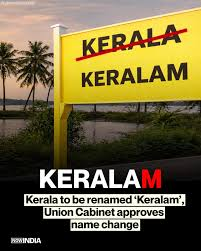
Constitutional Provision
- The renaming of a State in India is governed by Article 3 of the Constitution.
- It empowers Parliament to alter the name, boundaries, or area of any State by law.
Procedure for Renaming
- The process can be initiated by Parliament or a State Legislature.
- A Bill must be introduced in Parliament only after obtaining the recommendation of the President.
- The President refers the Bill to the concerned State Legislature to seek its views within a specified time.
- The State Legislature’s opinion is advisory and not binding on Parliament.
- The Bill is then passed by a simple majority in both Houses of Parliament.
Final Approval and Constitutional Changes
- After passage, the Bill is sent to the President for assent.
- Once assented, the name change becomes law.
- Necessary amendments are made in:
- First Schedule (names of States and Union Territories)
- Fourth Schedule (allocation of seats in Rajya Sabha, if required)
Share Buyback – Meaning, Reasons, Benefits, and Regulatory Framework

Context: Aurobindo Pharma has announced a share buyback worth ₹800 crore through the tender offer route, at a price higher than the prevailing market price.
What is Share Buyback?
- A share buyback (share repurchase) occurs when a company purchases its own shares from existing shareholders.
- It leads to a reduction in the number of outstanding shares in the market.
- Buyback can be carried out through:
- Tender offer (proportionate basis)
- Open market purchase (stock exchange/book-building)
- Odd-lot holders
- Regulatory Limit:
- Maximum buyback allowed is 25% of paid-up capital and free reserves.
Reasons for Share Buyback
- Undervaluation of shares: Company believes its stock is undervalued.
- Increase shareholder value: Fewer shares → higher earnings per share (EPS).
- Promoter holding increase: Helps prevent hostile takeovers.
- Surplus cash utilization: Company returns excess cash when investment opportunities are limited.
Benefits for Shareholders
- Tax efficiency: Company pays tax; shareholders are generally exempt from additional tax on buyback income.
- Exit opportunity: Shareholders can sell shares at a premium over market price.
- Value enhancement: Remaining shares may appreciate due to reduced supply.
Eligibility for Participation
- Shareholders must:
- Hold shares on or before the record date.
- Hold shares in dematerialized (demat) form.
Syngas – Production, Uses, Advantages, and Role in Energy Security
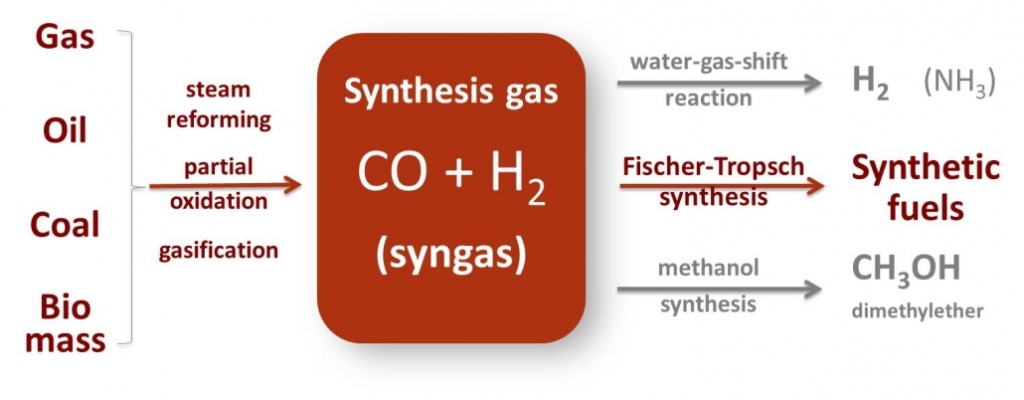
Context: Amid shortages of natural gas, LPG, and propane, industries such as Jindal Steel have adopted syngas as an alternative fuel to sustain operations.
What is Syngas?
- Syngas (Synthesis Gas) is a mixture of gases, primarily:
- Hydrogen (H₂)
- Carbon Monoxide (CO)
- Also contains CO₂, methane, water vapour, and hydrocarbons.
- It is produced from carbon-containing materials such as: Coal, biomass, natural gas, heavy oil, and waste
- It is a key product of:
- Gasification (partial oxidation of carbonaceous materials)
- Pyrolysis (thermal decomposition in absence of oxygen)
Production and Characteristics
- Coal Gasification: Converts coal into a mixture of H₂, CO, and CO₂.
- Energy Density: Approximately half that of natural gas, but still usable as fuel.
- Pre-treatment: CO₂ can be captured and separated before use.
- Acts as a cleaner-burning and flexible fuel source.
Uses of Syngas
- Fuel Applications: Used in industrial furnaces, gas engines, and power generation.
- Chemical Industry:
- Production of:
- Methanol
- Dimethyl Ether (DME)
- Olefins
- Urea and fertilizers
- Production of:
- Can be converted into synthetic fuels, solvents, and materials.
Advantages
- Energy Security: Utilises domestic resources and waste, reducing import dependence.
- Environmental Benefits: Enables lower greenhouse gas emissions (with CO₂ capture).
- Efficiency: Suitable for combined heat and power (CHP) generation with higher efficiency.
- Circular Economy: Converts waste and biomass into energy, supporting sustainability.
India Semiconductor Mission (ISM 1.0 and 2.0) – Objectives and Key Initiatives
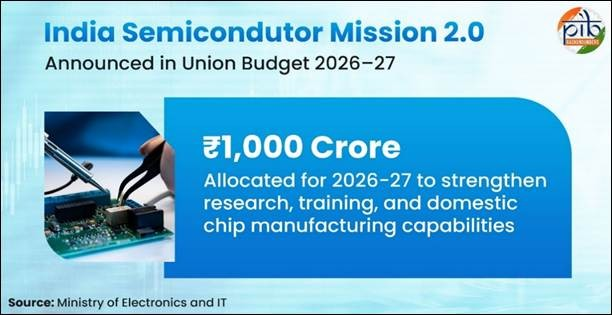
What are Semiconductors?
- Semiconductors are materials with conductivity between conductors and insulators.
- They form the backbone of modern electronics and digital infrastructure.
- Examples:
- Pure elements: Silicon, Germanium
- Compounds: Gallium Arsenide, Cadmium Selenide
- Essential for sectors such as: Information Technology, telecommunications, automobiles, aerospace, defence, clean energy, and medical devices
- Enable digital economy, AI, 5G, IoT, and advanced computing systems
- Considered a strategic and critical technology globally
- Semiconductor Scenario in India
- India largely depends on imports from China, Taiwan, USA, and Japan.
- Market Size:
- ~$38 billion (2023) → ~$45–50 billion (2024–25)
- Projected to reach $100–110 billion by 2030
- Target: Achieve 70–75% domestic self-sufficiency by 2029
India Semiconductor Mission (ISM 1.0)
- Launched: 2021
- Nodal Ministry: Ministry of Electronics and Information Technology (MeitY)
- Financial Outlay: ₹76,000 crore
- Objectives
- Develop a vibrant semiconductor and display ecosystem
- Promote manufacturing, design, and innovation
- Key Schemes
- Production Linked Incentive (PLI)
- Design Linked Incentive (DLI)
- SPECS (Scheme for Promotion of Manufacturing of Electronic Components and Semiconductors)
- Components
- Semiconductor fabs and display fabs
- Compound semiconductors, sensors, MEMS
- ATMP/OSAT (Assembly, Testing, Marking, Packaging)
India Semiconductor Mission (ISM 2.0)
- Aims to position India as a reliable and competitive global semiconductor hub
- Supports Aatmanirbhar Bharat and Make in India–Make for the World
- Budgetary Support: ₹1,000 crore (FY 2026–27)
- Key Focus Areas of ISM 2.0
- Indigenous Manufacturing: Focus on equipment, chemicals, gases, and materials
- Full-Stack IP Development: Promote end-to-end Indian semiconductor design capabilities
- Research & Skill Development: Industry-led R&D and training centres
- Supply Chain Resilience: Reduce vulnerability to geopolitical disruptions
- Key Initiatives:
- Design Linked Incentive (DLI) → Supports fabless companies
- Digital India RISC-V Programme → Open-source chip design
- Chips to Startup Programme → Access to design tools
- Indigenous Processors (e.g., DHRUV64) → Reduce import dependence
Fast Breeder Reactor – India’s Three-Stage Nuclear Programme
Context and Overview
- India’s first indigenous Fast Breeder Reactor (FBR) at Kalpakkam (Tamil Nadu) has attained criticality, marking a crucial milestone in the second stage of India’s three-stage nuclear programme.
- The reactor has a capacity of 500 MWe and has been developed by BHAVINI (established in 2003).
- With its commissioning, India will become the second country after Russia to operate a commercial Fast Breeder Reactor.
- The achievement reflects India’s advancing nuclear capability and engineering strength.
Fast Breeder Reactor: Concept and Working
- A Fast Breeder Reactor (FBR) is designed to produce more fissile material than it consumes.
- It uses:
- Mixed Oxide (MOX) fuel (Uranium + Plutonium)
- A surrounding Uranium-238 (U-238) blanket
- Through nuclear transmutation, U-238 converts into plutonium, generating additional fuel.
- This feature makes FBRs critical for fuel efficiency and sustainability in nuclear energy.
India’s Three-Stage Nuclear Programme
- India’s nuclear strategy is designed to utilise limited uranium and abundant thorium reserves.
- Stage 1: Pressurised Heavy Water Reactors (PHWRs)
- Use natural uranium and heavy water (D₂O)
- Form the major share of India’s current nuclear capacity (~8,000+ MWe)
- Stage 2: Fast Breeder Reactors (FBRs)
- Use plutonium-based fuel
- Generate additional fissile material
- Serve as a bridge to the thorium cycle
- Stage 3: Thorium-Based Reactors
- Use thorium (Th-232) to produce Uranium-233
- Aim for long-term energy security
- India possesses significant thorium reserves in coastal and inland regions, making this programme strategically important.
Criticality and Reactor Operation
- Criticality refers to a state where a self-sustaining nuclear chain reaction is achieved.
- In this state, each fission event releases enough neutrons to continue the reaction, enabling stable power generation.
- Nuclear Fission Process:
- Splitting of uranium atoms releases heat, radiation, and neutrons
- Heat is used to produce steam → turbines → electricity
- Control Mechanism:
- Control rods made of cadmium, boron, or hafnium regulate neutron flow
- Insertion reduces reaction; withdrawal increases it
- Full insertion can shut down the reactor
- Supercriticality:
- Temporary state where neutron production exceeds losses during start-up
- Eventually stabilised to critical state
16th Finance Commission (2026–31) – Key Recommendations on Tax Devolution and Grants
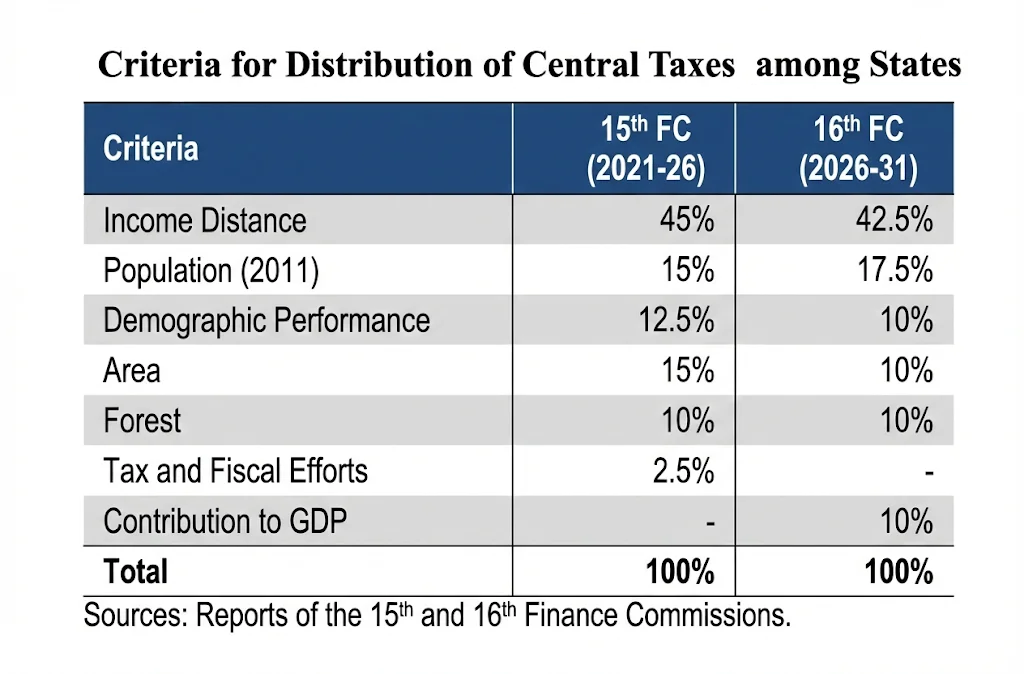
Key Recommendations
- Tax Devolution
- Vertical Devolution:
- States’ share retained at 41% of divisible pool (same as 15th FC).
- Divisible pool excludes: cesses, surcharges, and collection costs.
- Horizontal Devolution Criteria (Weights):
- Income distance – 42.5%
- Population (2011 Census) – 17.5%
- Demographic performance – 10%
- Area – 10%
- Forest & ecology – 10%
- Contribution to GDP – 10% (new criterion)
- Key Shift:
- Removal of tax effort parameter
- Greater emphasis on economic performance and equity
- Vertical Devolution:
- Grants-in-Aid
- Total grants: ₹9.47 lakh crore (2026–31)
- Local Body Grants:
- ₹8 lakh crore
- Rural: ₹4.4 lakh crore
- Urban: ₹3.6 lakh crore
- Conditions for grants:
- Proper constitution of local bodies
- Public disclosure of accounts
- Timely State Finance Commission reports
- Grant Structure:
- 80% Basic grants (50% tied to sanitation & water)
- 20% Performance-based grants
- Special Grants:
- Urbanisation premium: ₹10,000 crore
- Wastewater infrastructure: ₹56,100 crore
- Disaster Management Grants:
- ₹2.04 lakh crore
- Sharing ratio:
- 90:10 (NE & Himalayan states)
- 75:25 (others)
- Fiscal and Economic Reforms
- Fiscal Deficit Targets:
- Centre: 3.5% of GDP by 2030–31
- States: 3% of GSDP
- Debt Reduction:
- Combined debt to fall from 77.3% → 73.1% of GDP
- Off-budget borrowings:
- Recommended to be eliminated and included in fiscal accounting
- Fiscal Deficit Targets:
About Finance Commission (FC)
- The Finance Commission (FC) is a constitutional body under Article 280 of the Constitution (Part XII – Finance).
- It is considered a quasi-judicial body and acts as the balancing wheel of fiscal federalism in India.
- Constitution: Constituted by the President of India every 5 years (quinquennially) or earlier if required.
- Composition:
- Chairperson + 4 members (appointed by the President)
- Parliament determines qualifications of members
- Typically includes experts, including judicial background (e.g., HC judge)
- Tenure:
- Determined by the President
- Reappointment is allowed
- Recommendations are advisory and not binding on the government.
- The Commission has powers of a civil court under the Code of Civil Procedure, 1908.
