
Lakkundi Excavation
Overview
- Nature: ASI-supervised archaeological excavation at Kote Veerabhadreshwar (Veerabhadraswamy) Temple.
- Objective: Uncover buried structures and cultural layers to support heritage conservation and UNESCO nomination.
Location
- Village: Lakkundi (historical name: Lokkigundi)
- District: Gadag, Karnataka
- Proximity: ~12 km from Gadag town
Historical Background
- Period of prominence: 10th–13th centuries
- Rulers: Kalyana Chalukyas, later Hoysalas
- Epithet: “Village of a hundred wells and temples”
- Cultural patronage: Linked to Queen Attimabbe (11th century), noted Jain philanthropist
- Religious landscape: Hindu temples, Jain basadis, stepwells, and a later Muslim dargah
- Architecture: Known for the “Lakkundi school” of Chalukyan temple architecture
Key Discoveries
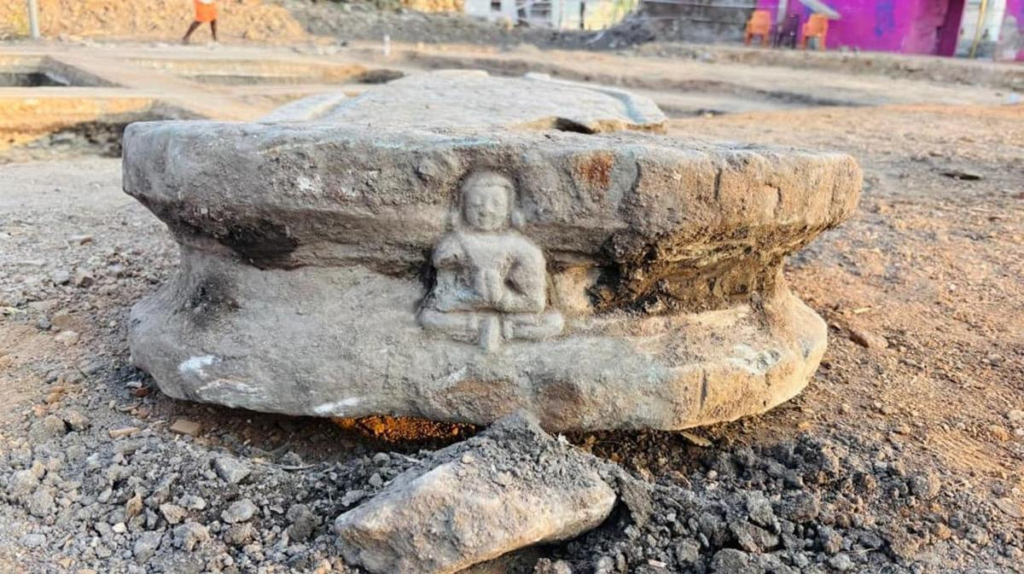
- Neolithic layer: Grey clay pot fragments, stone axe, cowrie shells, cross-shaped pedestal
- Early historic–medieval layer: Stone pedestal with Jina carving, inscriptions, buried temple remains
- Continuity: Evidence of occupation from prehistoric to early medieval phases.
Significance
- Extends Lakkundi’s timeline beyond medieval history to prehistoric settlement.
- Strengthens Karnataka’s case for UNESCO World Heritage nomination of Lakkundi monuments.
Bharat Ratna
Overview
- India’s highest civilian honour, conferred by the President of India.
- Awarded for exceptional service in any field, without discrimination of gender, profession, or nationality.
Establishment & Authority
- Instituted: 2 January 1954
- By: President Dr. Rajendra Prasad
- Recommendations: Made by the Prime Minister to the President.
Recognition & Nature
- Award includes:
- Sanad (certificate) signed by the President.
- Medallion (no cash component).
- Not a title:
- Article 18(1) prohibits use as prefix/suffix.
- Permitted usage: “Recipient of Bharat Ratna” in biodata and official documents.
Eligibility & Limits
- Open to Indians and non-Indians.
- Annual cap: Maximum three awards per year.
- Exceptions: 1999 (4 awards), 2024 (5 awards).
- Posthumous awards: Allowed since 1966.
First & Notable Recipients
- First recipients (1964):
- Dr. Sarvepalli Radhakrishnan
- Dr. C.V. Raman
- C. Rajagopalachari
- First posthumous award: Lal Bahadur Shastri (1966).
- Youngest recipient: Sachin Tendulkar (2014).
- Non-Indian recipients: Mother Teresa, Khan Abdul Ghaffar Khan, Nelson Mandela.
Legal Position
- Supreme Court (Balaji Raghavan v. Union of India, 1996):
- National awards do not violate Article 18.
- They are honours, not hereditary or titular distinctions.
Medal Design & Production
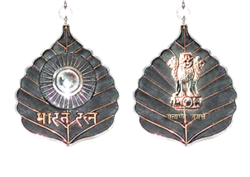
- Shape: Peepal leaf form.
- Obverse: Sunburst with “Bharat Ratna” in Devanagari.
- Reverse: “Satyameva Jayate” below the State Emblem.
- Materials:
- Platinum (emblem, sun, rim)
- Burnished bronze (inscriptions)
- Minted at: Alipore Mint, Kolkata
FRBM Act, 2003

Overview
- Full form: Fiscal Responsibility and Budget Management Act, 2003
- Objective: Ensure fiscal discipline, inter-generational equity, and long-term macroeconomic stability.
- Focus: Guide Central Government towards sustainable deficit and debt management.
- CAG Role: Mandatory annual compliance audit of FRBM provisions.
Mandatory Budget Statements (Laid Before Parliament)
- Macro-Economic Framework Statement: Economic outlook and assumptions.
- Medium-Term Fiscal Policy Statement: Fiscal targets and rolling projections.
- Fiscal Policy Strategy Statement: Policy stance and fiscal priorities.
Key Fiscal Targets
- Fiscal Deficit
- Original target: ≤ 3% of GDP
- Deadline: 31 March 2021
- Actual (2023–24, CAG): 5.32% of GDP
- Revised path: < 4.5% of GDP by FY 2025–26
- Public Debt Limits
- General Government (Centre + States): ≤ 60% of GDP
- Central Government: ≤ 40% of GDP
- Deadline: End of FY 2024–25
- Current (2023–24):
- Central Government: 57% of GDP
- General Government: 81.3% of GDP
- Additional Guarantees
- Cap: ≤ 0.5% of GDP per year
- Linked to: Consolidated Fund of India
- FRBM Amendment, 2018:
- Removed targets for Revenue Deficit and Effective Revenue Deficit.
- Shifted focus to debt and fiscal deficit anchoring.
Strategic Asset Allocation and Risk Governance (SAARG)

Overview
- A committee for Strategic Asset Allocation and Risk Governance (SAARG) is constituted by Pension Fund Regulatory and Development Authority (PFRDA).
- Chairperson: Narayan Ramachandran
- Timeframe: To submit recommendations within 9 months
- Scope: National Pension System (NPS) — Government and Non-Government sectors
Purpose
- Modernise NPS investment guidelines in line with global pension best practices.
- Align portfolio design with Indian capital market evolution and long-term subscriber needs.
Mandate / Key Functions
- Global benchmarking: Compare NPS norms with leading international pension systems.
- Asset class review: Assess current classes; recommend new/alternative assets for diversification.
- Strategic allocation: Propose optimal mix across equity, debt, money market, and alternatives with prudential caps.
- Performance framework: Reform benchmarks and evaluation of Pension Funds.
- Risk governance & ALM: Strengthen market, credit, liquidity, and operational risk management aligned to liabilities.
- Intermediary oversight: Review custodial architecture and end-to-end investment processes.
- Sustainability: Integrate climate risks and net-zero pathways into NPS investments.
Significance
- Enhances returns, diversification, and resilience of NPS portfolios.
- Strengthens governance and accountability in pension fund management.
- Supports long-term retirement security for NPS subscribers.
Jeevan Raksha Padak Awards
Overview
- Nature: Civilian life-saving gallantry award series for acts involving personal risk to save lives.
- Established: 1961 (offshoot of the Ashoka Chakra gallantry awards).
- Authority: Approved by the President of India on PM’s recommendations.
Categories
- Sarvottam Jeevan Raksha Padak: Conspicuous courage under very great danger.
- Uttam Jeevan Raksha Padak: Courage and promptitude under great danger.
- Jeevan Raksha Padak: Courage with grave risk of bodily injury.
Eligibility
- Open to all persons, irrespective of gender or occupation.
- Posthumous awards permitted.
- Acts covered: Drowning rescues, fires, accidents, electrocution, mine rescues, natural disasters.
Process
- Nominations: Invited annually from States/UTs and Union Ministries.
- Scrutiny: Jeevan Raksha Padak Awards Committee (within two years of the act).
- Final approval: Prime Minister and President of India.
Award & Allowance
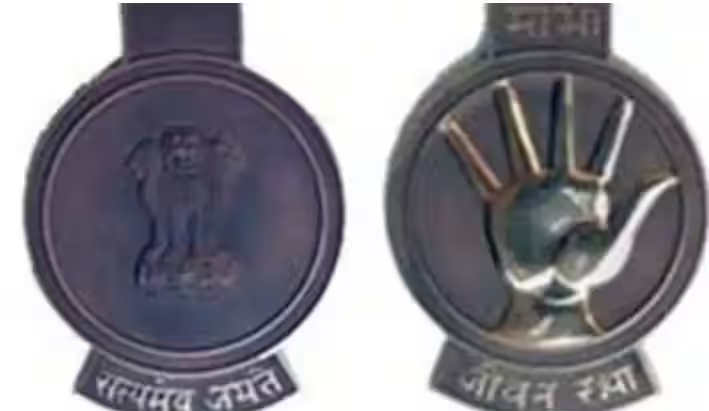
- Components: Medallion + Certificate.
- One-time monetary allowance:
- Sarvottam: ₹2 lakh
- Uttam: ₹1.5 lakh
- Jeevan Raksha: ₹1 lakh
- No service concessions: No rail/airfare or additional perks.
Significance
- Promotes civic courage and humanitarian values.
- Recognises ordinary citizens for extraordinary life-saving acts.
Dugong Conservation Centre
Context
- EAC (MoEFCC) recommended a design overhaul of the proposed International Dugong Conservation Centre.
- Location: Manora, Thanjavur, Tamil Nadu.
- CRZ Status: Falls in CRZ-III No Development Zone and overlaps CRZ-I areas with mangroves and seagrass meadows.
Dugong (Dugong dugon)
- Overview
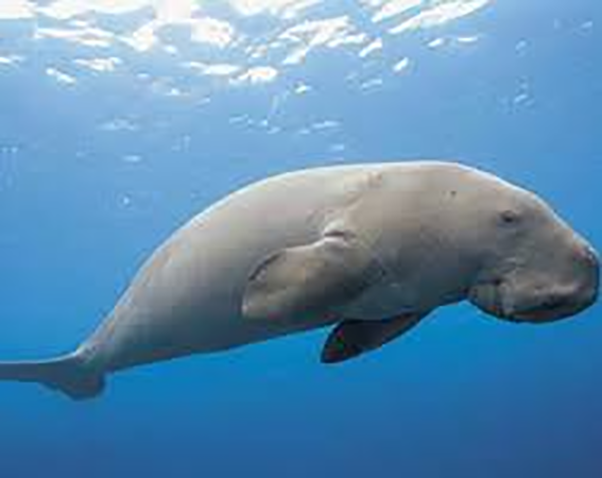
- Type: Large marine mammal, also called “sea cow” and “farmer of the sea”.
- Size: Grows up to 10 feet; weighs about 420 kg.
- Tail: Dolphin-like, fluked tail.
- Habitat & Diet
- Habitat: Shallow, warm coastal waters (<10 m depth), bays and lagoons.
- Diet: Strictly herbivorous, feeds on seagrass meadows.
- Distribution in India
- Gulf of Kutch
- Gulf of Mannar–Palk Bay
- Andaman and Nicobar Islands
- Behaviour & Reproduction
- Social pattern: Solitary or in small pairs.
- Lifespan: Up to 70 years.
- Maturity: Reaches sexual maturity at 9–10 years.
- Breeding interval: One calf every 3–5 years.
- Conservation Status
- IUCN: Vulnerable (VU)
- CITES: Appendix I (international trade prohibited)
- India: Schedule I, Wildlife (Protection) Act, 1972
Seagrass
- Overview
- Type: Underwater flowering plant forming vital coastal wetland ecosystems.
- Functions: Stabilises seabed, supports fisheries, carbon sequestration, shelters marine biodiversity.
- Distribution in India
- Highest diversity: Gulf of Mannar and Palk Bay, Tamil Nadu.
- Species richness: Over 13 species recorded.
- Limited populations: Lakshadweep, Kachchh, Andhra Pradesh, Odisha.
- Threat status: Increasingly degraded and fragmented.
- Significance
- Dugongs depend directly on healthy seagrass ecosystems.
- CRZ-I overlap highlights conservation–development trade-offs in coastal infrastructure planning.
Graviton

Context
- Researchers from Stevens Institute of Technology and Yale University are developing an experiment to detect gravitons, aiming to link quantum mechanics with general relativity.
About Graviton
- Overview
- Definition: A hypothetical elementary particle proposed to mediate the gravitational force.
- Analogy: Similar to photons carrying electromagnetic force.
- Scientific value: Confirmation would establish gravity as a quantum force.
- Proposed Detection Method
- Detector type: Superfluid helium resonator.
- Operating condition: Cooled to quantum ground state to minimise background noise.
- Mechanism:
- A passing gravitational wave may transfer a single quantum of energy (graviton).
- This generates a phonon (quantum vibration) inside the resonator.
- Lasers are used to detect the vibration signal.
- Detection Challenges
- Weakest fundamental force: Gravity is far weaker than electromagnetic, strong, and weak nuclear forces.
- Low interaction probability: Gravitons can pass through matter with near-zero interaction.
- Signal ambiguity: Observed vibrations may still be explained by classical gravity effects.
- Limitations
- Practical feasibility: Theoretical studies suggest single-graviton detection may be technologically unachievable.
- Noise sensitivity: Extreme isolation and precision are required to avoid false signals.
- Significance
- Theoretical breakthrough: Would support a quantum theory of gravity.
- Scientific impact: Bridges the gap between Einstein’s general relativity and quantum mechanics.
- Cosmological insight: Enhances understanding of the fundamental structure of the universe.
