
Why in News: In May 2025, the Indian government accepted a report recommending a Repairability Index for electronics. New e-waste rules now offer minimum payments to incentivise formal recycling.
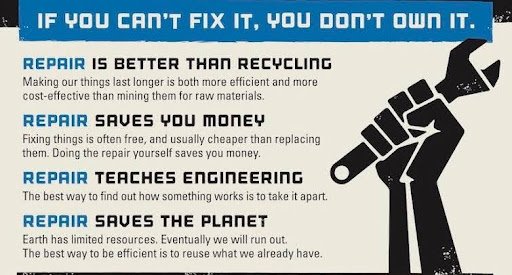
The Need for Repairable Electronics
1. Growing Consumer Concerns
- Increase in complaints about modern appliances breaking down faster than older ones.
2. Reasons Behind Poor Durability
- a. Planned Obsolescence: Companies intentionally design products with shorter lifespans.
- b. Declining Metal Content: Reduction in durable materials used in appliances due to:
- Rising global metal prices
- Market competition
- c. Import Dependence: India heavily relies on imported metals like copper which increases vulnerability to global supply and pricing issues.
3. Broader National Goals Linked to Repairability
- Reduce electronic waste (e-waste)
- Promote a circular economy where old parts are reused and reintegrated.
- Lower demand for virgin (newly mined) metals, conserving natural resources.
The Right to Repair Movement
The Right to Repair empowers consumers to:
- Choose how and where to repair their devices.
- Access services from either manufacturers or independent repairers.
- Promote transparency, affordability, and sustainability in product maintenance.
Indian Initiative: The Department of Consumer Affairs (DoCA) launched the:
- Right to Repair Portal to enhance consumer access and awareness.
Challenges faced by India’s repair ecosystem
- Tacit repair knowledge is mostly informal and at risk of being lost.
- Policies focus more on recycling than repair, ignoring informal repair skills.
- Modern products are designed to be hard to repair with limited spare parts.
- AI and digital policies do not adequately recognise repair communities.
- Informal repairers lack formal market access, skilling, and social protection.
- Poor repair culture increases e-waste and demand for virgin materials.
Importance of Tacit Knowledge
- Informal repairers rely on hands-on, experiential learning (e.g., muscle memory, observation).
- Skills passed through apprenticeship, not formal training.
- Informal repairers (e.g., Karol Bagh, Ritchie Street) keep products running beyond planned obsolescence.
- Use sensory diagnosis, reuse parts, and improvise.
Policy Gaps
- E-waste rules 2022 focus on recycling, barely mention repair.
- PMKVY does not accommodate improvisational repair skills.
- NEP 2020 values experiential learning but lacks implementation for repair traditions.
- Mission LiFE promotes sustainability but overlooks repairers.
Comparison of the Right to Repair Movement
1. Right to Repair Movement in the United States: Gained strong legislative support targeting restrictive repair practices such as
- Limiting access to spare parts
- Using proprietary software to lock devices
- Penalizing third-party repair providers
Laws require companies to:
- Publish repair costs transparently
- Provide access to spare parts for consumers and independent repairers.
Example: McDonald’s ice cream machines can only be repaired by Taylor Company technicians, causing consumer frustration and attracting regulatory attention.
2. Right to Repair Movement in India: Indian policy is still evolving with ongoing collaboration between
- The government
- Manufacturers and stakeholders
The Department of Consumer Affairs launched:
- The Right to Repair framework (2022)
- A national repair portal (2023) covering sectors like electronics, automobiles, and farm equipment.
3. Global Mandates and Frameworks: The European Union mandates
- Access to spare parts
- Availability of repair documentation for consumers and repairers.
Significance of Right to Repair
- Reduces pollution and saves natural resources by countering planned obsolescence.
- Supports small repair shops and strengthens local economies.
- Lowers repair costs and improves service quality by ending manufacturer monopolies.
Role of AI and Technology
- AI benefits from tacit labour but fails to credit it.
- Need to align AI development with grassroots realities.
- Use LLMs and decision trees to document and preserve tacit knowledge.
Recommendations
- Embed repairability in AI and hardware design.
- Recognise informal repairers via e-Shram and social schemes.
- Revise skilling programmes to include diagnostic and improvisational training.
- Treat repairers as stewards of sustainability, not marginal workers.
Conclusion: Repair is not just a service — it is embodied knowledge. Preserving tacit repair wisdom is crucial for technological sustainability and justice. A truly inclusive tech future requires not just innovation but remembrance of human expertise.
UPSC Relevance
GS Paper II – Governance
- Government policies and interventions
GS Paper III – Environment & Economy
- Environmental pollution and waste management
Mains Practice Question
Q. “The Right to Repair is not just about consumer choice, but about sustainability, equity, and preservation of local knowledge.” Discuss in the context of India’s evolving digital and environmental policy landscape.