
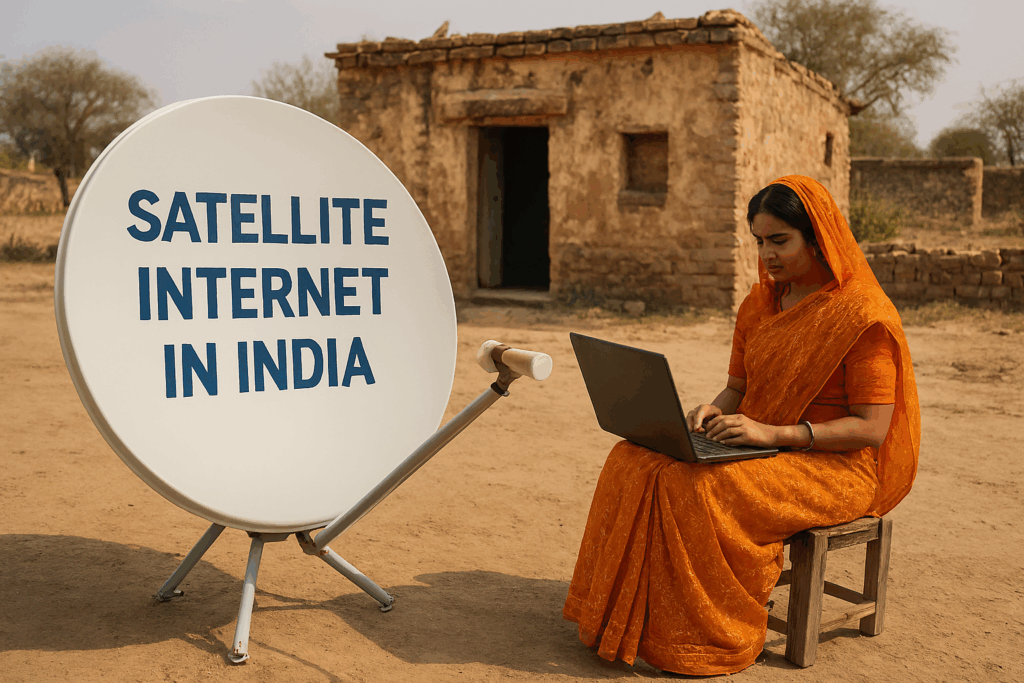
Why in News: Elon Musk’s Starlink satellite internet is set to debut in India, highlighting the country’s move toward space-based internet connectivity.
A) Need for Satellite Internet
A.1 Limitations of Ground-Based Networks
- Depend on physical infrastructure like cables & towers.
- Economically unviable in sparsely populated or remote regions.
- Vulnerable to natural disasters (floods, earthquakes) that damage infrastructure.
- Cannot fully meet on-the-move connectivity needs (air travel, shipping, disaster response, military in remote zones).
A.2 Advantages of Satellite Internet
- Global and resilient coverage irrespective of terrain or terrestrial infrastructure.
- Rapid deployment for sudden demand surges or disaster recovery.
- Works on moving platforms (planes, ships, remote expeditions, oil rigs).
- Bridges digital divides in underserved regions.
B. Dual Nature of Satellite Internet
Satellite internet serves both civilian and military purposes — a dual-use nature that creates unique opportunities and risks.
Beneficial Usage:
- Hurricane Harvey 2017: Viasat provided emergency connectivity when 70% of cell towers went down.
- Russia–Ukraine War: Starlink enabled Ukrainian forces to coordinate troop movements, medical evacuations, and drone operations.
- Indian Army at Siachen: Ensured connectivity in extreme conditions.
Risks & Illicit Use:
- Smuggled Starlink terminals seized from insurgent and criminal groups in India.
- The borderless nature of satellites can bypass local censorship and security controls.
Strategic Implication: Control over satellite internet is emerging as a new dimension of national power.
How Satellite Internet Works
A satellite internet system has two key segments:
- Space Segment: The satellites in orbit carrying communication payloads.
- Ground Segment: User terminals, ground stations, and network control systems.
Satellites:
- Cost-intensive to build and launch.
- Operate for 5–20 years depending on design.
- Chosen orbital altitude determines latency, coverage, and costs.
C. Three Main Satellite Orbits
C.1 Geostationary Earth Orbit (GEO)
Altitude: ~35,786 km.
Feature: Matches Earth’s rotation — remains fixed over one location.
Coverage: ~1/3 of Earth’s surface (except polar regions).
Advantages: Large coverage.
Disadvantages:
- High latency due to signal travel distance.
- Not ideal for real-time applications.
- Example: Viasat’s Global Xpress.
C.2 Medium Earth Orbit (MEO)
Altitude: 2,000–35,786 km.
Advantages: Lower latency than GEO, better performance for some applications.
Disadvantages:
- Still not optimal for real-time applications.
- Requires a constellation for complete coverage.
- Example: O3b Networks (20-satellite system).
C.3 Low Earth Orbit (LEO)
Altitude: <2,000 km.
Advantages:
- Very low latency.
- Small, relatively inexpensive satellites (often table-sized).
- Faster deployment cycles.
Disadvantages:
- Small coverage footprint → requires large mega-constellations for global reach.
- Example: Starlink (7,000+ satellites, plans for up to 42,000).
D. LEO Mega-Constellations
How They Work:
- Hundreds/thousands of satellites form a mesh network in space.
- On-board processing improves efficiency and reduces reliance on bulky ground equipment.
Optical Inter-Satellite Links (OISL):
- Satellites communicate with each other directly, routing data in space.
- Minimises dependence on multiple ground stations.
Handover Mechanism:
- LEO satellites move at ~27,000 km/h and stay in view for only a few minutes.
- Steerable antennas manage smooth handovers between satellites for uninterrupted service.
E. Future Developments
- Direct-to-smartphone connectivity under testing (AST SpaceMobile, Starlink).
- Potential elimination of standalone terminals.
- Integration into everyday devices like laptops and smartphones.
F. Applications Across Sectors
- Connectivity in remote and rural regions.
- Disaster management and emergency communications.
- Military operations and secure field communications.
- Transportation: Navigation, logistics, autonomous vehicles.
- Agriculture: Precision farming, crop monitoring.
- Healthcare: Telemedicine, remote patient monitoring.
- Environmental monitoring, energy exploration, tourism, and smart cities.
Strategic and Policy Implications
- Means to close the digital divide in countries like India.
- Enhances civil resilience and military readiness.
- Raises national security concerns due to misuse potential.
- Highlights the urgency for international rules and governance for mega-constellations.
Conclusion: Satellite internet is not just an emergency backup — it is a transformative technology that can reshape:
- Global connectivity
- Economic development
- Civil infrastructure resilience
- National security strategies
UPSC RELEVANCE
GS Paper 3 – Science & Technology, Economy, Disaster Management
- Emerging technologies: satellite internet and LEO mega-constellations.
Mains Practice Questions:
Q. “Satellite internet is not just a technological innovation but a new dimension of national power.” Discuss with examples.