
Syllabus: Linkages between development and spread of extremism.
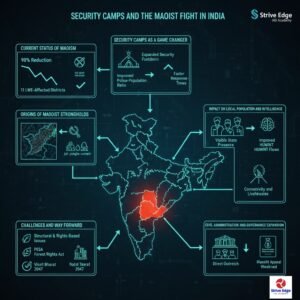
Current Status of Maoism
- Maoist violence has declined sharply, with incidents reducing by nearly 90% between 2010 and 2025.
- LWE-affected districts fell from 126 (2018) to 11 (October 2025).
- Only Bijapur, Narayanpur, and Sukma in south Bastar remain most affected.
- Insurgency is now confined to limited pockets of Bastar division, Chhattisgarh.
Origins of Maoist Strongholds
- Maoists entered Dandakaranya region (DKR) in the early 1980s.
- Pressure in Andhra Pradesh pushed cadres into forested, rugged border regions.
- DKR’s terrain spanned Chhattisgarh, Andhra Pradesh, Maharashtra, Odisha, Telangana.
- Administrative neglect and governance deficit enabled Maoist expansion.
- Tribal marginalisation and conflicts over jal–jungle–zameen shaped the insurgency.
Security Camps as a Game Changer
- Establishment of security camps in remote Maoist-dominated areas proved decisive.
- Initial local resistance declined after visible benefits to communities emerged.
- Camps expanded the security footprint, deterring Maoist movement and dominance.
- Improved police–population ratio restricted Maoist operational freedom.
- Faster response times placed Maoists in a defensive posture.
- Enhanced force confidence and morale altered the conflict balance.
Impact on Local Population and Intelligence
- Visible state presence caused a psychological setback to Maoists.
- Locals increasingly viewed the government as the welfare provider.
- Improved human intelligence (HUMINT) flows strengthened counter-insurgency operations.
- Road construction and mobile towers transformed connectivity and livelihoods.
Civil Administration and Governance Expansion
- Civil administration leveraged security camps to re-enter inaccessible areas.
- Officials like collectors, tehsildars, and patwaris began direct outreach.
- Maoist appeal weakened and recruitment, funding, and arms acquisition declined.
- Many cadres and leaders have surrendered or been neutralised.
Challenges and Way Forward
- Long-term peace requires addressing structural and rights-based issues.
- Implementation of PESA and Forest Rights Act is essential.
- Governance must be rebuilt from scratch in previously neglected areas.
- A long-term task force plan till 2047, aligned with Viksit Bharat, is required.