
Why in News: Assam Police recently summoned The Wire editors Siddharth Varadarajan and Karan Thapar under Section 152 of the BNS, despite Supreme Court protection in their petition challenging the law.
Significance of the Issue
- Freedom of Speech & Expression (Art. 19(1)(a)): Core of democratic governance.
- Reasonable Restrictions (Art. 19(2)): Must be narrowly defined, not open to abuse.
- Press Freedom: Essential for holding government accountable and fostering informed citizenry.
- Judicial Role: Supreme Court is examining validity of Section 152 → potential landmark ruling.
Issues with Section 152 (BNS)
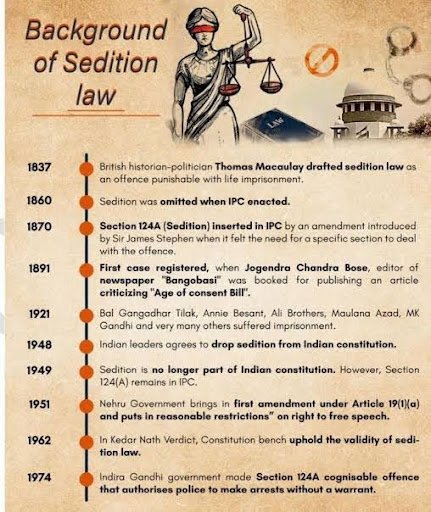
- Rebranded Sedition – replaces Section 124A IPC but expands scope.
- Vague Wording – “sovereignty, unity, integrity” left undefined → wide room for misuse.
- Lower Bar for Prosecution – use of term “knowingly” allows cases without proving intent to incite violence.
- Political Weaponisation – Used by ruling regimes to silence criticism and opposition.
- Chilling Effect – Journalists, academics, civil society avoid critical voices → self-censorship.
Democratic and Constitutional Concerns
- Contradiction with Article 19: Over-broad restrictions on free speech.
- Basic Structure Doctrine: Free speech is integral to democracy; overreach threatens constitutional morality.
- Federal Implications: Different states may use law selectively → uneven impact.
- Global Standing: Undermines India’s image as the world’s largest democracy.
Way Forward
- Judicial Review: SC must clarify constitutional validity and narrow interpretation of Section 152.
- Safeguards against Misuse:
- Judicial oversight before FIRs.
- Mandatory disclosure of FIRs & reasons for summons.
- Legislative Reform: Replace vague wording with precise definitions, ensure intent-based thresholds.
- Press Freedom Protections: Institutional safeguards for journalists against harassment.
- Public Debate: Encourage informed dialogue on balancing national integrity with free expression.
Conclusion
Section 152 represents a continuity of colonial sedition laws under a new name. In a democracy, dissent and criticism are not threats but vital correctives. True national unity comes from inclusive governance and protected freedoms, not criminalisation of dissent.
Upsc Relevance
GS Paper II: Fundamental Rights, Freedom of Speech & Expression (Art. 19), reasonable restrictions, role of police & judiciary, accountability of institutions.
Mains Practice Question
Q. Section 152 of the Bharatiya Nyaya Sanhita has been criticised as a “rebranded sedition law.” Critically examine its implications for freedom of expression, press freedom, and democratic accountability in India. (10/15 marks)