
Features of the Act
- Private Sector Participation in Nuclear Energy
- The Act opens India’s nuclear sector to private companies and joint ventures, expanding participation beyond the State.
- Private entities may operate plants, generate electricity, and manufacture nuclear equipment and fuel.
- However, all radiation-linked activities require prior regulatory safety authorisation to protect public health.
- Activities Reserved for Central Government
- Sensitive stages of the nuclear fuel cycle remain under exclusive government control.
- This includes enrichment of radioactive materials and management of spent nuclear fuel.
- Such centralisation seeks to safeguard national security and public safety.
- Statutory Status to Atomic Energy Regulatory Board
- The Act grants legal status to the Atomic Energy Regulatory Board (AERB).
- This strengthens oversight over nuclear safety, radiation exposure, and emergency preparedness.
- Enhanced accountability aims to reassure citizens about plant safety and disaster readiness.
- New Civil Liability Framework
- The law introduces capped liability for nuclear operators at graded financial levels.
- Operator liability is capped between ₹100 crore and ₹3,000 crore.
- Total accident liability is capped at 300 million SDR (~₹3,900 crore).
- Compensation beyond these caps is covered through a Nuclear Liability Fund.
- Supplier liability has been removed, raising concerns about accountability in accident situations.
- The law introduces capped liability for nuclear operators at graded financial levels.
- Regulatory Oversight, Licensing & Dispute Mechanisms
- A structured system governs licensing, safety approvals, and operational compliance.
- Dedicated forums like the Nuclear Damage Claims Commission address accident disputes.
- Appellate remedies lie with the Appellate Tribunal for Electricity, ensuring legal recourse.
- Scope Expansion & Government Powers
- The Act regulates nuclear technologies used in healthcare, agriculture, and research.
- It grants the Centre acquisition powers in specified nuclear matters.
- Compensation provisions extend even to cross-border nuclear damage under defined conditions.
Significance of Nuclear Energy and the SHANTI Act
- Nuclear energy contributes only about 3% of India’s electricity generation.
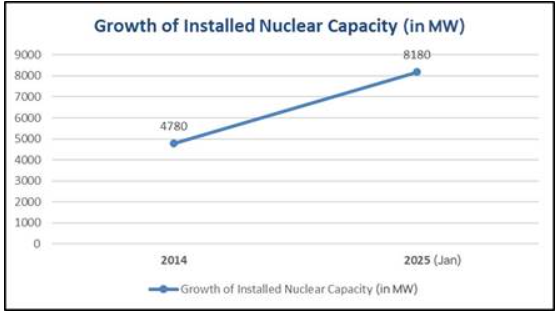
- At present, India’s nuclear capacity is 8180 MW.
- India targets nuclear capacity of 22.5 GW by 2031-32 and 100 GW by 2047.
- Successive capacity targets have remained significantly unachieved. The high capital costs and safety concerns hindered expansion.
- The Act aims to attract private and multinational investment.
- Liability dilution aligns India with international nuclear liability norms.
- It opens large commercial opportunities in reactor construction.
- Large reactor projects globally involve multi-billion-dollar investments. The Act facilitates corporate participation in such ventures.
Challenges Associated with the Act
- Supplier Indemnity : Removal of supplier liability weakens accountability for reactor design and equipment defects.
- Liability Cap Inadequacy : Compensation ceilings remain negligible compared to catastrophic nuclear damage costs.
- Victim Justice Deficit : Affected populations may bear uncompensated losses beyond capped limits.
- Moral Hazard Risk : Liability dilution reduces incentives for stringent safety and risk mitigation.
- Regulatory Independence Concerns : Oversight bodies lack full autonomy, raising safety governance questions.