
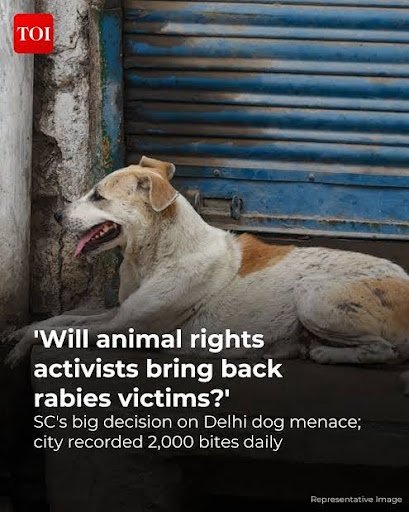
Why in News: On August 11, 2025, the Supreme Court of India directed the Delhi government and local bodies to immediately capture all stray dogs and place them in shelters.
Context
- The Court was responding to rising incidents of stray dog attacks on children, noting that “not a single dog picked up shall be released back on the streets.”
- This order has divided public opinion:
- Supporters welcome it due to the high number of dog-bite cases.
- Critics question its practicality, highlighting Delhi’s lack of shelter capacity and whether relocation alone will solve the problem.
Key Issues with the Supreme Court Order on Stray Dogs:
1. Insufficient Shelter Capacity
- Delhi lacks enough shelters to house all captured stray dogs, risking overcrowding and poor animal welfare.
2. Conflict with Existing Laws
- The order contradicts Animal Birth Control Rules 2023, which mandate “capture, neuter, vaccinate, release” and forbid permanent confinement of healthy dogs. Dogs can only be kept long-term if rabid, incurably ill, or proven dangerously aggressive.
3. Ineffective Sterilisation Coverage
- Sterilisation drives have not reached the 70% coverage needed to control dog populations, leading to persistent high densities in public areas.
4. Outdated Legal Framework
- The 1960 Prevention of Cruelty to Animals Act does not address the complexities of today’s urban dog populations.
5. Ideological Conflicts
- Tension exists between protecting “community dogs” and ensuring public safety in densely populated areas.
6. Lack of Funding and Professional Support
- Urban bodies lack steady funding and trained veterinary staff to run shelters and sterilisation programs effectively.
7. Risk of Merely Shifting the Problem
- Without proper resources, dogs may be confined in poorly managed shelters, not solving the stray dog issue but displacing it.
8. The Data Problem: Accurate population estimates are missing.
- National census: The last nationwide stray dog count is from the 2019 Livestock Census.
- Delhi census: Conducted in 2016, making current estimates outdated.
- Policy impact: India is framing policies in 2025 based on years-old dog population figures.
Examples of Data Mismatch:
Tamil Nadu (2019):
- 4.4 lakh stray dogs recorded.
- 8.3 lakh dog-bite cases — 2 bites for every stray dog reported.
Manipur (2019):
- Census recorded zero stray dogs.
- 5,500 dog-bite cases reported the same year.
Such inconsistencies suggest population data is unreliable, not bite data (since hospitals must record all dog bites due to rabies risk).
Supreme Court Order on Stray Dogs is Justified:
1. Addressing Public Safety Concerns
- Rising stray dog attacks, especially on children and infants, pose a serious threat to public safety.
- Delhi records around 30,000 dog bite cases annually, many risking fatal diseases like rabies.
2. Urgency and Decisive Action Needed
- Previous approaches (e.g., capture-neuter-release) have failed to curb dog population growth and reduce attacks effectively.
- The Court’s order demands immediate and comprehensive action, signaling seriousness to tackle a persistent problem.
3. Preventing Release of Dogs Back to Streets
- The directive to not release captured dogs back to public spaces aims to break the cycle of dog aggression and attacks in high-density areas.
- It reduces the risk of territorial packs re-establishing in residential neighborhoods.
4. Compels Expansion of Shelter Infrastructure
- The order pushes authorities to create and expand shelter capacity rapidly, highlighting the need for systematic care for stray dogs rather than ad hoc measures.
- This ensures humane treatment while addressing the stray population problem.
5. Overrides Administrative Inertia
- By overriding bureaucratic delays and lethargy, the Court compels local governments to act decisively and responsibly.
- Demonstrates judicial willingness to prioritize citizens’ safety and public health.
6. Focus on Rabies Control and Public Health
- Stray dogs are a major vector for rabies transmission, responsible for nearly 99% of human cases worldwide.
- Controlling dog populations through sheltering and management can complement vaccination efforts to reduce rabies incidence.
7. Promotes Accountability
- Mandates municipal bodies to be accountable for managing stray dogs and reducing dog bites, with clear timelines and directives.
8. Sets a Precedent for Other Cities
- Delhi’s high-profile case sets an example for other urban centers grappling with similar issues, encouraging nationwide policy reform.
Way forward
- Clear legal classification of stray dogs:
- Sociable (fit for adoption)
- Aggressive/ill (requiring euthanasia)
- Healthy but unadoptable (requiring shelter)
- Strict ban on dogs on public roads.
- Expand shelter capacity with proper veterinary and staffing standards.
- Stable funding sources (e.g., via National Centre for Disease Control) for:
- Building and running shelters.
- Large-scale sterilisation and vaccination.
- Modern veterinary training in shelter medicine.
- Mass Vaccination: Vaccinate at least 70% of dogs continuously to eliminate rabies, following successful models like Goa.
- Legal Reforms: Update outdated laws and Animal Birth Control Rules to allow flexible management, including sheltering and long-term impoundment.
- Accurate Dog Census: Conduct regular, scientific dog population counts to update policies with reliable data.
- Balanced Approach :Avoid romanticizing “community dogs” to the detriment of human health and safety.
UPSC Relevance
1. GS Paper II (Governance, Polity, and Welfare)
- Judicial intervention and suo motu cases (SC directing Delhi Govt on stray dogs).
2. GS Paper III (Economic Development, Environment, and Disaster Management)
- Public health issues: Rabies, dog bites, and their socio-economic impact.
Mains Practice Question
Q. Discuss the role of the judiciary in addressing public health crises: Illustrate with the recent Supreme Court order on stray dogs.