
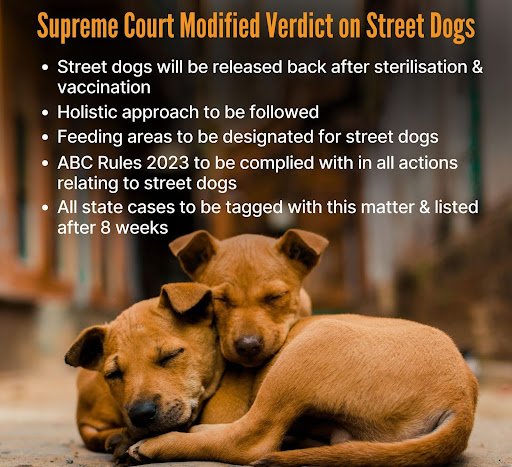
Why in News: On August 11, 2025, the Supreme Court directed all street dogs in Delhi to be rounded up and confined in shelters. The order was later stayed on August 22, 2025, shifting focus back to humane and scientific solutions like the Animal Birth Control (ABC) programme.
Problems with the Initial Order
Scientific Concerns
- Shelter model failure: Globally, large-scale dog shelters have failed, often resulting in overcrowding, aggression, and disease outbreaks (e.g., U.S. “pound system”).
- Public health risk: Overcrowded shelters can spread rabies, leptospirosis, and other zoonotic diseases.
- Ecological imbalance: Removal of dogs creates a vacuum effect, inviting dogs from neighbouring states and causing rodent/monkey population surges.
- Contradicts WHO & NAPRE guidelines: Both recommend mass sterilisation and vaccination, not confinement.
Legal and Constitutional Issues
- Contradiction with prior SC judgment (2024): The earlier Bench upheld Animal Birth Control (ABC) Rules, 2023, rooted in humane and scientific methods.
- Violation of Article 51A(g): Fundamental duty of citizens to show compassion for living creatures.
- Risk of cruelty: Indiscriminate capture amounts to state-sanctioned cruelty.
Ethical and Social Concerns
- Street dogs as companions: For Delhi’s homeless and marginalised, street dogs provide safety and companionship.
- False narrative: Framing the issue as a “dog lovers vs. poor” conflict misrepresents the reality and deepens social divides.
Governance Failures
- Stray dog debate diverts attention from infrastructure, flooding, corruption, and inflation.
- MCD’s failure to implement Animal Birth Control (ABC) effectively.
- Chronic underfunding of sterilisation and vaccination programmes.
- Poor monitoring and lack of accountability in civic bodies.
- Negligence despite successful models (Jaipur, Jodhpur) showing proven results.
Humane and Scientific Solution: ABC Programme
- ABC = sterilisation + vaccination – globally endorsed as effective.
- Jaipur model: steady reduction in stray dog numbers.
- Jodhpur study (2010): significant population decline and vaccination coverage.
- Recognised by WHO and ABC Rules, 2023.
- Humane, cost-effective, and sustainable compared to sheltering.
Way Forward
- Strict enforcement of ABC Rules, 2023 with adequate funding.
- Establish uniform national protocol for humane stray dog management.
- Ensure accountability of civic bodies (MCD, municipalities) in meeting sterilisation targets.
- Adopt evidence-based approaches: isolate only aggressive dogs.
- Strengthen public awareness and community responsibility in waste management and animal care.
Conclusion
The real problem lies not with the animals but with institutional apathy and governance failures. A safer and more humane city can only be achieved through Animal Birth Control, vaccination, and accountability of civic authorities.
UPSC Relevance
- GS Paper II (Polity & Governance): Judicial accountability, role of municipal bodies, policy implementation.
- GS Paper III (Science & Technology / Environment): Public health, zoonotic diseases, ecological balance.
Mains Practice Question
Q. The issue of stray dog management in India highlights the intersection of public health, judicial accountability, and humane governance. Critically analyse the Supreme Court’s recent order in this context and suggest a way forward.