

UPSC MainsGS Paper IIIIndian Economy
The Cost of Unconditional Cash Transfers
📰 State governments are rolling out unconditional cash transfer schemes before elections, prompting the Election Commission and Supreme Court to flag fiscal and ethical concerns.
Theoretical Basis
Universal Basic Income (UBI)
RBI Warning
State debt-to-GSDP nearing unsustainable levels
Watchdog Concern
Election Commission & Supreme Court
📰
Unconditional Cash Transfer Schemes: News
- Multiple state governments are implementing unconditional cash transfer schemes targeting voters before elections.
- These schemes provide direct cash payments to beneficiaries without any conditionality attached.
- The Election Commission and Supreme Court have expressed concern about scheme announcements before elections.
📖
Meaning of Unconditional Cash Transfer
- Unconditional Cash Transfers (UCTs) are direct payments to citizens without requiring any specific behaviour.
- Unlike Conditional Cash Transfers (CCTs) such as PM Kisan, UCTs impose no obligation on recipients.
- CCTs link payments to school attendance, health check-ups or agricultural practices, improving outcomes.
- UCTs include schemes like free electricity, free bus travel, monthly cash payments to women and similar programmes.
- The theoretical basis for UCTs is Universal Basic Income, which proposes unconditional payments to all citizens.
⚠️
Issues with Unconditional Cash Transfer Schemes
- Fiscal Stress: States implementing large UCT programmes face rising fiscal deficits and deteriorating debt ratios.
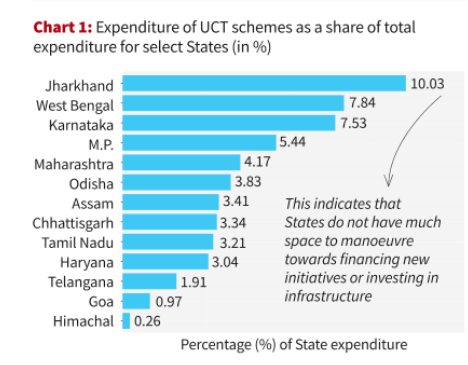
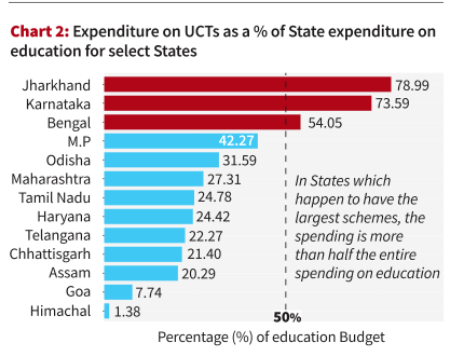
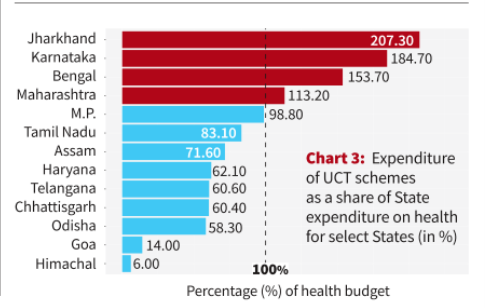
- Capital Expenditure Crowding Out: UCT spending crowds out critical infrastructure, health and education expenditure needed for long-term growth.
- Electoral Motivation: UCTs are often announced immediately before elections, raising ethical and democratic governance concerns.
- Regressive Targeting: Universal or broadly targeted UCTs often benefit non-poor populations disproportionately, reducing efficiency.
- Inflation Risk: Large cash transfers can fuel localised inflation, particularly in food and essential commodities.
- Dependency Creation: Unconditional transfers without skill development or livelihood components create welfare dependency over time.
- Credit Rating Impact: State fiscal deterioration from UCTs leads to credit rating downgrades, raising borrowing costs for states.
- RBI Concern: RBI has flagged that several states’ debt-to-GSDP ratios are approaching unsustainable levels due to populist spending.
- Competitive Populism: Once one state announces UCTs, rival parties in other states face political pressure to match promises.
🧭
Way Forward for Sustainable Welfare Spending
Conditionality Integration
Convert UCT programmes into CCTs, linking payments to education, health and skilling outcomes.
Fiscal Responsibility Norms
Strengthen FRBM Act provisions at state level to cap welfare spending as a percentage of revenue.
Needs-Based Targeting
Use Socio-Economic Caste Census data to target welfare payments to genuinely vulnerable populations.
Finance Commission Role
The 16th Finance Commission must factor in freebies spending when assessing state fiscal health.
Productive Asset Transfer
Replace pure cash transfers with productive asset transfers like livestock, tools and equipment to build livelihood capacity.
Pre-Election Scrutiny
Strengthen Model Code of Conduct provisions to prevent new welfare scheme announcements during election season.
Public Debt Ceiling
Enforce constitutionally backed state borrowing ceilings that automatically tighten when welfare spending exceeds thresholds.
Welfare spending is not inherently wrong — it becomes problematic when driven by electoral cycles rather than genuine need. Sustainable welfare requires fiscal discipline, targeted design and conditionality, not unconditional transfers to win elections.
📰
Source: The Hindu
