
Why in News: Tobacco imposes a massive economic and health burden on India, yet existing laws like COTPA 2003 remain inadequate, especially in tackling smokeless tobacco.
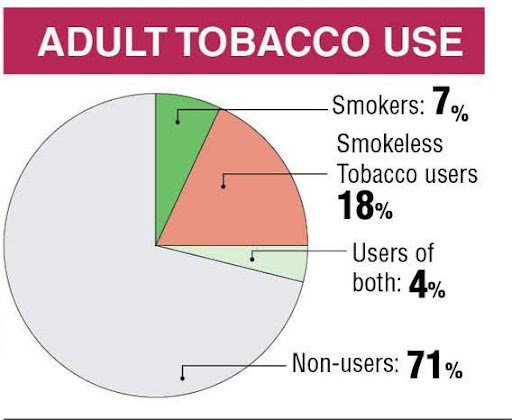
The Economic Burden of Tobacco
- In 2017, the annual economic costs of tobacco use for India’s 35+ population were estimated at ₹1.77 lakh crore (1.04% of GDP).
- In addition, ₹56,670 crore (0.33% of GDP) was spent annually on healthcare costs attributable to second-hand smoke.
- These figures highlight the urgent need to strengthen tobacco control measures to reduce disease burden and economic losses.
Gaps in the Existing Law (COTPA 2003)
1. Neglect of Smokeless Tobacco (SLT)
- SLT is cheaper, culturally accepted, and less stigmatized, making it the most consumed tobacco form in India.
- SLT is often more carcinogenic than smoked tobacco, yet COTPA does not adequately address it.
- Food Safety and Standards Regulations (2011) attempt some control but remain weak and poorly enforced.
2. Surrogate Advertisements and Indirect Promotion
- Direct tobacco ads are banned, but companies use mouth freshener packaging and branding for surrogate promotion.
- Movies, OTT platforms, and social media further normalize tobacco use.
- Such exposure increases initiation, especially among teenagers.
3. Weak Fiscal Measures
- Raising taxes is the most effective way to curb consumption, but taxation remains inadequate and uneven.
- Current tax burden: 22% on bidis, ~50% on cigarettes (WHO recommends 75%).
- SLT remains poorly taxed due to large-scale unorganised sector production.
4. Ineffective Health Warnings
- India mandates 85% pictorial warnings, but their impact is rarely assessed.
- Current warnings focus mainly on oral cancer and early death.
- Other global practices include warnings on fertility, pregnancy, and circulation issues.
- India could adopt plain packaging to reduce the appeal of tobacco products.
5. Weak Implementation of E-Cigarette Ban
- Despite the Prohibition of Electronic Cigarettes Act 2019, e-cigarettes remain easily available online, posing a growing public health risk.
Shortcomings in Tobacco Control Programmes
1. Over-Reliance on Awareness Campaigns: The National Tobacco Control Programme (NTCP) focuses primarily on awareness rather than comprehensive behavioural interventions.
2. Neglect of Social Determinants: Drivers such as poverty, stress, hunger, and unemployment are ignored, though they strongly influence initiation and cessation.
3. Inadequate Cessation Support: Cessation clinics are too few to meet the needs of millions of users, leaving the majority without support.
4. Weak School-Based Interventions: The Tobacco Free Education Institute (ToFEI) limits itself to posters and occasional events, with no comprehensive curriculum or sustained engagement.
5. Lack of Stakeholder Involvement: Teachers, parents, and communities are not adequately engaged, unlike global best practices (e.g., CDC model in the US, which stresses whole-community involvement).
6. Absence of Monitoring and Evaluation: Neither NTCP nor ToFEI has robust mechanisms to assess programme effectiveness, leading to stagnation in outcomes.
Way Forward: Towards a Tobacco Endgame: To effectively tackle tobacco use, India needs a multi-pronged strategy:
- Strengthen laws with explicit focus on smokeless tobacco.
- Close loopholes in advertising and enforce surrogate ad bans.
- Increase and rationalize taxes on all forms of tobacco, including bidis and SLT.
- Adopt plain packaging and expand warning messages to cover broader health impacts.
- Strictly enforce e-cigarette prohibition with online regulation.
- Upgrade NTCP to address social determinants and provide community-based support.
- Strengthen school-based prevention programmes with scientific, continuous, and holistic interventions.
- Invest in research and real-time data collection to counter industry tactics.
Conclusion:
India’s tobacco epidemic, particularly the widespread use of smokeless tobacco, cannot be curbed by partial or poorly implemented laws. A strong, well-enforced, and evidence-driven approach is crucial to achieve the country’s tobacco endgame goals.
UPSC Relevance
GS-II (Governance, Health, Social Justice): Issues relating to health, education, and human resources
Mains Practice Question
Q. “India’s tobacco control laws remain out of step with the ground realities of smokeless tobacco consumption.” Critically examine the gaps in the current legal and programme framework, and suggest a way forward.