
Why in News: The National Education Policy (NEP) 2020 has brought about a paradigm shift in India’s educational landscape, especially in the domain of Early Childhood Care and Education (ECCE).
Introduction
Early Childhood Care and Education (ECCE) refers to the formative stage of the first six years of life, which is marked by the most rapid growth and development in a human being.
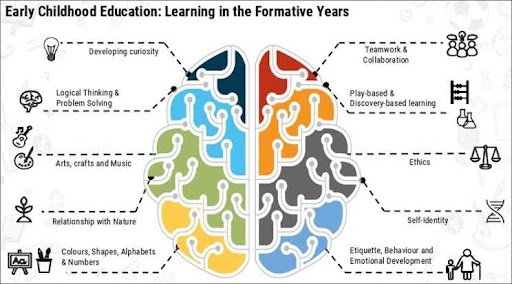
Components: ECCE is a holistic concept that includes
- Care and protection
- Health and nutrition
- Play-based early learning
- A safe, nurturing, and enabling environment
Why it Matters
- 158.7 million children in India (0–6 years, Census 2011) need access to quality ECCE.
India is committed through:
- CRC (1989) and EFA (1990) – ECCE as a global priority.
- SDG 4.2 – Ensure quality pre-primary education for all by 2030.
Significance of ECCE
1. Brain Development
- The early years are critical for brain development, shaping physical health, mental well-being, and behavioural patterns throughout life.
2. Preventing Developmental Deficits
- Deficiencies in this stage have cumulative and long-lasting adverse impacts on learning, behaviour, and overall human development.
3. Improving Learning Outcomes
- According to UNICEF, pre-primary education builds a solid foundation for all future learning, improving the efficiency of every subsequent educational stage.
4. Reducing Inequity and Disadvantage
- ECCE is the most cost-effective strategy to break the intergenerational cycle of poverty and disadvantage.
Provision for ECCE under NEP 2020
1. Inclusion in School Structure
- ECCE integrated into the new 5+3+3+4 structure, starting from age 3, to enhance early development.
2. Curricular Framework
- NCERT to develop the National Curricular and Pedagogical Framework for ECCE for 0–3 and 3–8-year-olds.
3. Universal Access and Social Inclusion
- ECCE to be provided across the country, prioritizing disadvantaged areas.
- Delivered through Anganwadis, integrated centres, pre-primary sections, and standalone preschools.
4. Infrastructure and Integration
- Anganwadis to upgrade facilities and play equipment.
- Promote child-friendly environments and school transition through activity tours.
- Strengthen linkages between Anganwadis and schools.
5. Balavatika (Preparatory Class)
- Play-based learning before age 5 with qualified ECCE teachers.
- Includes early literacy, numeracy, mid-day meals, and health monitoring.
6. Teacher Training
- Anganwadi workers to receive ECCE training (6-month certificate or 1-year diploma).
- Digital training methods supported.
- Long-term plans for professional ECCE educators and continuous development.
7. Extension to Tribal Areas
- ECCE to gradually expand to Tribal Ashramshalas and alternative schools.
Key Structural Shifts in ECCE Under NEP 2020
1. Expansion of ECCE Infrastructure
- NEP 2020 mandates universal access to ECCE by 2030, introducing Balvatika 1–3 (ages 3–6) in government schools to complement and expand the long-standing Anganwadi network.
Opportunities:
- Expands ECCE coverage beyond the 14 lakh Anganwadi centres that saw limited growth for decades.
- Backed by financial support under Samagra Shiksha, encouraging state-level implementation.
- Enables integration of ECCE into the formal school system, potentially improving quality and continuity in learning.
Challenges:
- Requires robust personnel management: recruitment, training, financing, and deployment of skilled ECCE workers.
- Uneven implementation across states and Union Territories—some states have not fully utilised the available provisions.
- Lack of monitoring mechanisms to ensure efficient use of allocated funds and consistent quality standards.
2. Migration from Anganwadis to Government Schools
- An increasing number of children aged 4–6 years are moving from Anganwadis to newly opened preschool classes in government schools, influenced by the belief that schools offer better education.
Opportunities:
- Strengthens school-based preschool education, aligning with parental expectations for quality learning environments.
- Encourages formalisation of preschool education within the public school system.
- Initiatives like “Poshan Bhi Padhai Bhi” aim to improve the educational component in Anganwadis.
Challenges:
- Anganwadis risk losing their core age group (3–6 years) if they don’t adapt to changing preferences.
- Need to redefine the Anganwadi role to maintain relevance, especially in education delivery.
- Risk of “schoolification”—where schools may overemphasise academics (reading/writing) at the cost of play-based, holistic learning, which is more appropriate at this stage.
3. Reorientation Towards 0–3-Year-Olds through Home Visits
- With 3–6-year-olds gradually transitioning to schools, Anganwadis have the potential to refocus on 0–3-year-olds through structured home visit programs.
Opportunities:
- Aligns with global best practices (e.g., Perry Preschool Study, Yale-Pratham Study) highlighting the benefits of early stimulation and caregiver engagement.
- Supports India’s goals under the POSHAN Abhiyaan, focusing on the first 1,000 days of life (a critical period for development).
- Enables individualised care for infants, young children, and pregnant/lactating mothers.
Challenges:
- Anganwadi workers are overburdened with centre-based responsibilities, leaving little time for meaningful home visits.
- Requires additional training, logistical support, and systematic implementation for success.
- Monitoring outcomes in home-based services can be difficult without clear performance indicators.
UPSC Relevance
1. General Studies Paper 1 (Indian Society and Education)
- Education reforms
2. General Studies Paper 2 (Governance, Social Justice, and International Relations)
- Policy coordination
Mains Practice Question
Q. Critically examine the challenges and opportunities in implementing Early Childhood Care and Education reforms under NEP 2020. How can effective inter-ministerial coordination improve outcomes?