
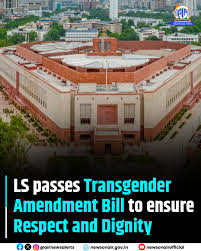
Context: The Transgender Persons (Protection of Rights) Amendment Bill, 2026 was introduced to address gaps in the 2019 Act. It proposes significant changes in definition, certification, and regulatory mechanisms.
Key Provisions of the Amendment Bill
- Narrowing of Definition
- Restricts “transgender person” to specific socio-cultural identities and intersex variations.
- Excludes gender-fluid identities and diverse sexual orientations from legal recognition.
- Removal of Self-Perceived Identity
- Deletes the right to self-perceived gender identity from the earlier legal framework.
- Introduces a medicalised certification process under a designated authority.
- Institutional and Administrative Changes
- Replaces District Magistrate-based certification with a medical board system.
- Mandates reporting of transgender surgeries to authorities, raising privacy concerns.
- Penal Provisions
- Introduces stringent punishment for forcing individuals into transgender identity, begging, or servitude.
Key Issues and Criticisms
- Conceptual and Definitional Problems
- Confuses sex identity with gender identity, leading to flawed legal categorisation.
- Continues to club intersex persons under transgender, ignoring their distinct needs.
- Violation of Rights and Privacy
- Removal of self-identification undermines dignity and autonomy of individuals.
- Mandatory reporting of surgeries raises concerns regarding bodily integrity and privacy.
- Lack of Data and Scientific Approach
- Absence of reliable data on transgender and intersex populations weakens policymaking.
- Failure to separate sex and gender identity in official records perpetuates invisibility.
- Inconsistency with Global Standards
- Contradicts definitions provided by international bodies such as the UN and WHO.
- Undermines global human rights commitments regarding intersex protections.
Structural and Institutional Concerns
- Persistence of Problematic Framework
- Retains “transgender” as an umbrella term without recognising diverse GIESC identities.
- Fails to reform institutional structures like welfare bodies.
- Ignoring Exploitative Social Structures
- Does not regulate hijra jamath-gharana systems, which control earnings and perpetuate exploitation.
- Lack of rehabilitation and protection mechanisms for vulnerable children within these systems.
- Gaps in Child Protection and Policing
- Weak response to trafficking and abuse of gender non-conforming children.
- Absence of targeted policies for their safety and inclusion.
- Medical and Ethical Concerns
- No safeguards against non-consensual intersex surgeries on infants.
- Lack of requirement for genetic counselling and long-term medical research.
- Unregulated practices in gender-affirming medical procedures remain unaddressed.
- Absence of Intersectional Approach
- No provisions addressing caste, disability, poverty, or religious vulnerabilities.
- Marginalised groups within transgender communities continue to face compounded discrimination.
- Lack of Civil and Legal Rights
- No recognition of marriage, adoption, inheritance, or family rights.
- Excludes transgender persons from core aspects of citizenship and legal identity.
Way Forward
- Adopt a scientific approach distinguishing biological sex and gender identity.
- Ensure explicit protections for intersex persons, including ban on non-consensual surgeries.
- Reform institutional structures to reflect diverse GIESC identities.
- Introduce evidence-based policies, including research and data collection.
- Address exploitative social systems and ensure protection of vulnerable children.
- Extend full civil rights to ensure dignity and equality in society.
Conclusion
- While the Amendment Bill attempts procedural corrections, it leaves deeper structural and rights-based concerns unresolved. A rights-based, inclusive, and scientifically grounded framework is essential to uphold dignity and constitutional values.