

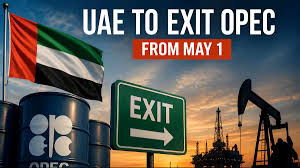
Context: The United Arab Emirates announced its exit from OPEC after five decades, citing strategic autonomy and long-term economic diversification goals. The decision comes amid disruptions caused by the US-Iran conflict, intensifying uncertainties in global oil markets.
About OPEC and Its Role
- OPEC, founded in 1960, coordinates petroleum policies to ensure stable prices and fair returns for oil-producing nations.
- It functions like a market stabiliser, regulating supply through production quotas to manage price volatility.
- The broader OPEC+ alliance controls nearly 40% global production and dominates international oil trade flows.
Reasons Behind UAE’s Exit
- Strategic Factors
- Rising regional instability due to the US-Iran war has heightened concerns over energy security and supply routes.
- Disruptions in the Strait of Hormuz threaten exports, reducing confidence in collective decision-making mechanisms.
- Economic Motivations
- OPEC quotas restricted UAE’s ability to utilise its full production capacity and maximise resource potential.
- Large-scale investments in oil infrastructure require higher output to support long-term economic transition goals.
- Geopolitical Autonomy
- Exit allows UAE to pursue independent energy diplomacy and build alternative strategic partnerships globally.
Structural Weakening of OPEC
- UAE’s exit reduces OPEC’s influence by weakening its control over spare production capacity and collective decision-making.
- It undermines cartel cohesion, potentially encouraging other members to reconsider production quota commitments.
- Reduced coordination may limit OPEC’s ability to stabilise markets during demand-supply shocks.
Impact on Global Oil Prices
- Increased competition among producers is likely to create downward pressure on oil prices globally.
- Loss of coordinated supply control may increase price volatility in already unstable energy markets.
- Short-term price decline benefits consumers, but long-term uncertainty may disrupt investment and supply planning.
Implications for India
- Lower global oil prices may reduce India’s import bill and ease inflationary pressures.
- Diversification of oil suppliers enhances India’s energy security and bargaining power in global markets.
- However, increased volatility may create uncertainties for fiscal planning and energy policy stability.
Way Forward
- Strengthen global energy governance frameworks to ensure market stability despite weakening of traditional cartels like OPEC.
- India should diversify energy sources, including renewables, to reduce dependence on volatile fossil fuel markets.
- Promote strategic reserves and long-term contracts to enhance energy resilience amid geopolitical uncertainties.
Conclusion
- UAE’s exit signals a shift from collective control to competitive energy geopolitics, reshaping global oil market dynamics. A balanced approach integrating energy security, affordability, and sustainability is essential for countries like India.
