

Su-57 Fighter Jet
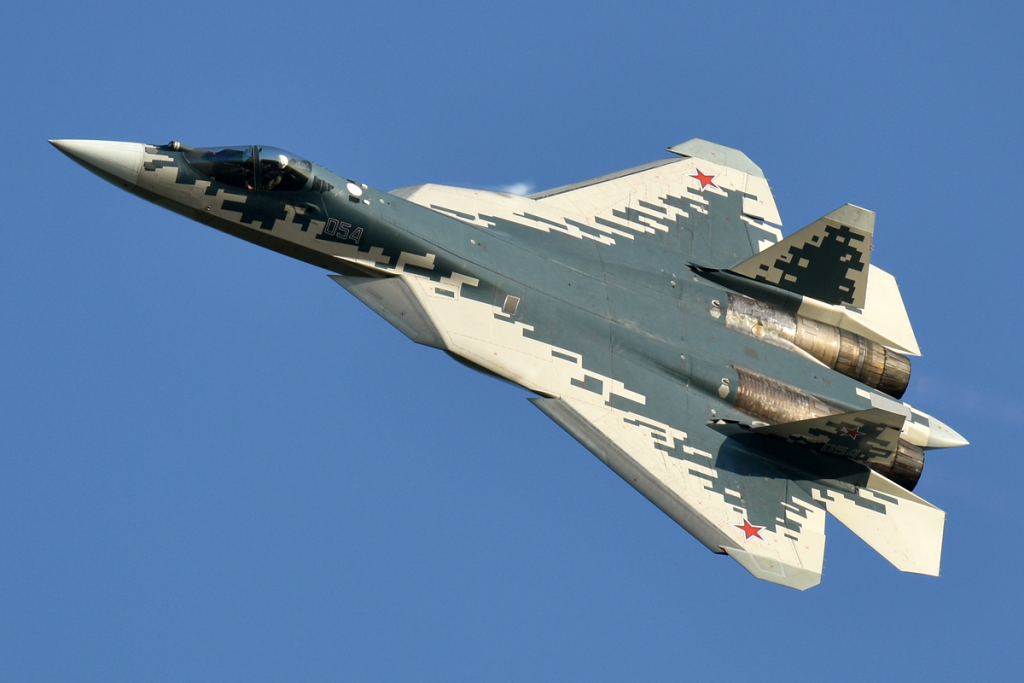
About Su-57
- Su-57 is a fifth-generation stealth fighter jet developed by Russia’s United Aircraft Corporation (UAC).
- It is designed for air superiority and ground attack roles with multi-role combat capabilities.
- It was developed primarily for the Russian Air Force.
Key Features
- Stealth Design: Features a low radar cross-section (RCS) using composite materials and radar-absorbing coating.
- AESA Radar: Equipped with a multi-band Active Electronically Scanned Array (AESA) radar for enhanced situational awareness.
- Supermaneuverability: Uses thrust-vectoring engines for superior dogfight agility.
- Supercruise: Can sustain supersonic speeds without afterburners.
- AI Integration: Equipped with AI-assisted avionics for advanced combat decision-making.
- Advanced Weaponry: Carries hypersonic missiles and precision-guided air-to-air and air-to-ground weapons.
Monetary Policy Committee (MPC)
Context: The MPC of RBI voted unanimously to keep the policy repo rate unchanged at 5.25% under the Liquidity Adjustment Facility (LAF).
More in News
- The Standing Deposit Facility (SDF) rate remains at 5% and the Marginal Standing Facility (MSF) rate and Bank Rate remain at 5.50%.
- SDF Rate is the rate at which banks park excess liquidity with the RBI without any collateral.
- MSF Rate is the rate at which banks can borrow overnight funds from RBI against approved securities.
- Real GDP growth for 2026-27 is projected at 6.6%, down from the earlier projection of 6.9%.
- Key risks cited include sub-normal southwest monsoon, El Niño risks, elevated energy prices, and global supply chain disruptions.
About MPC
- MPC is constituted by the Central Government under Section 45ZB of the RBI Act, 1934.
- It is entrusted with fixing the benchmark policy repo rate to contain inflation within the specified target.
- MPC replaced the earlier Technical Advisory Committee.
- MPC decisions are binding on the RBI.
- The MPC is required to meet at least four times a year.
- Composition
- MPC has six members:
- RBI Governor (Chairperson),
- RBI Deputy Governor (in charge of monetary policy),
- one official nominated by the RBI Board, and
- three members representing the Government of India.
- External members hold office for a period of four years.
- The quorum for a meeting is four members, including at least the Governor or Deputy Governor.
- Decisions are taken by majority vote; in case of a tie, the RBI Governor has a casting vote.
- RBI’s Monetary Policy Department (MPD) assists the MPC in formulating monetary policy.
- MPC has six members:
E85 Fuel

About E85
- E85 is a high-ethanol fuel blend containing 85% ethanol and 15% petrol, used mainly in flex-fuel vehicles.
- Ethanol has lower energy density and higher oxygen content than petrol, making it incompatible with ordinary vehicles.
- Common Ethanol-Petrol Blends
- E10: 10% ethanol and 90% petrol.
- E20: 20% ethanol and 80% petrol.
- E85: 85% ethanol and 15% petrol.
- E100: Almost pure ethanol.
- Flex-Fuel Vehicles (FFVs)
- E85 requires flex-fuel vehicles, which can run on petrol, ethanol, or any blend of both.
- FFVs need ethanol-compatible fuel lines, modified fuel injection systems, corrosion-resistant materials, and cold-start management systems.
India’s Ethanol Blending Programme
- The National Policy on Biofuels, 2018 (amended in 2022) advanced India’s 20% ethanol blending target to Ethanol Supply Year 2025-26, from the earlier 2030 target.
- India achieved the E20 milestone in 2025.
- Feedstock for Ethanol
- Ethanol can be produced from sugarcane molasses, sugarcane juice, maize, damaged food grains, surplus grains, and agricultural residues.
International Space Station (ISS)
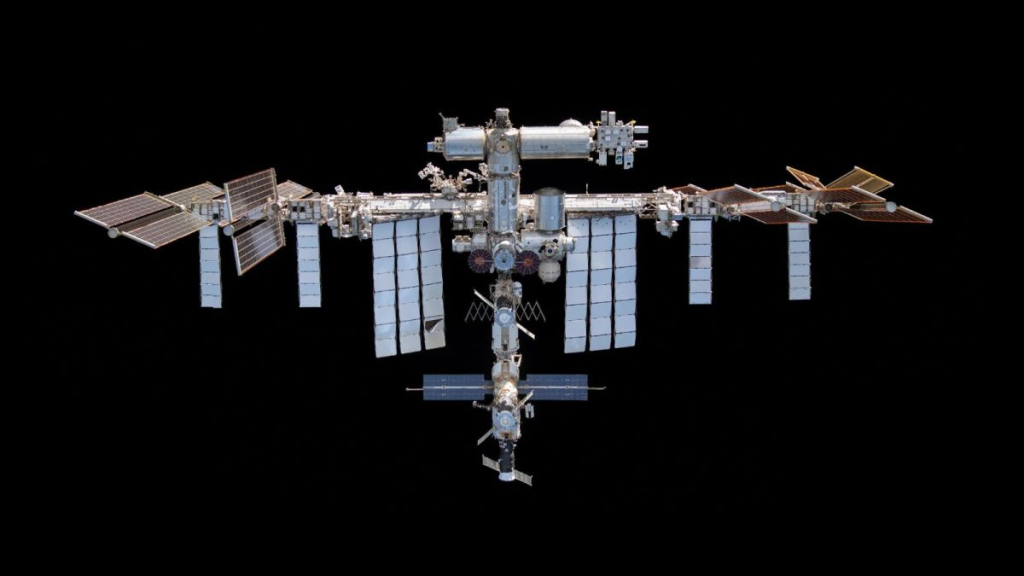
Context: Russian space agency Roscosmos detected two leaks aboard the ISS; the first was sealed with a hermetic compound while the second is being addressed.
About ISS
- ISS is a habitable artificial satellite orbiting in Low Earth Orbit at an altitude of 370 to 460 km.
- It is the largest artificial body in orbit, weighing approximately 400 tonnes and covering an area as large as a football pitch.
- Its first component was launched in 1998 and assembly required more than 40 missions.
- It has been continuously inhabited for more than 20 years, beginning with Expedition 1 in 2000.
- It is expected to remain operational until at least 2030.
- ISS travels at 5 miles per second, orbiting Earth approximately every 90 minutes.
- Its orbital inclination is 51.6°, allowing it to fly over 90% of inhabited Earth.
- Key Partner Agencies: NASA (USA), Roscosmos (Russia), ESA (Europe), JAXA (Japan), and CSA (Canada).
Other Space Stations
- Salyut 1 (USSR, 1971): World’s first space station, launched by the Soviet Union on April 19, 1971.
- Skylab (USA, 1973): America’s first space station, launched by NASA.
- Tiangong (China): Tiangong-1 (2011) and Tiangong-2 (2016) were test labs; Tiangong Space Station became fully operational in late 2022.
- Future Missions:
- NASA’s Artemis Base Camp (Moon surface) and Gateway (lunar orbit)
- India’s Bharatiya Antariksha Station.
Sea of Azov
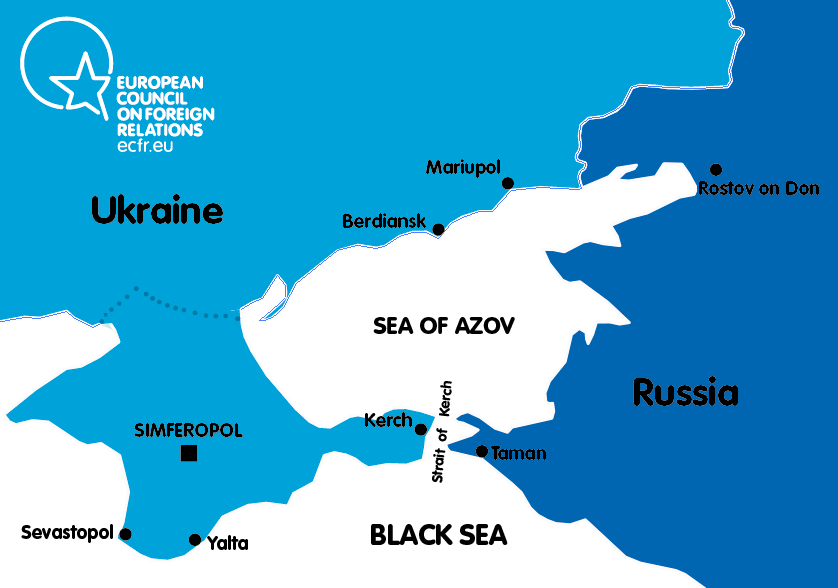
Context: Five Azerbaijanis were killed in a drone attack on two cargo ships in the Sea of Azov, with Russia blaming Ukraine for the strike.
About Sea of Azov
- The Sea of Azov is located in Eastern Europe, north of the Black Sea, connected through the Strait of Kerch (approximately 4 km wide).
- It is the smallest sea in the former Soviet region, covering nearly 39,000 sq. km, approximately 360 km long and 180 km wide.
- It is the shallowest sea globally with an average depth of 7 metres and maximum depth of 14 metres.
- Physical Features
- The Don and Kuban rivers contribute over 90% of freshwater inflow, reducing its salinity significantly.
- Salinity is very low at 10 to 12 PSS, becoming almost fresh in Taganrog Bay due to river inflow.
- Notable coastal features include the Syvash lagoon and long sand spits like Arabat, Fedotov, and Berdyansk.
- It has a continental climate with cold winters (sometimes reaching -30°C) and warm summers (23 to 25°C).
