

PRELIMS
Quadruple Star System
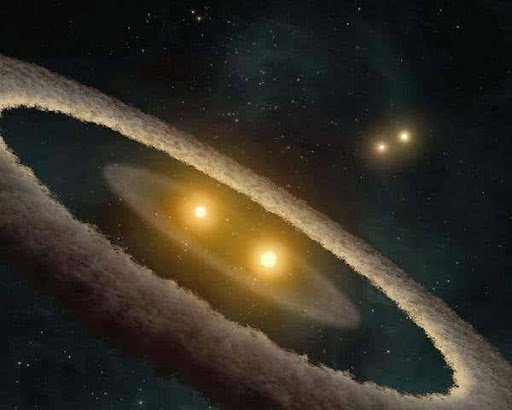
Why in News: Scientists have discovered a rare quadruple star system in the Milky Way, named UPM J1040-3551 AabBab, consisting of a pair of cold brown dwarfs orbiting two young red dwarf stars.
Quadruple Star System:
- First time discovered with two T-type brown dwarfs orbiting a pair of red dwarfs.
- Study published in Monthly Notices of the Royal Astronomical Society.
Brown Dwarfs (Failed Stars):
- Celestial bodies intermediate between stars and planets.
- Formed like stars (from collapsing gas & dust clouds) but lack sufficient mass to sustain hydrogen fusion.
- The atmosphere resembles gas giants (Jupiter, Saturn).
- Mass: up to 70 times Jupiter.
- Very faint → difficult to detect.
Why Significant?
- Provides rare insights into formation of stars and planets.
- Brown dwarfs usually exist singly; probability of a low-mass brown dwarf having a companion is <5%.
- Helps study star formation, age, composition, and temperature by comparing faint brown dwarfs with brighter companion stars.
- Enhances understanding of dark matter, since much of the universe’s undetectable mass may include brown dwarfs.
Star Systems
- Single star system: e.g., our Sun + planets.
- Binary/multiple star systems: Common in the Milky Way.
- Quadruple star systems: Rare → first time observed with two T-type brown dwarfs orbiting a pair of red dwarfs.
H-1B Visa Debate in US

Why in News: US Commerce Secretary Howard Lutnick recently called the H-1B visa program a “scam,” questioning its impact on American jobs and economy.
H-1B Visa
- Introduced under: Immigration Act, 1990.
- Purpose: Allows American employers to hire foreign workers in occupations requiring “high level of skill” and at least a bachelor’s degree.
- Nature: Temporary work visa (up to 6 years maximum), with a pathway to permanent residency (green card).
- Sectors: Primarily technology, IT, engineering, and specialised services.
- Eligibility:
- Bachelor’s degree or higher in the specific specialty.
- Employers must prove they cannot otherwise obtain required skills from within the US workforce.
Annual Limits
- Regular cap: 65,000 visas per fiscal year.
- Additional cap: 20,000 visas for applicants with US Master’s degree or higher.
- Thus, 85,000 visas annually, but demand far exceeds supply → hence lottery system.
Key Features
- Not all H-1B petitions lead to employment (some rejected due to unmet criteria).
- Dependents (spouse, children under 21) may accompany under H-4 visa.
- Workers must be employed in “specialty occupations”.
Significance for India
- Indians are the largest beneficiaries of H-1B visas.
- Over 70% of approved petitions go to Indians.
- Highly concentrated in IT firms like TCS, Infosys, Wipro, HCL, Tech Mahindra.
- Many Indians use H-1B as a pathway to US permanent residency.
PM Inaugurates Green Mobility Initiatives in Gujarat
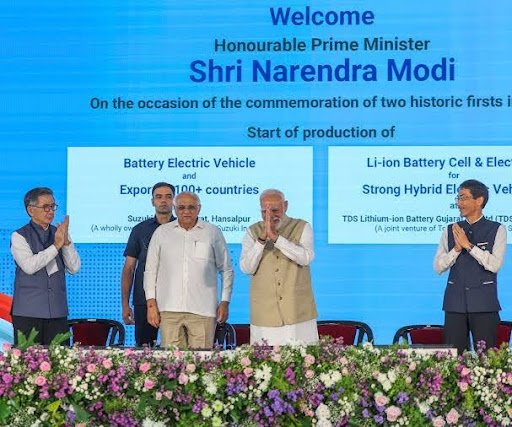
Why in News: PM inaugurated Green Mobility Initiatives at Hansalpur, Gujarat.
Context
- Flagged off “e-VITARA” – Suzuki’s first Made-in-India global strategic Battery Electric Vehicle (BEV), to be exported to 100+ countries.
- Also inaugurated local production of hybrid battery electrodes at the TDS Lithium-Ion Battery plant, ensuring >80% of battery value is now manufactured in India.
About Battery Electric Vehicles (BEVs)
- Definition: Run entirely on battery-powered electric drivetrain.
- Charging: Plugged into electricity grid.
- Main Components: Electric motor, Inverter, Battery, Control module, Drive train.
- Working Principle: DC power from battery → converted to AC → powers electric motor.
Challenges with BEVs in India
- Operational: Limited driving range, inadequate charging infra.
- High upfront cost: Batteries ≈ 40% of EV cost.
- Awareness gap: Limited understanding among consumers/stakeholders.
- Environmental concerns: Battery waste, recycling, reuse issues.
- Stress on power grid: High EV charging demand can strain electricity infrastructure.
Steps Needed
Financial measures:
- Battery leasing to decouple vehicle & battery cost.
- Blended fund for e-Trucks & e-Buses.
R&D:
- New battery tech for lower prices, higher energy density, and reduced rare earth dependence.
Infrastructure:
- Strategically scale charging stations based on viability studies.
Green Mobility Initiatives in India
- National Electric Mobility Mission Plan (NEMMP) 2020: Accelerate EV adoption & manufacturing.
- PLI Scheme – Automobile & Auto Components (PLI-Auto).
- PLI – Advanced Chemistry Cell (ACC) Battery Storage.
- India Electric Mobility Index (IEMI) – NITI Aayog: Measures state/UT progress on EV adoption.
Typhoon Kajiki
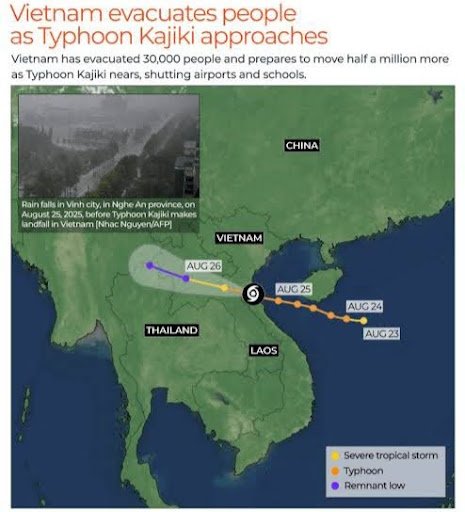
Why in News: Vietnam has initiated mass evacuations, shut airports, and cancelled flights as Typhoon Kajiki (winds up to 166 km/h) approached its central coast in August 2025.
About Typhoon Kajiki
- Type: Powerful tropical cyclone formed in the West Pacific Ocean.
- Location: Approaching central Vietnam (between Thanh Hoa and Nghe An provinces).
- Storm was 150 km off the central coast.
- Earlier, Kajiki skirted China’s Hainan Island, forcing shutdown of businesses and public transport.
Impacts:
- Over 500,000 people evacuated.
- Airports in Thanh Hoa and Quang Binh provinces shut down.
- Dozens of flights cancelled.
Features
- Wind speeds up to 166 km/h (103 mph).
- Heavy rainfall, floods, mudslides, storm surges expected.
About Typhoons
- Definition: Tropical cyclone formed over the West Pacific Ocean, powered by heat & moisture from warm sea surfaces.
- Regional naming of tropical cyclones:
- Hurricane → Atlantic & East Pacific.
- Typhoon → West Pacific.
- Cyclone → Indian Ocean & Australia.
Key Features:
- Large spiralling storm with an eye (calm centre).
- Generates storm surges, floods, landslides, leading to destruction.
Conditions for Formation of Tropical Cyclones
- Warm sea surface temperatures (>27°C).
- Coriolis Force (rotation of Earth).
- Minimal variation in vertical wind speed.
- Pre-existing low-pressure area.
- Upper-level divergence (spreading of air at high altitudes).
