
Juristic Person

Meaning
- Juristic person: Non-human entity recognised by law as a legal person.
- Natural person: Human being with legal rights and duties.
- Juristic persons can own property, sue and be sued, and hold legal obligations.
- Represented in courts through guardians or authorised representatives.
Examples of Juristic Persons
- Deities: Hindu idols with public consecration (Prana Pratishtha).
- Corporations: Companies as separate legal entities.
- Animals: Recognised by Punjab & Haryana High Court.
- Rivers: Ganga and Yamuna (Uttarakhand HC; later quashed by Supreme Court).
- Mountains: Mount Taranaki (New Zealand).
- Foreign example: Whanganui River (New Zealand).
Important Judgments
- Dakor Temple Case (1887), Bombay HC: Hindu idols recognised as juristic persons.
- Tata Engineering v. State of Bihar: Corporation is a permanent legal entity.
- Bishwanath v. Thakur Radhaballabhji (1967): Public can approach court as “friend of deity.”
- Yogendra Nath Naskar v. CIT (1969): Juristic status requires public consecration.
- Sabarimala Case: Juristic status ≠ full constitutional rights.
Key Features
- Can hold property in own name.
- Has legal rights and liabilities.
- Acts through human representatives.
Chagos Islands
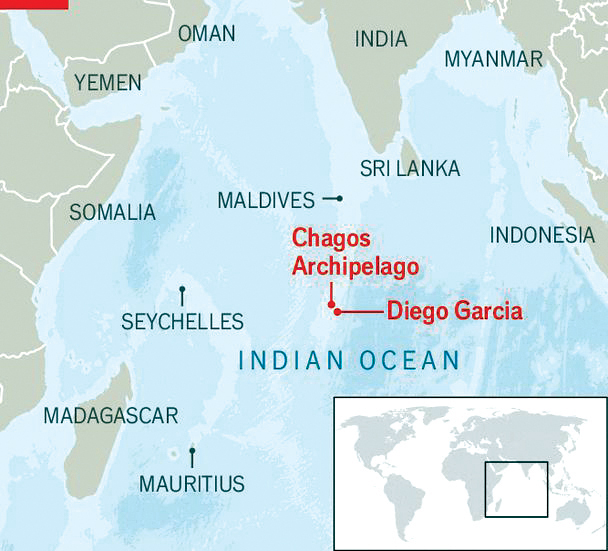
Location
- Archipelago of 60+ islands in central Indian Ocean.
- Lies south of Maldives, east of Seychelles.
- Diego Garcia is the largest island.
Strategic Importance
- Hosts US–UK military base at Diego Garcia.
- Key hub for operations in West Asia, South Asia, East Africa.
- Supports intelligence, surveillance, and long-range military deployments.
Historical Background
- Under British control since 1814 (ceded by France).
- 1965: Separated from Mauritius to form British Indian Ocean Territory (BIOT).
- 1968: Mauritius gained independence without Chagos.
UK–Mauritius Chagos Sovereignty Deal (2025)
- Sovereignty transferred to Mauritius.
- 99-year lease of Diego Garcia to UK–US for military use.
- UK to pay ~£101 million annually over lease period.
Significance
- Completes Mauritius’s decolonisation process.
- Preserves Western military presence in Indian Ocean.
- Balances sovereignty with strategic security interests.
India’s Position
- Supports Mauritius’s claim.
- Based on territorial integrity and international law principles.
Gaza Peace Board

Context
- The United States has proposed the Gaza Peace Board as a post-conflict governance and reconstruction mechanism for Gaza following the Israel–Hamas war.
- The proposal envisages a multinational supervisory body operating outside existing UN-led frameworks.
Overview
- A proposed US-led international governance and reconstruction authority for post-war Gaza.
- Intended to oversee administration, security transition, and economic rebuilding.
- Also referred to as the “Board of Peace” in draft documents.
Proposed Leadership and Structure
- Proposed by: Former US President Donald Trump.
- Chairperson: Donald Trump as inaugural Chairman.
- Special feature: Draft charter provides the Chair with veto powers, independent of US presidential tenure.
Membership and Participation
- Invitations reportedly extended to ~60 countries.
- Notable invitees include: India, Egypt, Jordan, Türkiye, Canada, Argentina, and others.
- Envisioned as a coalition-based, voluntary participation framework.
Objectives
- Stabilisation: Support political and security transition in post-conflict Gaza.
- Reconstruction: Mobilise international capital for infrastructure and humanitarian rebuilding.
- Governance: Establish a technocratic Palestinian administrative authority for civilian management.
- Conflict Management: Provide a replicable model for post-war governance in other global conflict zones.
Key Functions
- Oversee a non-partisan Palestinian civilian administration (NCAG).
- Coordinate international funding, investments, and donor assistance.
- Monitor ceasefire compliance and security transition mechanisms.
- Support restoration of essential public services and economic activity.
- Act as a high-level political and financial coordination platform for Gaza’s recovery.
Environmental Protection Fund
Context
- Union Government notified detailed rules in January 2026 to operationalise the Environmental Protection Fund.
- Rules implement provisions introduced under the Jan Vishwas Act, 2023, which decriminalised offences but retained monetary penalties.
About
- What it is
- A statutory Government of India fund to utilise environmental penalties for pollution control, restoration, monitoring, research, and institutional strengthening.
- Legal Basis
- Provided under the Environment (Protection) Act, 1986.
- Operational framework notified through 2026 Rules.
- Strengthened by Jan Vishwas Act, 2023.
- Nodal Authority
- Ministry of Environment, Forest and Climate Change (MoEFCC) or a notified Central Government body.
- Aim
- Recycle pollution penalties into remediation, clean technology promotion, and regulatory capacity building.
- Sources of Funds
- Penalties under:
- Air (Prevention and Control of Pollution) Act, 1981
- Environment (Protection) Act, 1986
- Interest from investments.
- Penalties under:
- Permitted Uses
- Pollution prevention and mitigation.
- Remediation of contaminated sites.
- Environmental monitoring systems and equipment.
- Clean technology research and innovation.
- IT-enabled compliance platforms.
- Laboratory and institutional capacity building.
- Revenue Sharing Formula
- 75% credited to State/UT Consolidated Fund.
- 25% retained by the Central Government.
- Oversight and Transparency
- CAG audit of the Fund.
- CPCB to develop and maintain a national online monitoring portal.
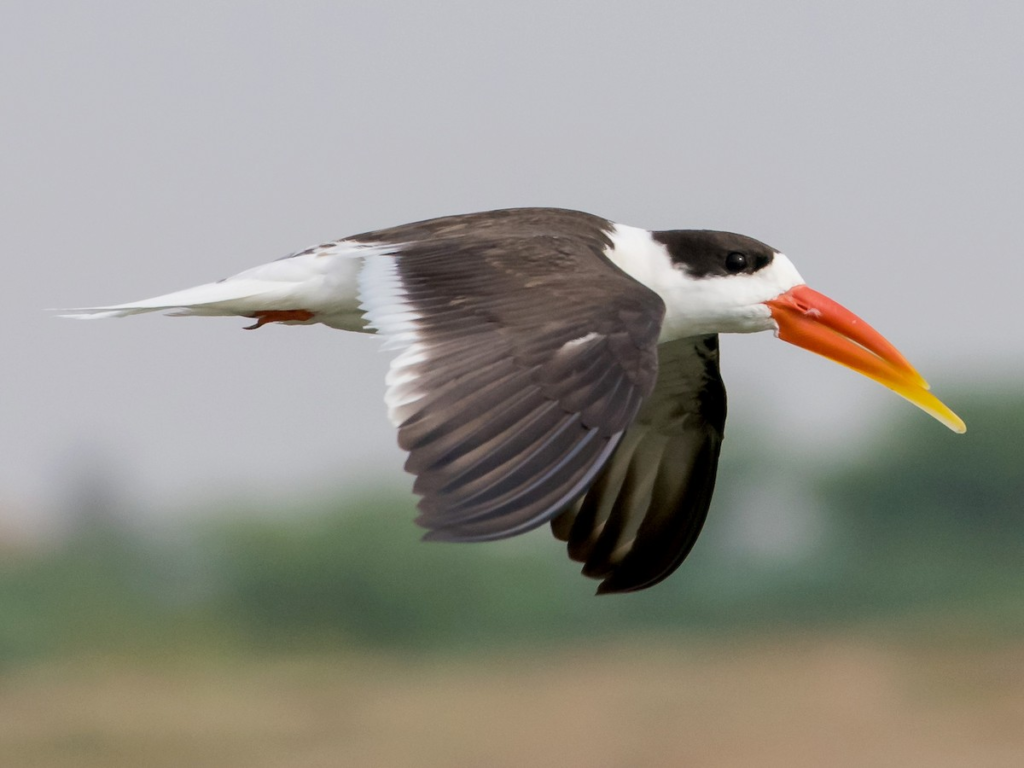
Indian Skimmer (Rynchops albicollis)
Context
- Bombay Natural History Society (BNHS) and National Mission for Clean Ganga (NMCG) launched a conservation initiative to protect Indian Skimmer breeding habitats across the Ganga Basin.
- Focus on sandbar protection and river ecosystem restoration.
Overview
- A riverine bird species specialised in surface-feeding using an elongated lower mandible to skim water for fish.
Scientific Classification
- Scientific name: Rynchops albicollis
- Family: Laridae
- Common group: Skimmers
Habitat and Distribution
- Prefers large, slow-flowing rivers with sandy islands and exposed sandbars.
- Breeding rivers: Ganga, Chambal, Yamuna, Mahanadi and tributaries.
- Non-breeding presence in coastal and estuarine zones.
IUCN Conservation Status
- Endangered (EN)
- Global population: ~3,700–4,400 individuals.
- India hosts: Nearly 90% of global population.
Ecological Role
- Indicator species of healthy riverine and sediment systems.
- Reflects natural flow regimes and sandbar stability.
Major Threats
- Dams and flow regulation altering sediment deposition.
- Sand mining destroying nesting sites.
- Human disturbance and river pollution.
- Climate variability affecting breeding success.
Significance
- Acts as a flagship species for river conservation.
- Population decline signals degradation of freshwater ecosystems.
Kamchatka Peninsula
Context
- Severe winter storm disrupted life across Kamchatka Peninsula, Russia’s Far East.
- Heavy snowfall buried settlements and transport infrastructure.
Location & Political Status
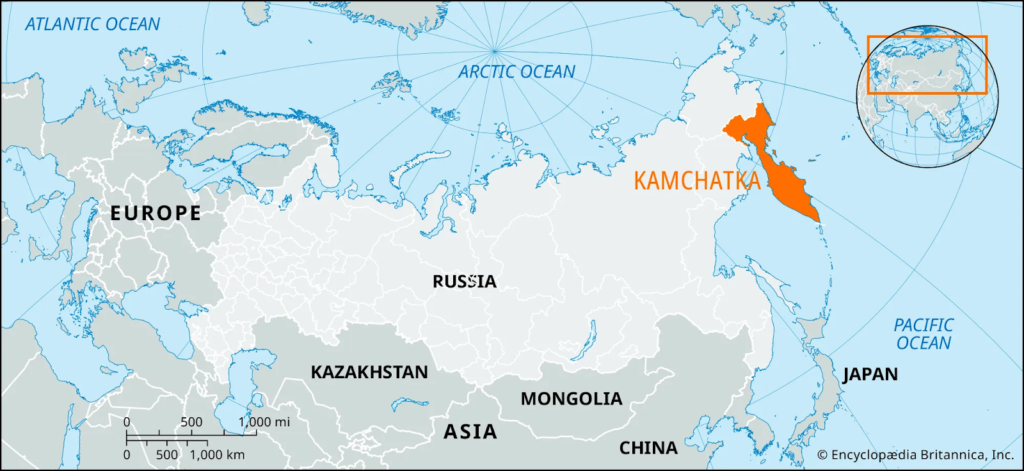
- Part of Russian Far Eastern Federal District.
- Administered as Kamchatka Krai.
- Lies between Sea of Okhotsk (west) and Pacific Ocean–Bering Sea (east).
Physical Geography
- Length: ~1,250 km long volcanic peninsula.
- Mountain ranges:
- Sredinny Range (Central Range)
- Vostochny Range (Eastern Range)
- Volcanism:
- About 29 active volcanoes.
- Part of the Pacific Ring of Fire.
- Listed under UNESCO “Volcanoes of Kamchatka” World Heritage Site.
Drainage System
- Kamchatka River flows through the Central Valley.
- Drains into the Pacific Ocean.
Solid–Liquid Hybrid State of Matter
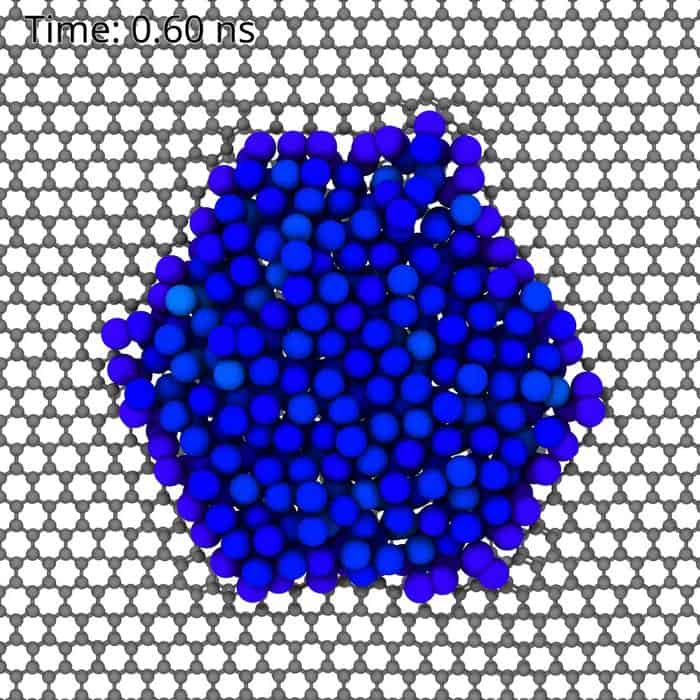
Context
- Scientists reported a new nanoscale state of matter showing simultaneous solid and liquid behaviour.
- Observed using high-resolution transmission electron (HRTE) microscopy.
What it is?
- A metal nanoparticle state where atoms display solid-like order and liquid-like mobility simultaneously.
- Challenges the traditional sharp phase boundary between solid and liquid.
Key Features
- Dual behaviour: Retains crystal-like structure while allowing atomic flow.
- Sub-freezing liquidity: Remains liquid-like below normal freezing temperatures.
- Nanoscale phenomenon: Seen only at atomic and nanoparticle dimensions.
- Phase ambiguity: Indicates solid–liquid transitions are gradual, not absolute, at small scales.
Observation Method
- High-Resolution Transmission Electron Microscopy (HRTE):
- Enables real-time atomic-level imaging of nanoparticle structure and motion.
Significance & Applications
- Catalyst durability: Prevents clumping and poisoning in heterogeneous catalysts.
- Energy systems: Improves performance of fuel cells and hydrogen technologies.
- Industrial use: Relevant for pharmaceuticals, petrochemicals, and pollution control.
- Materials science: Opens pathways for phase-engineered nanomaterials.
