
Prelims pinpointer

Rice Production in India

In News
- India became the world’s largest rice producer in 2024–25.
- India’s rice output stood at 150.18 million tonnes.
- China recorded 145.28 million tonnes, ranking second globally.
State-wise Production (2023–24)
- Telangana produced 16.63 MT of rice.
- Uttar Pradesh produced 15.72 MT of rice.
- West Bengal produced 15.12 MT of rice.
- Other Major Rice-Producing States
- Major contributors include Andhra Pradesh, Punjab, Odisha, Bihar, Chhattisgarh, Tamil Nadu and Assam.
Conditions for Rice Cultivation
- Climate and Season
- Rice is a tropical Kharif crop requiring heat and moisture.
- It grows best under hot and humid climatic conditions.
- In eastern and southern India, 2–3 rice crops are grown annually.
- In northern and hilly regions, only one summer crop is possible.
- Water Requirement
- Rice needs semi-aquatic conditions throughout its growth period.
- Fields are flooded with 10–12 cm standing water during sowing.
- Soil should not dry during the growing season.
- Rainfall Conditions
- Annual rainfall over 100 cmannually, with ideal zones receiving 150 cm to 300 cm.
- Rice is grown in low-rainfall areas using intensive irrigation.
- Irrigation enables rice cultivation in Punjab, Haryana and western Uttar Pradesh.
- Relief and Terrain
- Rice is mainly cultivated in plains and lowlands.
- Rice grown in flooded plains is called wet or lowland rice.
- Cultivation occurs below sea level in Kuttanad, Kerala.
- In hilly regions, rice is grown on terraced slopes.
- Rice grown in hills with limited water is termed dry or upland rice.
- Soil Conditions for Rice
- Loamy soils need frequent irrigation due to low water retention.
- Loamy soil regions include Punjab, Haryana and northern plains.
- Clayey soils have high water-holding capacity.
- Clayey soil regions include southern coastal plains, Karnataka and Telangana.
- Rice can grow in both acidic and alkaline soils.
- Loamy soils need frequent irrigation due to low water retention.
Initial Public Offering (IPO)

Core Concepts
- Public issue refers to raising funds by issuing equity shares to the public.
- IPO is the first public issue by an unlisted company.
- IPO may involve a fresh issue, an offer for sale, or both.
- An unlisted company has shares not traded on stock exchanges.
- A listed company has securities listed on a recognised stock exchange.
- Public Sector Undertakings with listed securities are treated as listed companies.
Related Terms
- Follow-on Public Offer (FPO) is raised by an already listed company.
- FPO may involve fresh issue or offer for sale.
- Offer for Sale (OFS) allows promoters to sell stake via intermediaries.
IPO Regulation
- IPOs are regulated by Securities and Exchange Board of India (SEBI).
- Company must have net tangible assets ≥ ₹3 crore.
- Net worth requirement: ₹1 crore in each of last three years.
- Average pre-tax profit ≥ ₹15 crore in three of last five years.
Eligible Investors
- Qualified Institutional Buyers (QIBs) include FPIs, mutual funds and insurers.
- Retail investors invest up to ₹2 lakh.
- High Net-Worth Individuals (HNIs) invest above ₹2 lakh.
National Green Tribunal (NGT)

Basic Profile
- NGT is a specialised judicial body for environmental protection matters.
- It deals with cases concerning forests and natural resources.
Legal Basis and Timeline
- Concept traced to UNCED Rio Summit, 1992.
- Law Commission 186th Report (2003) recommended environmental courts.
- Established under National Green Tribunal Act, 2010.
- Tribunal became operational in 2011.
Composition
- Headed by a Chairperson.
- Includes 10–20 Judicial Members.
- Includes 10–20 Expert Members.
Qualifications
- Chairperson: Supreme Court Judge or Chief Justice of High Court.
- Judicial Members: SC Judge / HC Judge / former HC Judge.
- Expert Members: Technical degree with 15 years experience, including environment-related work.
Appointment and Tenure
- Chairperson appointed by Central Government in consultation with CJI.
- Members appointed by a Selection Committee.
- Tenure is five years or age 65, whichever is earlier.
- No reappointment permitted.
Benches
- Principal Bench located in New Delhi.
- Four Regional Benches at Bhopal, Pune, Chennai and Kolkata.
- Circuit Benches may be constituted as required.
Jurisdiction
- NGT hears civil cases under laws listed in Schedule I of NGT Act, 2010.
- Covers Water Act 1974, Air Act 1981, Environment Protection Act 1986, among others.
- Does not cover Wildlife Protection Act, 1972 and Forest Rights Act, 2006.
Guiding Principles
- Guided by principles of natural justice.
- Applies sustainable development principle.
- Applies precautionary principle.
- Applies polluter pays principle.
Appeal Provision
- NGT orders are appealable before the Supreme Court.
- Appeal must be filed within 90 days.
Olive Ridley Sea Turtle

Species Profile
- It is one of the smallest sea turtle species.
- Named after its olive-green, heart-shaped carapace.
- It is known for mass nesting behaviour called arribada.
Habitat and Distribution
- Found in tropical Indian, Pacific and Atlantic Oceans.
- In India, major nesting occurs along Odisha coast.
- Key Odisha sites include Gahirmatha, Rushikulya and Devi river mouth.
- Solitary nesting reported along Tamil Nadu, Andhra Pradesh and Andaman coasts.
- Spends most time in open ocean, migrates to sandy beaches for nesting.
Physical Characteristics
- Carapace has 5–9 pairs of lateral scutes.
- Each flipper bears one or two claws.
Reproductive Traits
- Females attain maturity at 12–15 years.
- Lay around 100 eggs per clutch.
- Nest 1–3 times per season.
- Sand temperature determines hatchling sex.
Conservation Status
- IUCN Red List: Vulnerable.
- Wildlife (Protection) Act, 1972: Schedule I.
Hydrokinetic Turbine Technology

In News
- Tripura government identified 10 river sites for 185 MW power generation.
- Power generation proposed using hydrokinetic turbine technology.
Technology Profile
- Hydrokinetic turbines generate electricity from moving water currents.
- They are installed directly within river channels.
- Technology functions without constructing dams or barrages.
- Uses kinetic energy of flowing water, not potential head.
Energy Characteristics
- Operates with near-zero hydraulic head.
- Classified as a renewable energy technology.
Environmental Aspect
- Causes minimal alteration of river flow.
- Has a smaller ecological footprint than conventional hydropower.
Operational Features
- Suitable for single units or multi-turbine arrays.
- Requires lower maintenance due to fewer mechanical components.
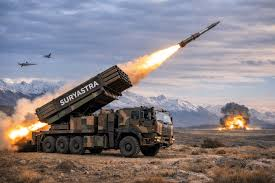
Suryastra Rocket System
In News
- Indian Army signed a ₹293-crore emergency procurement contract for Suryastra.
- Contract executed with NIBE Limited, in collaboration with Elbit Systems.
System Profile
- Suryastra is India’s first indigenous universal multi-calibre long-range rocket launcher.
- Designed for surface-to-surface precision strikes.
- Supports 150 km and 300 km strike ranges.
Technology Base
- Based on Israeli PULS (Precise & Universal Launching System).
- Adapted for Indian needs under a Technology Collaboration Agreement (July 2025).
Key Capabilities
- Universal launcher compatible with multiple calibres.
- Supports 122 mm, 160 mm and 306 mm munitions.
- Achieved Circular Error Probable (CEP) below 5 metres during trials.
- Capable of simultaneous multi-range engagements.
- Platform adaptable to 4×4, 6×6 and 8×8 wheeled chassis.
