
Context
- India has 18% global population but only 4% freshwater resources, indicating severe imbalance. Further, the per capita water availability declined from 1,816 cubic metres (2001) to 1,486 (2021).
- By 2050, India may approach water scarcity threshold of 1,000 cubic metres.
- Also, the economic losses reached ₹5 lakh crore (2019–2023) due to extreme water-related events.
Challenges
- Structural Water Scarcity
- Rising demand and limited supply create long-term water stress across regions.
- Declining availability constrains agriculture, industry, and domestic consumption sustainability.
- Climate Variability
- 55% tehsils report increased rainfall, but concentrated bursts cause flooding risks.
- Around 11% tehsils face rainfall decline, affecting agricultural productivity during sowing.
- Agricultural Inefficiency
- Agriculture consumes nearly 90% of total water resources, creating sectoral imbalance.
- Water productivity remains low at $0.52 per cubic metre, far below global standards.
- Further, the policies incentivise water-intensive crops like rice accelerates groundwater depletion.
- Neglect of Green Water
- Policy focuses on blue water, ignoring soil moisture as critical resource.
- 60% rainfall stored as green water globally supports rainfed agriculture systems.
- Urban Water Crisis
- Only 28% urban wastewater is treated, with minimal reuse across cities.
- Urbanisation creates impermeable surfaces, reducing recharge and increasing flood risks.
- Over half of Delhi’s 1,300 water bodies have disappeared due to encroachment.
- Governance and Pricing Failures
- Water is treated as free resource, leading to inefficient and excessive usage.
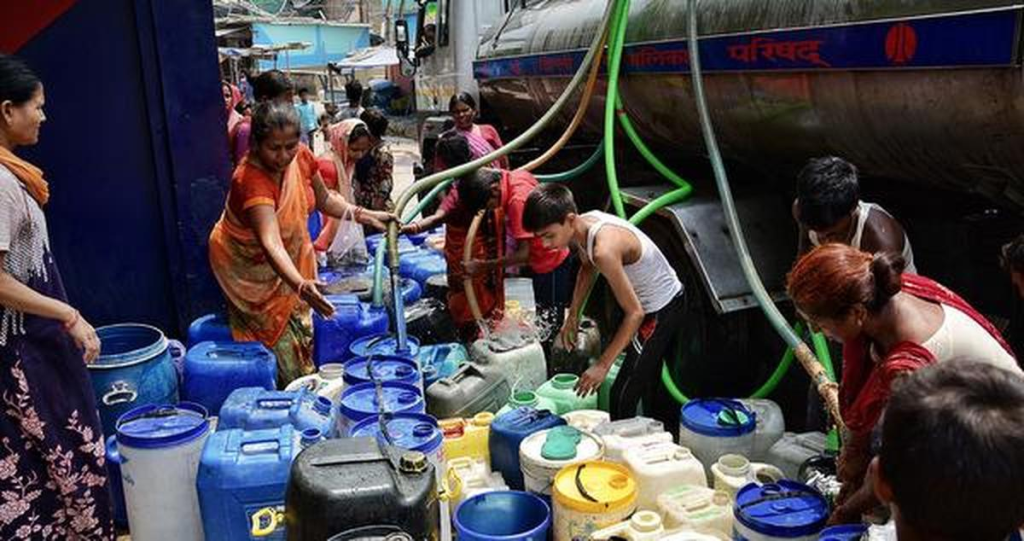
- Poor households often pay higher prices through informal markets, showing inequity.
- Environmental Degradation
- Chemical-intensive agriculture reduces soil water retention capacity significantly.
- Loss of forests disrupts hydrological cycles and downstream water availability.
Way Solution
- Recognising Water as Strategic Resource
- Water must be treated as finite economic resource requiring efficient allocation mechanisms.
- Implement digital water accounting systems for transparency and real-time monitoring.
- National Green Water Mission
- Integrate soil moisture management into water governance frameworks for sustainability.
- Promote regenerative practices like mulching and no-till farming to retain moisture.
- Protect upstream forests to regulate downstream water flows effectively.
- Agricultural Reforms
- Shift 3.6 million hectares from rice to millets and pulses to save water.
- This transition can save 29 billion cubic metres annually while improving nutrition.
- Circular Water Economy
- Treat wastewater as resource rather than waste, enabling reuse and recycling.
- Circular model can create ₹3.2 lakh crore market by 2047.
- It can generate over one lakh jobs and enhance economic sustainability
- Urban Water Resilience
- Adopt blue-green infrastructure like wetlands, urban forests, and permeable surfaces.
- Prioritise stormwater absorption and aquifer recharge in urban planning frameworks.
- Develop decentralised wastewater treatment systems for peri-urban regions.
- Governance and Pricing Reforms
- Ensure rational water pricing with protection for vulnerable populations.
- Introduce bulk water trading and monitoring systems to improve efficiency.
- Climate-Integrated Water Management
- Align water policies with climate adaptation strategies addressing floods and droughts.
- Strengthen drainage systems and groundwater recharge mechanisms for resilience.
Conclusion
- India’s water crisis is a structural challenge affecting economy, society, and sustainability. The climate change and governance failures have deepened existing vulnerabilities significantly. However, reforms in governance, agriculture, and urban systems can transform outcomes. A shift toward efficient, sustainable, and equitable water management is essential for future resilience.